
What began as an intervention with heavy machinery on a farm in Herefordshire, England, ended up becoming one of the most serious cases of river destruction pursued by British environmental authorities. Farmer John Price used excavators and bulldozers to modify around 1.5 kilometers of the Lugg River, removing gravel, altering its banks and removing dozens of trees.
The action affected a protected area and the habitats of numerous species. Price was initially sentenced to 12 months in prison, later reduced to ten, and to pay £600,000 in court costs, in addition to facing the restoration of the affected section. Years later, the case is again relevant because recovery work continues and experts estimate that the ecosystem may need between 20 and 30 years to fully recover.
He dredged and modified 1.5 kilometers of the river without authorization and uprooted 71 trees
The most serious events date back to 2020. John Price, owner of land near Kingsland, used heavy machinery to dredge and reshape approximately 1.5 kilometers of the River Lugg, in the English county of Herefordshire. The Environment Agency points out that the work was carried out without the necessary authorizations and that the owner continued to intervene despite having received an order to stop them.
Among the actions carried out were the extraction of gravel and sediments, the modification of the bed and banks and the elimination of riparian vegetation. Information about the case includes 71 trees uprooted or felled. Price used some of the removed gravel to build a road and horse exercise area on his property.
The farmer maintained that one of his motivations was to reduce flooding problems that affected nearby properties. The court did not accept this justification for actions carried out without authorization in a specially protected space. Judge Ian Strongman described what happened as “ecological vandalism on an industrial scale.”
In April 2023, Price was initially sentenced to 12 months in prison, a sentence that was later reduced to 10 months after appealing the sentence. He was also disqualified from acting as a company director for three years and had to bear £600,000 in prosecution costs. Therefore, although some recent information speaks of a fine of 700,000 euros, technically that amount corresponds approximately to legal costs, not a conventional fine. Added to this was the obligation to finance and execute environmental restoration.
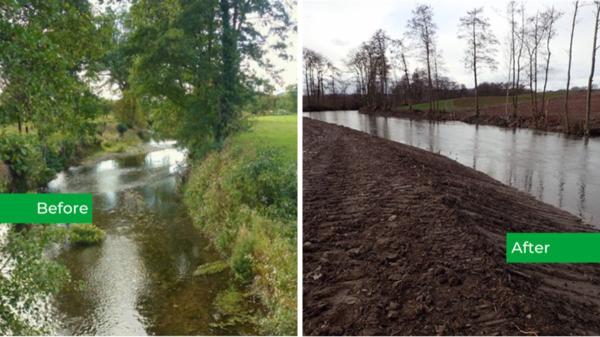
Why felling trees and dredging a river can cause damage for decades
The problem is not only that several dozen trees disappear. Riparian vegetation plays essential roles in river ecosystems: roots stabilize banks, the canopy provides shade and helps limit water warming, while branches, leaves and wood help create shelters and microhabitats.
Modifying the bed is not harmless either. The natural distribution of gravel, sediment, pools and areas of different velocity provides places for fish and invertebrates to feed, reproduce or shelter.
Natural England, the UK government’s official public body charged with protecting and enhancing the natural environment in England, has highlighted that excess fine sediment can cover gravels used by fish and invertebrates, while historic physical alterations, such as dredging and channel rectification, reduce habitat diversity and the natural functioning of rivers.
The Lugg also has exceptional ecological value. It is declared a Site of Special Scientific Interest (SSSI) and is part of the protected system associated with the River Wye. According to the British Environment Agency, it is home to at least 121 species of river plants, which in turn provide habitat for invertebrates, fish and birds. Among its fauna are otters, kingfishers and salmon.
The authorities indicated that Price’s work destroyed habitats used by species such as the otter (Lutra lutra), the Atlantic salmon (Salmo salar), also endangered in Spain, and different fish and invertebrates. Recovering a mature riparian forest is not simply about planting new trees either: years must pass before they develop roots, crowns, cavities and structures comparable to those that have disappeared.
For this reason, ecologist Richard Fishbourne has calculated that complete recovery of the affected section may take between 20 and 30 years.
The first signs of recovery contrast with a river that is still in an unfavorable state
The conviction included a specific restoration order under the Wildlife and Countryside Act 1981. Price was obliged to carry out various actions to repair the bed, banks and vegetation under the supervision of Natural England and the Environment Agency.
The first results show positive signs. The monitoring carried out in the area has once again detected trout, bullheads or cavilats, small fish and birds such as kingfishers and sapper martins. Wooden elements have also been introduced into the channel to encourage the natural formation of gravel bars and banks that provide reproduction and refuge areas for fish.
This does not mean that the river has recovered its previous situation. Young trees will need decades to perform the same ecological functions as removed mature specimens, and the physical structure of the channel requires time to evolve.
Furthermore, an assessment published by Natural England in July 2026 provides worrying context: the River Lugg SSSI complex continues to be classified as “unfavorable and deteriorating”. The institution identifies excessive concentrations of phosphorus, accumulation of fine sediments, proliferation of algae, invasive species and the effects of ancient physical modifications of the river among the main existing pressures.
The case of John Price thus illustrates why intervening in a river is not equivalent to carrying out works on any other part of private property. Channels are connected systems: changing water speed, removing sediment, or removing trees can shift effects downstream and alter habitats that took decades to form.
The British justice precisely wanted the sentence to serve as a warning. The recovery of the Lugg demonstrates the enormous time difference between destroying and restoring an ecosystem: an excavator can transform in a few days a riverbank whose natural structure will take several decades to develop again.
If you want to read more articles similar to A 68-year-old farmer destroys 1.5 km of a river and cuts down 71 trees: he ends up in jail for “ecological vandalism”, we recommend that you enter our Other environment category.
