
For decades, the Iberá Wetlands, in the Argentine province of Corrientes, lost some of the species that had been part of their fauna. The disappearance of large mammals and birds altered an ecosystem of enormous value, but since 2007 an ambitious restoration project has been working to recover part of that biodiversity.
The territory that makes up the Great Iberá Park totals 758,000 hectares, between the Iberá National Park and the Iberá Provincial Park. In this space one of the main projects of rewilding of Latin America, based on returning missing animals and reinforcing populations that had been greatly reduced.
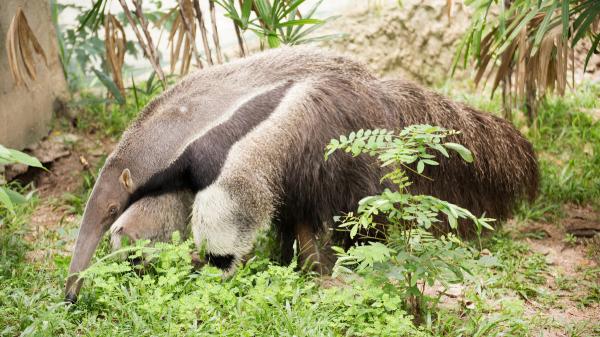
The project began with a pair of anteaters
The starting point is in 2007, when a pair of giant anteaters were released in the Rincón del Socorro reserve. The species had disappeared from Corrientes in the mid-20th century and became the first major objective of the program.
The project ensured that these animals not only survived the releases, but also began to reproduce in the wild. According to Iberá Park, in 2021 there were already estimated to be more than 200 anteaters living freely in the area, including specimens born there.
The success of this first reintroduction allowed the program to be expanded to other species. A study published in Perspectives in Ecology and Conservation In 2017, it already described the first results of the program and highlighted the importance of having sufficient habitat, long-term continuity and the ability to adapt strategies to each species.
Seven species have returned to Iberá
Throughout these 19 years, the program has worked with different species that have disappeared from Corrientes. Among those that have returned to live in the wild are the giant anteater, the pampas deer, the collared peccary, the scarlet macaw, the jaguar, the muitú and the giant otter.
Not everyone is in the same recovery phase. Some already have breeding populations and others continue to be subject to a reintroduction and monitoring process.
The project itself indicates that the objective is not simply to release animals, but to ensure that the species can form viable populations and recover their functions within the ecosystem. Among the animals that have been historically lost in Corrientes are also the tapir, the giant otter and different species of peccaries, in addition to the jaguar.
One of the most striking cases is that of the yaguareté or jaguar. The big cat had been missing from Corrientes for more than 70 years when, in 2021, a female and her two cubs became the first specimens to live completely free in the province in decades. The National Parks Administration subsequently documented new releases and the establishment of specimens born within the project itself.
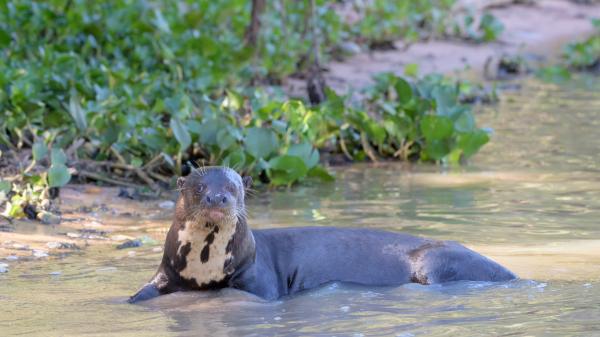
The giant otter has also returned after decades missing
Another of the great recent milestones is the return of the giant otter (Pteronura brasiliensis), a species that had disappeared from Argentina.
Work to recover this enormous mustelid began in Iberáin 2019. After several years of preparation, in 2025 a family of four specimens was released into the wetlands, in the first step to return the species to its former territory. The giant otter can reach around 1.8 meters in length and occupies a prominent place in the food chains of aquatic ecosystems.
Its return also has a special meaning because it is not just about recovering a striking species: it means reincorporating into the ecosystem a large aquatic predator that had disappeared from the country.
The objective goes far beyond recovering animals
The restoration of Iberá is not about creating a collection of species. The idea is to reconstruct the ecological relationships that existed before certain animals disappeared.
A study published in 2024 in the scientific journal Biological Conservation analyzed precisely what happens when large native herbivores reoccupy a territory where domestic livestock previously predominated. The researchers verified changes in the composition and functional structure of dung beetle communities, related to the replacement of resources provided by livestock with those of native mammals.
It’s an example of how the return of a species can have effects that go far beyond its own population. Animals modify vegetation, disperse seeds, transport nutrients, serve as food for other organisms or, in the case of large predators, regulate the populations of their prey.
The muitú, for example, plays an important role as a seed disperser of trees with fleshy fruits. Iberá Park itself highlights this function as part of its importance for the regeneration of forests.
A 758,000 hectare project that is still continuing
The Great Iberá Park is made up of 158,000 hectares of the Iberá National Park and 600,000 of the Iberá Provincial Park, according to data from Fundación Rewilding Argentina. The whole thus reaches 758,000 hectares.
The recovery of seven species does not mean, therefore, that the process is over. The project continues working with other species and with populations that need reinforcement or monitoring.
Furthermore, the success of a reintroduction is not measured solely by the number of individuals released. True recovery requires animals to survive, reproduce, and return to their ecological roles.
Almost two decades after that first pair of anteaters, Iberá has thus become a large-scale example of how the restoration of an ecosystem can go from protecting what remains to recovering part of what had been lost.
If you want to read more articles similar to It began in 2007 and has already returned seven species to nature: the enormous project that recovers the fauna of 758,000 hectares in Argentina, we recommend that you enter our Ecosystems category.
