
A solar plant in the middle of the Arizona desert became an unusual refuge for small burrowing owls that had lost their habitat due to the expansion of a housing development.
In March 2025, 19 specimens were moved to this location located west of Phoenix. Just over a year later, around 40 owls were still using the area, a result made possible by an intervention specifically designed to facilitate their adaptation.
The terrain was prepared with artificial burrows, tracking cameras and measures to help them find food during the first weeks. The objective was to check if a photovoltaic plant could also offer adequate space for these small predators to shelter and reproduce.
19 owls lost their home and ended up at an Arizona solar plant
In the Arizona desert, a colony of little owls found a rather unusual home. It is a huge solar plant located west of Phoenix. They didn’t get there by chance. In March 2025, 19 burrowing owls had to be relocated after a real estate project threatened to destroy the place where they lived, located about 80 kilometers away.
The case is especially interesting because of the way of life of these birds. Unlike many birds of prey, the burrowing owl does not build its nest in trees or cliffs, but rather spends much of its life in burrows underground. In the western United States it often takes advantage of tunnels abandoned by small mammals, such as ground squirrels. When land is converted to build homes, roads or farms, these shelters can disappear along with much of the available habitat.
The situation of the species was already delicate. Its American population had declined by more than a third since the 1960s, and the U.S. Fish and Wildlife Service considers it a species of conservation concern. Urban and agricultural expansion, in addition to the fragmentation of their habitats, are among the threats that affect these small owls.
That’s when an unexpected alternative appeared. Wild at Heart, an Arizona organization dedicated to the rescue and rehabilitation of birds of prey, needed to find a new location for the 19 birds. Longroad Energy, responsible for the Sun Streams solar complex, offered about 250 acres of land, equivalent to approximately 101 hectares, located between the Sun Streams 2 and Sun Streams 3 facilities.
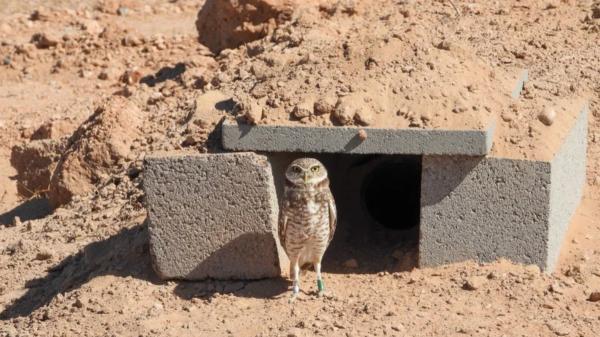
40 artificial burrows prepared the ground to receive the owls
For the transfer to work, it was not enough to take the 19 owls to the solar plant and set them free. The Wild at Heart and Longroad Energy team previously prepared an area of about 250 acres, about 101 hectares, located between the Sun Streams 2 and Sun Streams 3 facilities, west of Phoenix.
The main element was 40 artificial burrows, designed to reproduce the type of underground shelter that these owls use naturally. Each pair was initially given its own space and the entrances were surrounded with nets to prevent the birds from immediately leaving the area and trying to return to the territory from which they had been moved.
Nor was the adaptation limited to providing them with a place to sleep. During the first weeks, those responsible for the project had to help the animals find food in their new environment. Thawed mice were provided each day, while lights intended to attract insects, an important part of the diet of these small predators, were also installed.
At the same time, motion-activated cameras monitored what was happening around the burrows. In this way they could check if the owls used the shelters, how they behaved and, above all, if they were capable of adapting to a completely different landscape than the one they had known until then.
The idea is that human intervention was only temporary support. Those responsible did not want to create a colony that depended indefinitely on someone bringing them food, but rather to see if the animals could establish themselves and reproduce on their own within a photovoltaic plant.
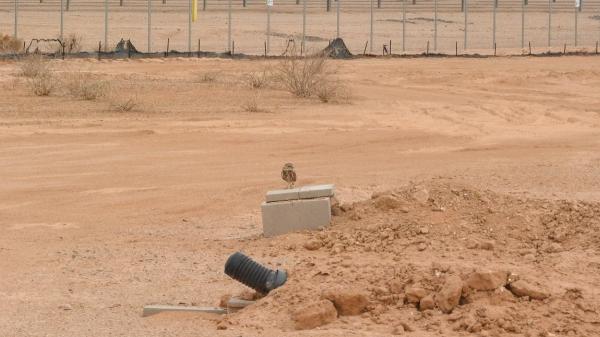
The 19 owls had 36 chicks in their first season
By the end of June 2025, the 19 adult owls had already given rise to 36 chicks. Over the next three months, 29 of those hatchlings managed to develop enough to fledge, leave the burrows and begin to fly. The landscape located between the solar panels had thus become a true breeding area for the species.
But it had to be checked if the owls could survive without depending indefinitely on humans. For the first few weeks, the team had supplied thawed mice daily to help the birds get used to the place. Then it began to progressively reduce that aid.
The observations themselves provided a pretty clear clue that the change was working. Those responsible found insect remains in the owls’ droppings, a sign that they were already hunting on their own within the facility. By the end of August 2025, supplemental feeding had been completely eliminated.
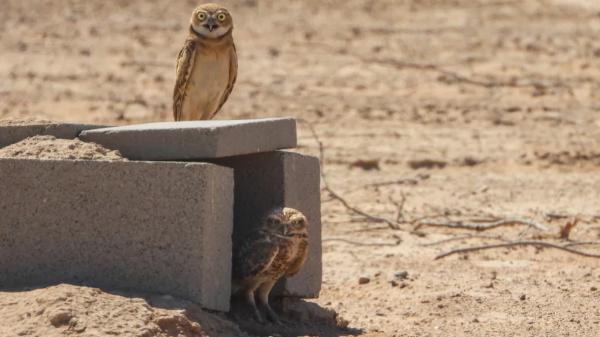
A year later, about 40 owls were still living among the solar panels
More than a year after the transfer, the experiment was no longer simply a rescue operation. In July 2026, around 40 birds were still using the solar plant environment, while cameras and biologists continued to monitor the colony and its artificial burrows. Of the 40 burrows initially installed, around 30 remained open and in use.
The result is especially interesting because owls don’t seem to simply tolerate solar panels. Those responsible for the project have observed that they use the land beneath them to hunt insects and take shelter during the hottest hours. The open space also allows them to detect possible predators from a distance, while the facilities themselves could favor the presence of insects that are part of their diet. Still, the researchers note that they are still studying exactly how solar infrastructure affects bird behavior.
If you want to read more articles similar to A solar plant in Arizona received 19 owls and ended up housing about 40: they designed the land so that energy and fauna could coexist, we recommend that you enter our Ecosystems category.
