
At the beginning of the 19th century, crossing the southern seas was a dangerous undertaking. Shipwrecks could leave a crew isolated for months in places where obtaining food was almost impossible. One of the solutions of the time was to convert certain uninhabited islands into improvised pantries: domestic animals were released so that they could reproduce and be hunted by future survivors.
That was precisely what happened in the Auckland Islands, a remote subantarctic archipelago located south of New Zealand. In 1807, British captain Abraham Bristow left pigs there. He could not imagine that that decision would end up causing an extraordinary involuntary natural experiment.
The animals survived, reproduced and, after generations without human care, acquired characteristics very different from those of pigs raised on livestock farms. But they also became a serious threat to one of the most valuable island ecosystems on the planet.
The pigs that arrived in the Auckland Islands in 1807
Determining exactly what type of pigs arrived in 1807 is not easy. Historical records do not specify their breed or how many specimens were released. A study published in the New Zealand Journal of Zoology points out that these were probably domestic pigs of the time transported from Australia or New Zealand.
Furthermore, there was no single introduction. After the one made by Bristow, others were produced during the 19th century. Records document new releases around 1840 and 1842-1843 and others later. By the end of that century there was already a stable and widespread population on Auckland Island.
Genetics made it possible to clarify part of the mystery. Research into the mitochondrial DNA of Auckland pigs compared their sequences with those of modern pig breeds and European and Asian wild boars. The results indicated that the specimens studied were closely related to European pigs, which strongly points towards that origin.
It is also worth clarifying a possible geographical confusion: there were introductions of domestic animals in different parts of the archipelago. The pigs brought to Enderby Island failed to establish a lasting population; The population that survived for generations was primarily that of Auckland Island, the main island.
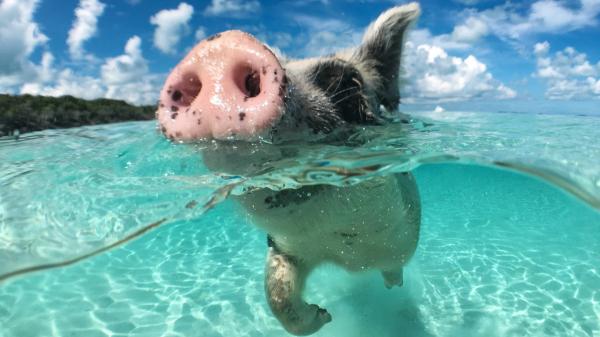
Almost two centuries living as wild animals changed them completely
Saying that pigs “evolved” requires some precision. A new species did not emerge nor did they cease to be Sus scrofa. What happened was an intense process of feralization, isolation and adaptation to conditions radically different from those of domestic livestock farming.
Without stables, human-provided food, or artificial selection aimed at producing large, meaty animals, those individuals capable of finding food and withstanding the harsh subantarctic environment survived.
Over the generations these suids developed a characteristic appearance. Auckland pigs were relatively small, slender and athletic, with narrow heads, long snouts and remarkably straight tails. Most were black in color, although black and tan specimens and some with white spots also appeared.
That is, rather than imagining a sudden transformation, we must think about approximately two centuries of domestic populations living like wild animals. Environmental pressures and isolation acted on them while the livestock selection that had conditioned their ancestors disappeared.
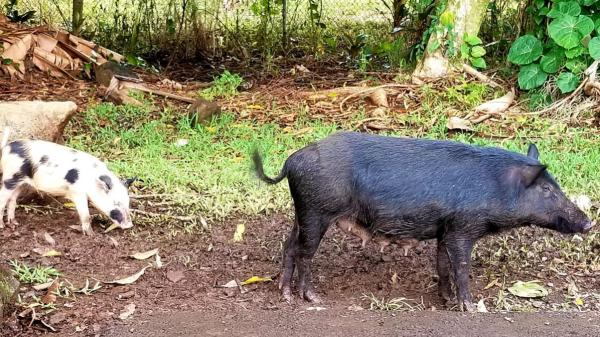
What helped the pigs survive became a disaster for the island
The adaptation that allowed pigs to survive had devastating consequences for Auckland Island. Island ecosystems are especially vulnerable to the arrival of introduced mammals because many of their species evolved without facing large terrestrial predators.
The pigs moved the soil looking for roots and invertebrates, destroyed vegetation and also consumed eggs and birds. A study carried out in the 1970s already documented its effects on the flora and seabirds that nested on the island.
The New Zealand Department of Conservation currently considers that the introduced mammals have caused serious ecological disruption to Auckland Island. Pigs have reduced plant biomass, damaged soils and affected the survival and reproduction of seabirds.
The story thus contains a paradox: the animals that humans introduced to save people ended up becoming a threat to native species.
In 1999 they rescued 17 specimens to prevent them from disappearing
Before the population could disappear as a result of environmental restoration programs, another concern arose: those pigs represented a unique genetic heritage.
In 1999, 192 years after the first introduction, an expedition by the Rare Breeds Conservation Society of New Zealand captured 17 individuals, including several pregnant females, and moved them to mainland New Zealand to conserve the population.
Their prolonged isolation also ended up providing them with unexpected biomedical interest. The descendants of those animals have been used as a source of biological material for medical research, especially related to xenotransplantation, that is, the use of animal cells, tissues or organs with possible applications in human beings.
The story began, therefore, with some animals abandoned as emergency supplies and ended almost two centuries later with a population unique enough for some of its members to be rescued.
It is also an extraordinary demonstration of how a seemingly simple human intervention can have consequences for centuries: pigs adapted to Auckland Island, but the island was never ready to adapt to them.
If you want to read more articles similar to In 1807 they left pigs on an island to feed the shipwrecked: 192 years later, their descendants were very different, we recommend that you enter our Ecosystems category.
