
In the fall of 1993, 300 American bison were released into the Joseph H. Williams Tallgrass Prairie Preserve in Oklahoma, United States. It was not simply a matter of recovering an emblematic species that had disappeared from a good part of its historical territory. The project pursued a much more ambitious goal: to see to what extent returning a large native herbivore could help restore the functioning of an entire ecosystem.
More than three decades later, the results allow us to observe a considerable transformation. The herd can reach around 2,700 individuals during the summer, including the calves born in spring, and the animals move across more than 12,000 hectares. Their grazing, combined with controlled fires, contributes to creating a heterogeneous landscape in which low grasses, areas of tall vegetation, wild flowers and small humid depressions coexist.
From 300 bison to a herd of 2,700 in three decades
The story began in 1989, when The Nature Conservancy acquired land from the former Chapman-Barnard Ranch to protect one of the last great vestiges of North American tallgrass prairie. Four years later the first 300 American bison were introduced (Bison bison), from a donation from the Ken-Ada Ranch.
The reserve currently occupies about 16,000 hectares (39,650 acres). Its importance is more evident when you look at what happened to this ecosystem: tallgrass prairies once extended across a huge swath of North America, but agricultural and urban expansion reduced their area to less than 4% of their original extent.
The bison also suffered an extraordinary decline. Before European expansion across the Great Plains, historical estimates speak of tens of millions of individuals. Massive hunting subsequently brought the species to the brink of extinction.
Therefore, their return to Oklahoma was not only intended to recover a population of animals, but also to return to the landscape one of the actors who had contributed to its shape for thousands of years.
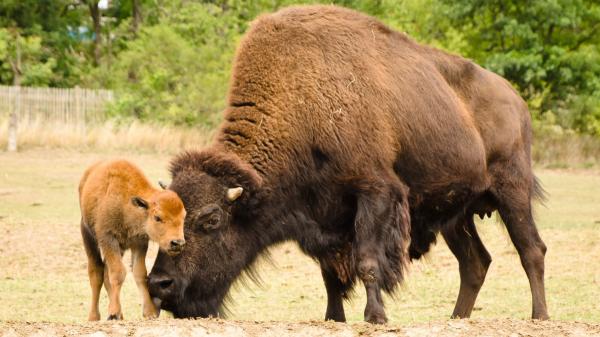
Bison caused plant diversity to increase by 103%
The scientific results obtained in the North American prairies help to understand the magnitude of this effect.
A long-term investigation published in Proceedings of the National Academy of Sciences (PNAS) compared areas with bison, ungrazed land, and areas subject to intensive grazing by domestic livestock.
After 29 years, areas where bison had been reintroduced had 103% more native plant species at a local scale than those where large herbivores had been excluded. At the basin scale, the increase reached 86%.
The effect was also resistant to the most extreme drought recorded in four decades during the period studied.
One of the explanations lies in the way these animals feed. Bison preferentially consume certain grasses and avoid other plants, which reduces the dominance of some competitive species and allows others to find space and light to develop.
Thus, the meadow ceases to be a homogeneous surface and becomes a mosaic of different habitats.
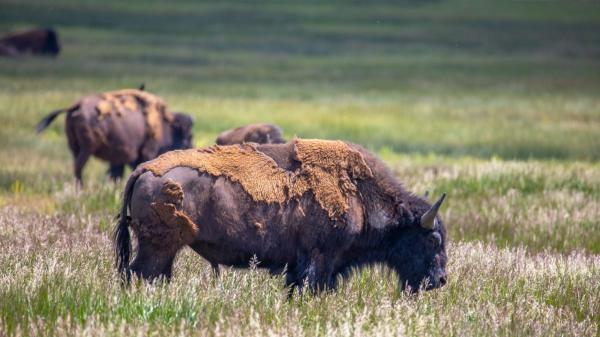
Fire and bison work together to transform the prairie
However, bison do not work alone. One of the essential elements of the Oklahoma project is the combination of grazing with prescribed or controlled fires.
Fire is part of the natural dynamics of the North American prairies. Eliminating it completely can encourage the accumulation of dead vegetation and facilitate the advance of woody plants on the grassland.
In the reserve, certain plots are deliberately burned. Shortly afterward, young and nutritious shoots appear that attract bison, concentrating grazing in those sectors. When another area is subsequently burned, the animals move towards it.
This interaction between fire and large herbivores, known as pyric herbivory, continually creates areas in different stages: some recently burned and heavily grazed; others covered by tall and dense vegetation.
This structural diversity provides different habitats for insects, small mammals and birds that need very different conditions to feed or reproduce.
Bison also create small wetlands by wallowing
The impact goes even beyond what they eat. American bison have the habit of rolling on the ground to shed hair, fight insects, and perform other bodily behaviors.
With their weight of more than 500 kilos in many adult specimens, these actions generate depressions in the ground known as wallows. When it rains, some can temporarily retain water and become small semi-aquatic habitats used by plants associated with humid environments and other organisms.
Their movements remove the soil, while their excrement returns nutrients to the soil. Even the hair they lose can be used by birds to build their nests.
Currently, The Nature Conservancy records more than 700 species of plants, about 300 species of birds, and around 80 species of mammals in the reserve.
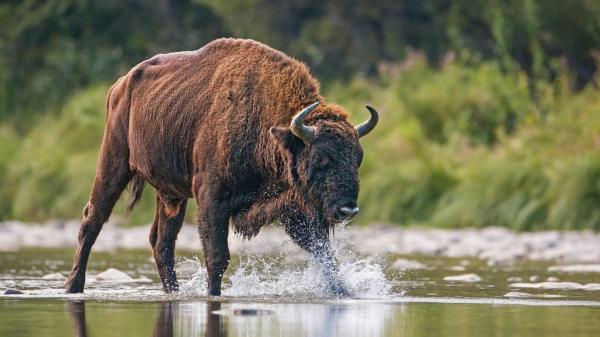
The goal was not just to recover the bison, but the entire ecosystem
The Oklahoma case also leaves an important lesson for ecological restoration projects. Introducing bison alone does not guarantee recovery of any grassland.
The number of animals, the space available, the frequency of fire, the climate and the management of the territory determine the results. Nor does it mean that any grazing of domestic livestock is necessarily harmful: different research shows that its effects depend greatly on the intensity and form of management.
What is truly significant about the Joseph H. Williams Tallgrass Prairie Preserve is that the project attempts to recover ecological processes and not just species.
More than three decades after that release of 300 animals, the bison are once again grazing, moving and wallowing on these grasslands. And with them has also returned part of the ancient relationship between fire, large herbivores, plants and fauna that for thousands of years shaped one of the most characteristic ecosystems in North America.
If you want to read more articles similar to Oklahoma reintroduced 300 bison in 1993: three decades later they have transformed one of the last great grasslands in the United States, we recommend that you enter our Ecosystems category.
