
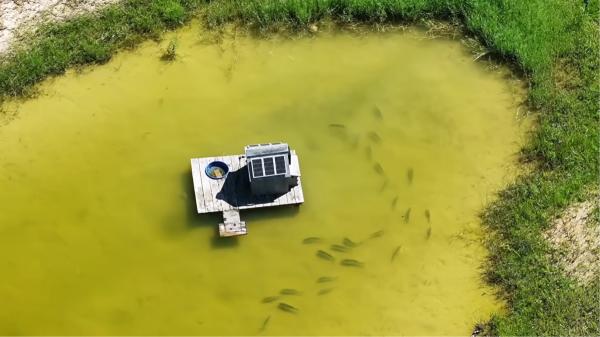
What began as a project to raise large fish ended up producing a much more complex result. An artificial pond of about five acres (just over two hectares) was excavated in an old agricultural field that, over time, began to attract birds, mammals, reptiles and insects until it became a small ecosystem.
The transformation has been documented for years by BamaBass, a popular American YouTube channel dedicated primarily to fishing and pond management. Its owner built the so-called Crimson Oak Pond with the initial intention of raising large specimens of bass, but approximately 1,000 days later the place had changed radically and numerous wild species had begun to use it.
The case allows us to observe on a small scale how the appearance of a new body of water and different habitats can modify the biodiversity of an agricultural landscape.
From a peanut field to a lake of more than two hectares
Before the transformation, the land was basically a field dedicated to growing peanuts. Construction of the lake began in 2021 and was far from simply cutting a hole and filling it with water.
According to project documentation, approximately 850 truckloads of clay were used to condition the land. Rocks, an island, docks and numerous submerged structures originally intended to provide shelter for fish were also incorporated.
The objective was to control factors such as water quality and oxygen concentration to promote the growth of the animals. Aerators, underwater cameras and other monitoring systems were installed, and later different aquatic species were introduced.
First came thousands of small fish destined to establish a base of the food chain. Later, tiger bass, tilapia, trout and freshwater shrimp, among other species, were added.
Eagles, deer, owls and raccoons arrived without anyone introducing them
The first wild animals began to appear without their owners introducing them. The deer came to drink, while different birds used the pond to rest or look for food. Owls, squirrels and raccoons also began to be seen.
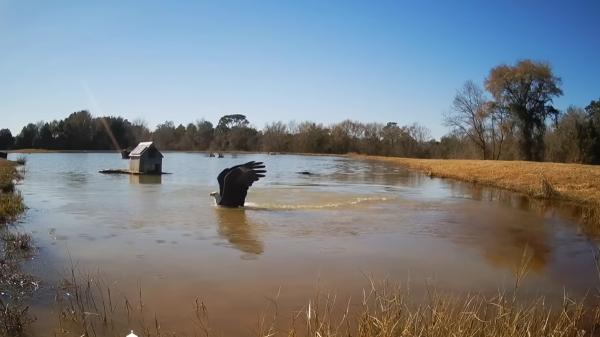
One of the most striking events was the appearance of bald eagles (Haliaeetus leucocephalus). Initially they were limited to flying over the terrain, but later they were observed descending to the pond to drink and search for fish. Those responsible for the project even installed a platform intended to facilitate their possible nesting.
The presence of predators is especially interesting because it shows how the creation of a resource can have effects at different levels of a food web. Fish provide food for piscivorous birds, while insects, small vertebrates and vegetation offer resources for other species.
Nor should the result be interpreted as a permanently peaceful coexistence. The cameras recorded episodes of predation, competition for shelters, and animals occupying structures originally intended for other species. There were also fish deaths associated with adverse weather events.
Precisely these interactions are characteristics of ecosystems: species compete, feed on each other and continually modify the conditions of the environment.
Why an artificial lake can end up becoming a refuge for wildlife
There is abundant scientific and technical documentation on the importance that small bodies of water can acquire in agricultural landscapes. The Farm Pond Ecosystems report from the United States Natural Resources Conservation Service explains that agricultural ponds can provide food, shelter and breeding grounds for amphibians, reptiles, fish, birds and mammals. In addition, proper management can help conserve habitats, reduce erosion and improve certain ecological functions.
Vegetation is especially important. Aquatic plants help maintain water quality and temperature, reduce bank erosion, and provide food, spawning grounds, and shelter. The logs and rocks also create spaces used by fish, amphibians, reptiles and birds.
Islands fulfill another relevant function: they can provide resting, feeding and nesting places for waterfowl, while the water that surrounds them makes access difficult for some terrestrial predators.
The report itself notes that mammals such as deer, raccoons, and squirrels may routinely use the resources provided by these ponds, exactly some of the animals observed around Crimson Oak Pond.
Creating a pond does not necessarily mean restoring a natural ecosystem
The case demonstrates nature’s ability to take advantage of new spaces, but it also leaves a warning. Creating a pond is not necessarily equivalent to restoring a natural ecosystem.
The Natural Resources Conservation Service recommends prioritizing native plant and fish species, conserving vegetation around the banks, reducing the use of fertilizers and pesticides and avoiding the introduction of invasive exotic species, capable of displacing local fauna and flora.
It is also important to maintain a certain physical complexity. A perfectly clear pond with its banks continually mowed may harbor less biodiversity than another with vegetation, stones, logs and different depths.
The case also shows the extent to which small bodies of water can become important in highly transformed agricultural landscapes. It is not about simply reproducing this project, but rather understanding that conserving vegetation on the banks, maintaining different depths and providing shelters can multiply the spaces available for fauna. An especially relevant lesson where intensive agriculture has reduced ponds, wetlands and other water sources.
If you want to read more articles similar to A man builds a lake to raise fish and 1,000 days later it becomes a refuge for eagles, deer and owls, we recommend that you enter our Ecosystems category.
