
Shared play between parents and children is an opportunity to connect and spend quality time together. Here are three simple activities that answer the question “What can I do with my baby?”
This article is sponsored by
“Do you want to play with me?”. It is good practice to let children ask for company in the game. If they don’t, they are probably peaceful in their “private” game and it is important to respect this space.
However, when you are “hired”, it is a good idea to accept the invitation if you have the time and desire to get involved! In short, if you play, you have to do it well!
Let’s try to identify some golden rules to keep in mind:
- turn off all possible sources of distraction, such as telephones, TV and computers, in order to dedicate quality time to your children;
- accept that the game is led by the child;
- put aside the idea that you can “play badly”.
An example of a game that lends itself particularly well to this type of sharing is that of LEGO DUPLO constructions, which can offer children and adults a meeting and exchange ground, while at the same time allowing them to exercise their imagination, patience and manual skills.
The flexibility of this type of game allows you to always have different experiences using the same simple bricks.
Let’s see three possible ways of playing with these materials.
Free construction by the child and shared play
If the child involves the parent in the game after having already assembled the bricks in a construction, he may want company for symbolic play, that is, to use what he has built to create stories and scenarios.
The “little builder” could have created a swimming pool, a fence, a school, a stable, a hospital or a forest which, however, are not always so easily recognizable in the eyes of adults!
In this case it will be appropriate to enter the game on tiptoe and first ask the child what he has built. Without expressing judgement, the parent will be able to accept the proposed narrative and let the child lead him in the game.
“Dad, take this, it’s a little horse, it needs to go back to the box for the night.”
«The teacher is very angry! Let’s make all the children sit down and have to listen!”.
Sets that provide environments and characters, such as LEGO DUPLO 3 in 1 modern family house with characters, can offer further ideas for this type of symbolic play: the house can become the place in which to set a story or the starting point for inventing ever-changing situations.
This game mode can easily prove to be a safe ground for the child through which to tell mum and dad, protected by pretend play, about dreams, experiences and even fears linked to his real life.
The parent can then occupy a privileged listening position, accompanying the child in the elaboration of his experiences: he plays roles, moves characters and, without pressing him with questions, welcomes his stories.
Co-design construction
There is another game possibility, which can arise when the invitation takes place in the initial phase, that is, when the bricks are still to be assembled. In this case the parent is also involved in the planning and construction of a game scenario.
It is best for the child to remain the “site manager”, while the parent can take on a more technical role, that of the builder, awaiting his “directives”. If you wish to offer useful suggestions for the project, you can propose them as advice and not as directions to follow.
An open construction box, such as LEGO DUPLO Large Brick Container, lends itself particularly well to this game mode: it does not propose a single scenario to play, but leaves the child the possibility of deciding what to build and the parent the possibility of supporting him in the creation.
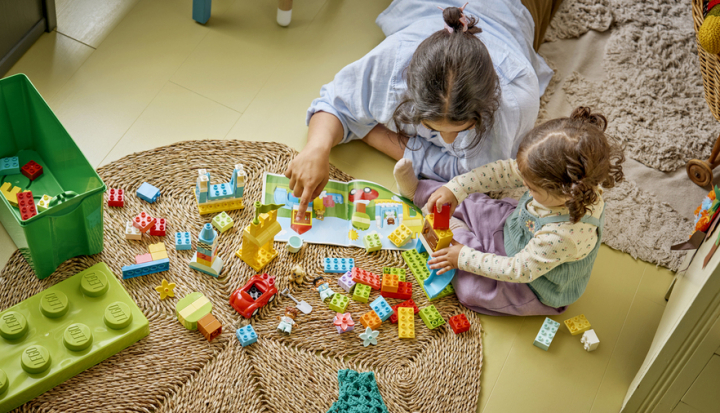
This game mode can become an opportunity for growth for the child, allowing him to practice expressing his thoughts and dealing with any mistakes and the frustration that may result.
In this game mode the child will be able to:
- explain your project clearly and give operational instructions to mum and dad, who will be able to ask for further details or clarifications to participate in the game while respecting their ideas;
- manage frustration if the project does not work as imagined or your requests are not understood (you will then be able to look for new words to express yourself or new solutions to realize your project).
Construction sharing space but not material
When the boy or girl is still young, let’s imagine around 18-24 months, he or she may not yet have sufficient interest or skills to build a symbolic scenario or to manage a co-planning taking on the role of “site manager”.
At this stage, for example, the LEGO DUPLO sets indicated for ages 18 months and above may be suitable, as they allow the child to experiment freely with the bricks: trying out the first joints, stacking them, combining them based on color or creating simple sequences.
In this third game mode, what can be the role of the parent so that the child is free to experiment, without pressure, judgment or haste? Mom and dad can dedicate themselves to their construction next to the child, after having identified and respected his “work” space.
The child will thus be able to observe the parent while he builds, chooses, fits together, changes his mind, makes mistakes and tries again. It will be an opportunity for him to learn through imitation and a possible source of inspiration for his constructions.
