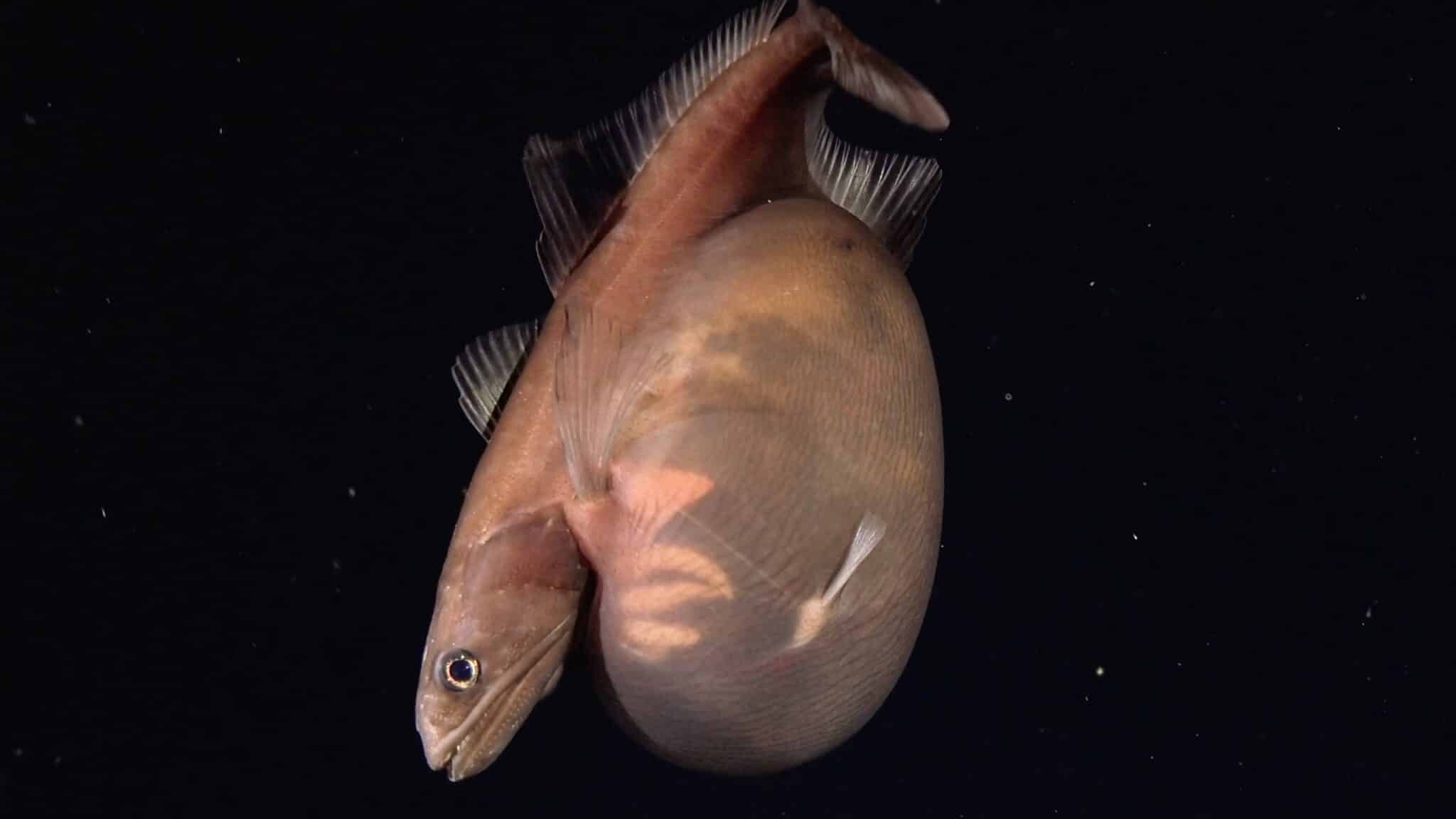
For fish that live in the ocean depths, food is a resource that is as scarce as it is precious: wasting even just a small amount can have disastrous consequences for animals that encounter it so rarely. One of the most extreme solutions to this resource shortage is that of the black swallower, a small fish with a huge appetite. Very rare to observe in nature, a specimen was recently filmed by a team from the Schmidt Ocean Institute during a series of dives in the waters of Trinidad and Tobago. And, as you can see from the video, he may have gone a little too far.
Giant stomach. The black swallower has solved the problem of food shortages in the depths by developing a gigantic stomach, at least in proportion to the rest of the body: these fish rarely reach 20 cm in length, but are capable of swallowing prey up to twice as long and ten times bigger than themselves. This is because the aforementioned stomach is extensible: when full, the skin stretches so much that it becomes almost transparent, allowing you to see the animal’s internal organs.
These fish are so voracious that every now and then they go overboard: there are not rare cases in which a black gobbler has, well, swallowed a prey so large that it was unable to digest it before it began to decompose. The formation of gas due to decomposition leads the poor fish to rise to the surface: this is how we encountered many of the specimens we observed. It is much more difficult to “catch” them when they are in their natural environment: this is why the video you saw above is an exceptional document.
Yes, but what had he eaten?
However, a mystery remains about the swallower filmed by divers: what did its abundant meal consist of? The answer is that we will never know: as Diva Amon, the leader of the expedition, commented, “if only we had an underwater CT machine… we would never know what he ate”. We know that this fish generally feeds on other bony fish, and we also have a hypothesis about its hunting strategy: as its name suggests, it eats its prey starting from the tail, and swallows them using its teeth, which are hooked and turned backwards.
A very plausible hypothesis, but unfortunately for now it remains only a hypothesis: we have not yet seen a black gobbler while hunting, and given how complicated it is to meet them, it is not certain that we will ever do so.
In the meantime, let’s enjoy what we have: a video that demonstrates the effects of a normal meal.
