
At 12,000 light years from us, the object IRAS 18293−0941 confirms a theory formulated thirty years ago. It is a black hole that devours a star and shoots jets of matter at the speed of light in our direction.
For thirty years astronomers have been hunting for something that, according to theory, should exist in our Galaxy, but could not be found. Now they have found it hidden behind a curtain of interstellar dust about 12,000 light years from Earth. It was identified by an international group led by researchers from Spain, the Netherlands and Argentina.
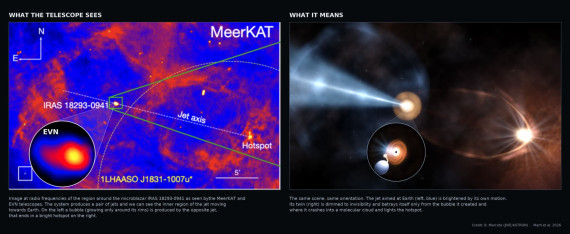
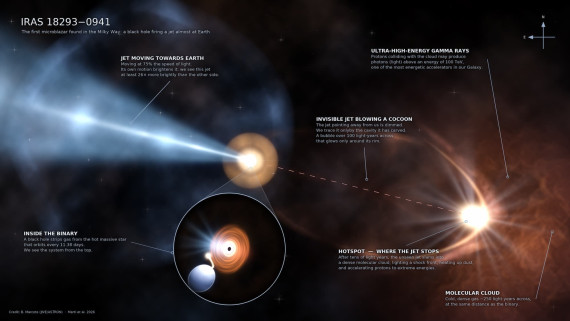
It is called IRAS 18293−0941 and is a binary system made up of a hot and massive star and a black hole that orbits it every 11.38 days. The black hole sucks in some of the material torn from the star and hurls the rest into space along two opposing jets, which travel at three-quarters of the speed of light. The peculiarity of the system lies in the fact that the jets point almost straight towards us.

A miniature cosmic monster
Jets directed towards Earth are nothing new to astronomers. At the heart of very distant galaxies, supermassive black holes, billions of times heavier than the Sun, emit beams that point at us. These objects, extremely bright and violent, are called “blazars”. Since the 1990s, theorists have argued that the same mechanism must also work on a smaller scale in the Milky Way and have called these hypothetical systems “microblazars”.
But no one had ever found one that stood up to scrutiny. IRAS 18293−0941 is the first. “Everything about IRAS 18293−0941 was hidden,” says Josep Martí, from the University of Jaén and lead author of the study. «It is behind so much dust that it is practically invisible in normal optical images. It was cataloged decades ago and then more or less forgotten.”
A jet that looks us in the face
Years of monitoring, with the contribution of the Spanish observatories of Montsec, Calar Alto and the University of Jaén, have shown that the star’s light oscillates slightly. That slight tremor revealed two things: the orbital period of 11.38 days and the fact that the system appears almost face-on to us. The radio images then revealed a single, one-sided jet, which can only be explained if it is pointed almost exactly towards Earth. The opposing jet remains invisible: this is a prediction of Einstein’s theory of relativity.
Thanks to the European VLBI network (EVN), a set of radio telescopes distributed across the continent that behaves like a single dish thousands of kilometers across, the researchers obtained very high resolution images, confirming the orientation of the jet and its origin from the star system.
Among the antennas involved there are also the Italian ones of Medicina and Noto, together with Hartebeesthoek (South Africa), Irene (Latvia), Jodrell Bank and eMERLIN (United Kingdom), Onsala (Sweden), Tianma (China), Torun (Poland), Westerbork (Netherlands) and Yebes (Spain). A radio and an optical method, completely independent, gave the same answer.
“It was the moment when the result became definitive,” explains Benito Marcote, of the Joint Institute for VLBI ERIC (JIVE), in the Netherlands. An isolated radio jet, in fact, could always belong to a distant galaxy that happens to be in the same line of sight. «The precision of the EVN position, together with that of the star known thanks to the Gaia satellite, confirmed that the jet belongs to the star system».
The invisible jet and the struck cloud
The other jet, the one moving away from us, cannot be seen. But it didn’t disappear without a trace, and the team identified its footprint. Deep images from the South African MeerKAT radio telescope show a huge bubble, 100 light-years across, crossed by the jet. At the end is a compact, bright node of radio emission. In the collision between the jet and the interstellar medium, the particles are accelerated, the dust heats up and the hydrogen gas emits light.
At that very spot, observatories such as LHAASO (China), HAWC (Mexico), HESS (Namibia) and the Fermi satellite have detected a source of very high-energy gamma rays: single photons carrying over 100 trillion electron volts, more than ten times the energy that the Large Hadron Collider provides to a single proton. Where these galactic objects get so much energy is one of the great open questions of modern astrophysics.

A particle accelerator in space
The team showed how the pieces of the puzzle can fit together. The jet carries enormous power, equal to half a million times the energy radiated by the Sun. Where it hits the molecular cloud, it accelerates the protons to very high energies and causes them to collide with the dense gas.
Particles are born from collisions which immediately disintegrate, emitting gamma rays. “The accelerator engine and the target are two different objects, light years away from each other,” observes Pedro Luque-Escamilla, from the University of Jaén and co-author of the research. «The jet accelerates. The cloud emits light.”
So for the first time we have an analogue of distant blazars in our own backyard, confirming a prediction from thirty years ago. This opens up the possibility of studying these systems in much greater detail and following their evolution on human time scales.
Furthermore, the interaction of the jet with the interstellar medium, which produces a true hot spot, suggests that processes of this type may matter in the evolution of the Galaxy.
