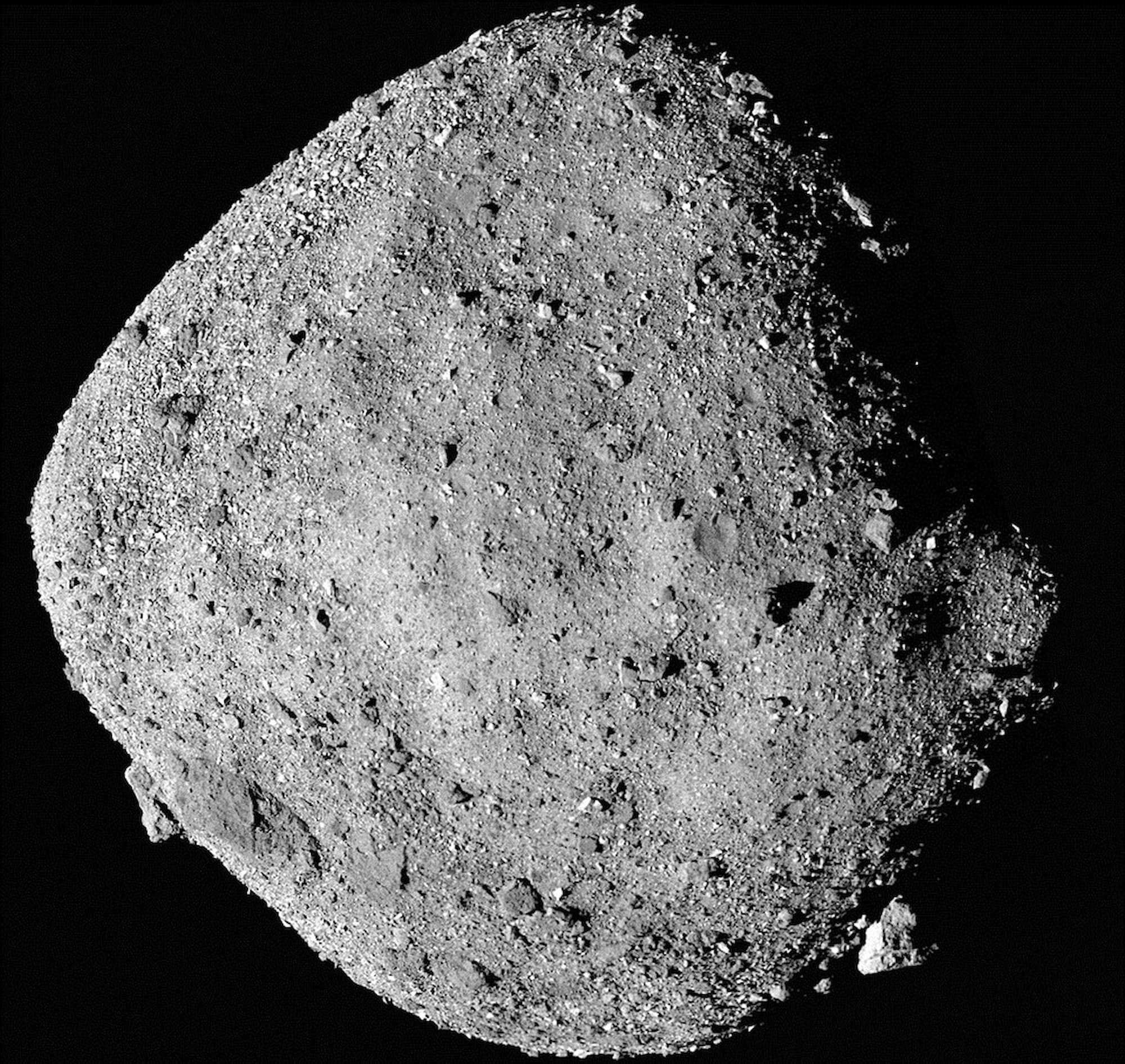
The OSIRIS-REx probe had detected unusual heat loss on Bennu’s surface. The analyzes conducted on the samples brought back to Earth reveal the “secret ingredient” hidden in its rocks.
When NASA’s OSIRIS-REx probe arrived at Bennu in 2018, scientists expected an asteroid with a nearly flat surface, as distant observations suggested. They found themselves faced with a very different scenario: a rugged landscape, dotted with huge boulders and with very few areas suitable for collecting samples.
“We expected boulders, but we expected at least large regions of fine, smooth regolith (dust), easy to collect. Instead it seemed like there were only boulders,” says Andrew Ryan, a scientist at the Lunar and Planetary Laboratory at the University of Arizona, who led the mission team dedicated to the physical and thermal properties of the samples.
An asteroid that defies logic
The real puzzle, however, was another. In 2007, NASA’s Spitzer Space Telescope showed that Bennu’s surface heated and cooled rapidly as the asteroid rotated between light and shadow.
Scientists call this property low thermal inertia. This is what happens to the sand on a beach, which burns under the sun and cools as soon as it sets. Large, compact rocks behave the opposite: like concrete, they accumulate heat and release it slowly.
How, then, was it possible for a boulder-covered asteroid to cool as quickly as sand?
The clues hidden inside the rock
The first clue came from OSIRIS-REx observations. The Bennu boulders may have been much more porous than expected and this would have made them capable of dispersing heat more quickly than solid rocks. With the samples brought to Earth, the researchers were finally able to test the hypothesis. Ryan and colleagues analyzed tiny fragments with different laboratory techniques and the results, published on Nature Communicationsconfirmed that the rocks are very porous. But porosity alone was not enough to explain such rapid cooling.
And here is the second discovery that led to an almost complete understanding of the phenomenon: many particles, in fact, were crossed by dense networks of internal cracks. To understand what effect these fractures had, researchers at Nagoya University, Japan, used the lock-in thermography. A laser heats a small area of the sample, while instruments measure how the heat spreads into the surrounding material, a bit like waves spreading across the surface of a pond. The data indicated that the size and internal structure of the rocks made the difference.
But the samples in the lab were tiny compared to the Bennu boulders, and we needed a way to understand what happens on a much larger scale.

A CT scan for asteroid fragments
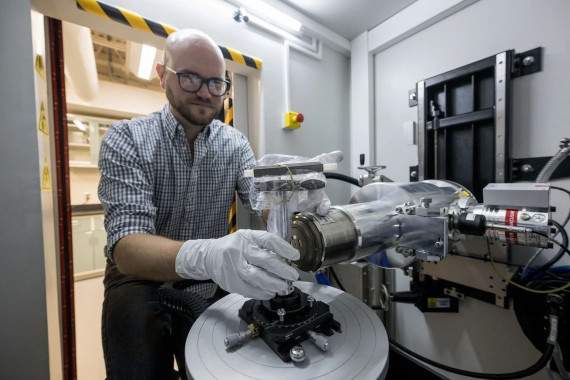
The solution came from NASA’s Johnson Space Center in Houston. There the researchers prepared the samples for X-ray analysis with operating room precautions. Inside a nitrogen-filled glove box, they sealed each particle in an airtight container, took it to the X-ray computed tomography lab, and then put it back in the chamber, without ever exposing it to Earth’s environment.
“The sample is placed in its ‘spacesuit,’ subjected to a CT scan, and then returned to its pristine environment,” explains Nicole Lunning, head of OSIRIS-REx sample curation at NASA Johnson and co-author of the study. “We can get images through these containers to see the shape and internal structure of the rock. Tomography allows us to observe the inside of an object in three dimensions, without damaging it,” adds Scott Eckley, co-author and X-ray specialist at the Johnson Space Center.
Each scan also produced a permanent 3D digital copy of the particle, entered into a public database. Ryan’s team finally fed this data into computer simulations that reconstruct the propagation of heat in rocks. By extending the calculations from single particles to Bennu’s large boulders, the researchers were able to reproduce the low thermal inertia measured by the probe.
