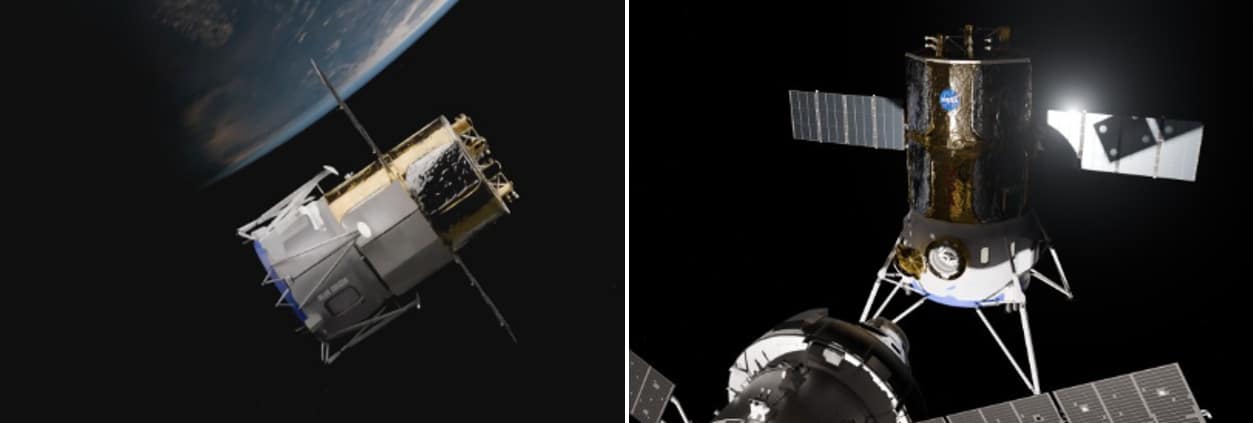
In 2027 the crew with Parmitano on board will pilot the docking of the two commercial landers. But to really land in 2028, NASA has many knots to untie…
NASA took stock of the Artemis program to explain what to expect from the next missions. Many elements were already known, but the press conference explained what the Artemis III missions, which will remain in Earth orbit, and Artemis IV, the mission that should bring man back to the Moon, aim to do.
At the NASA construction site
First of all, NASA announced that in the Vehicle Assembly Building, the large shed where the large SLS rocket is assembled, the teams have completed the initial assembly phase of the two solid-propellant auxiliary rockets of Artemis IV, i.e. those that are next to the large main tank, the “orange Core Stage”, to which they should be integrated in the next few days. The SLS of Artemis III, however, is already ready and awaits the integration of the Orion spacecraft.
For the latter there will be no second stage, which is used for the final push to the Moon, because the mission will remain in Earth orbit. But let’s go in order…
Artemis III: the dress rehearsal
Scheduled for 2027, Artemis III will not land on the Moon. It will take place in low Earth orbit and will serve to verify the fundamental operations of subsequent missions. The Orion crew will rendezvous, that is, a docking with two commercial landers: Blue Origin’s Blue Moon Mark 2 and a test version of SpaceX’s Starship V3. It will be the first time that NASA has tested in flight the compatibility between Orion and two moon landing systems developed by private companies.
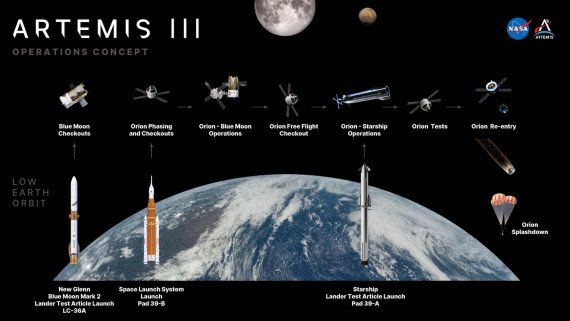

The crew of Artemis III will be composed of commander Randolph Bresnik, pilot Luca Parmitano who will have the task of attaching to the two lunar modules and mission specialists Frank Rubio and Andre Douglas. Reserve crew member is Bob Hines.
The mission is considered important because it will allow us to understand which of the Blue Moon landers and Starship is more advanced in being ready for the mission that should bring a crew to our satellite in 2028. At the moment, according to plans from a few years ago, Starship should be the spaceship chosen for the first human landing on the Moon of the new millennium, however the difficulties encountered by Spacex in recent years have pushed NASA to ask Blue Origin to accelerate the construction of its own lunar module and so we have arrived at this sort of challenge that will see a winner after the Artemis III mission.
Artemis IV: the upper stage
A higher stage will instead be used by Artemis IV to reach the Moon. But paradoxically we still don’t know with certainty what this higher stage will be. In fact, the situation is this: the Interim Cryogenic Propulsion Stage (ICPS) is a “provisional” upper stage, derived from the Delta IV rocket.
NASA only had three built: one for Artemis I (already used), one for Artemis II (already used) and one that was initially supposed to be used for Artemis III, but since that third ICPS is no longer needed it was moved to Artemis IV.
The race against time for the new rocket stage
The doubt arose because, in the meantime, NASA has decided that the future of the SLS will not be the ICPS (i.e. the current stage) but the Centaur V, built by United Launch Alliance (ULA). The Centaur V is more modern and more powerful. Furthermore, a version with longer tanks was chosen, which contains more propellant. The problem is that this configuration is still under construction and it is not known if it will make it to be ready for the SLS of Artemis IV.
If it is possible to develop it in the next few months, it will become necessary to intervene on the Mobile Launcher, the enormous tower that transports and supports the SLS on the ramp. If the upper stage changes size, mass, electrical connections or supply lines, the tower must also be modified. So it’s not enough to build a new stadium: the infrastructure that powers and supports it must also be adapted before take-off. It is therefore understandable the degree of uncertainty that still exists.
Two architectures to get to the Moon
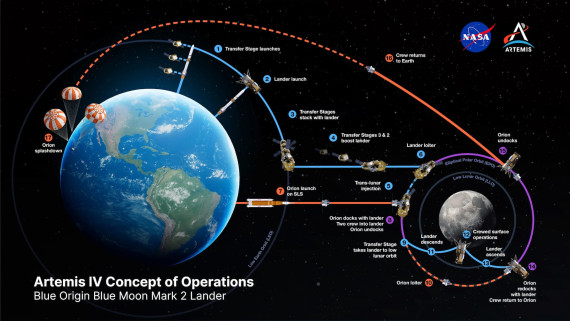
After the suspension of the Lunar Gateway at the beginning of the year, i.e. the lunar space station, we will go directly to the Moon with a lunar module without stopping. But the journey won’t be that simple. In the Blue Moon architecture, i.e. the way in which Blue Origin hypothesizes to send its module to the Moon, three transfer stages derived from the Mk1 (a lunar module that does not carry humans) will be assembled in low Earth orbit and will be filled with propellant.
The Mk2 lander, launched from a New Glenn 9×4, docks with them and departs towards an elliptical polar lunar orbit. Two stages will separate during the journey. At that point Orion will arrive directly in lunar orbit and dock with the lunar module.
Two astronauts will pass through the lander and at that point Orion will detach and the remaining stage will lower the lander into low lunar orbit from where Blue Moon, once detached from them, will descend onto the Moon.

The architecture of Starship
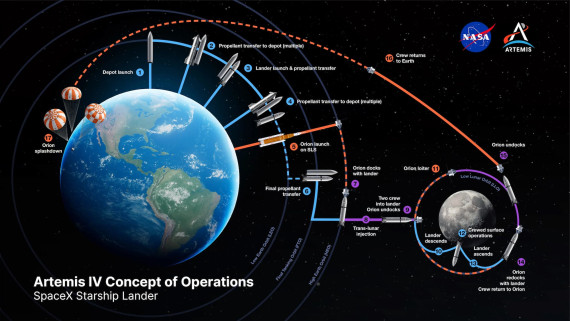
With SpaceX, the mission will be even more complex: first a depot ship will be placed in Earth orbit and resupplied in low orbit by multiple tanker flights. After this the lunar Starship will join it to refuel and ascend to a higher orbit, where, after a further fill of propellant, it will dock with Orion. The complex will thus depart towards the Moon and enter a low circular lunar orbit.
At that point Starship, more than 50 meters tall compared to Blue Moon’s 9, will descend on the Moon. After the surface work, for both spaceships, there will be a return to lunar orbit where the astronauts will pass into the Orion, which will return to Earth. NASA wants to keep both avenues open as long as possible, to maximize flexibility and the chances of a manned moon landing in 2028.

The knot of the suits
The Axiom Extravehicular Mobility Unit (AxEMU), aka the moon suit, is late. In 2024 the preliminary review of the design found that the weight was already over the limit and Collins Aerospace withdrew from the contract, leaving Axiom responsible for the lunar and zero-gravity suits. The tests, scheduled for 2025, have been postponed to 2027. NASA’s Inspector General called the current timeline “overly optimistic” and warned that, in line with historical delays, the suits may not be ready until 2031, too late for 2028.
So NASA asked Axiom for a “sortie suit”, lighter and with simplified interfaces. It will be certified for stays of at least two hours, but not for the perpetually shadowed regions near the South Pole, nor for long campaigns with multiple extravehicular activities. For comparison, Apollo 11’s walk lasted about two and a half hours, while Apollo 17’s each exceeded seven hours. The sortie suit could be ready for 2028, but at this point we have to ask ourselves: “Will the Artemis IV mission really launch the lunar base as has always been said? How will this be possible if astronauts cannot take walks of more than two hours?”.
Answers that will have to arrive very quickly.
