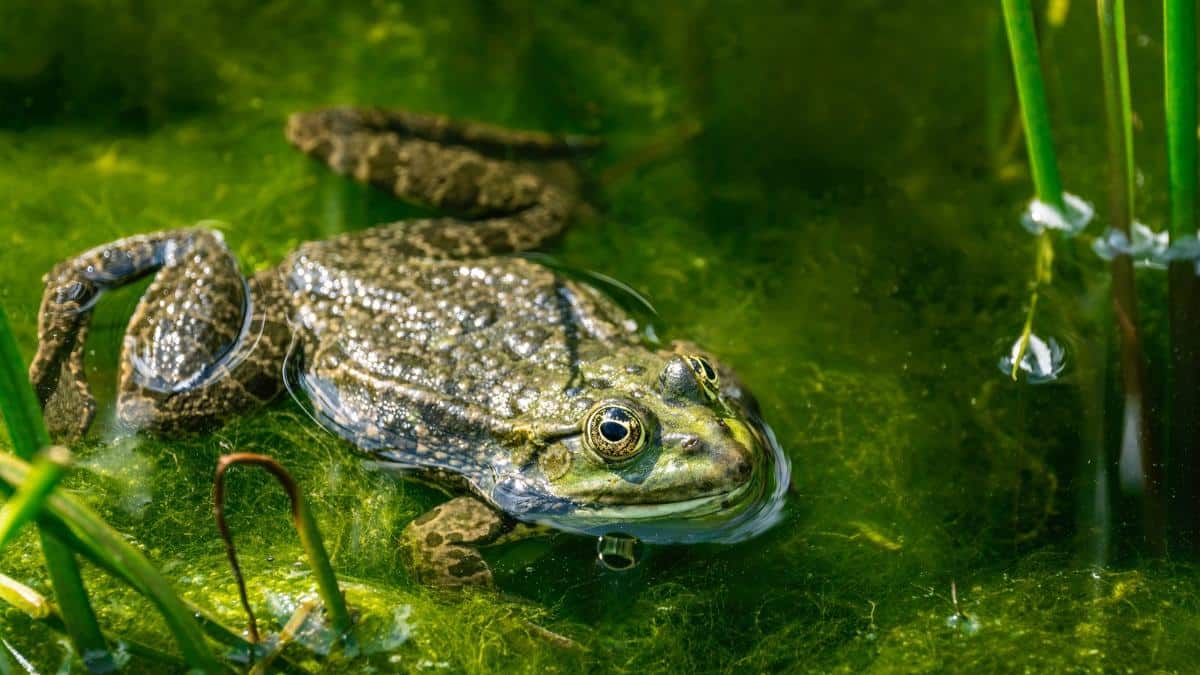
In 2017, the garden of a family in the Shenandoah Valley, Virginia (United States), was essentially an expanse of grass where the sound of crickets barely stood out. That fall, Maggie Johnson, then 14, decided to dig a small pond there as a project for a high school agriculture class.
What happened next offers a small-scale example of a process well known to ecologists: when a new aquatic habitat appears and there are nearby animal and plant populations capable of reaching it, colonization can begin surprisingly quickly.
Nine years later, that hand-dug hole is an ecosystem with amphibians, insects and aquatic plants that also provides water and food for birds and mammals.
The small hole that began to fill with life in a few weeks
The story was documented in 2026 by conservation photographer Steven David Johnson, Maggie’s father, at the National Wildlife Federation. Maggie marked out a circle about 12 feet (approximately 3.7 meters) in diameter and began digging by hand. After previously researching how to build it, he managed to have it filled with water in the spring of 2018.
The family then prepared the banks with stones, earth and vegetation. But the fauna moved forward. “Just a few weeks after the pond was filled, the first American toads arrived,” Maggie recalls in the article.
Over the years more amphibians appeared. In a previous publication by the organization itself, Johnson explained that, in addition to those first toads, six other species of frogs had arrived, along with dragonflies and aquatic beetles. Birds use the water to bathe and deer come to drink.
The process is not an ecological anomaly. A research published in Basic and Applied Ecology on the biodiversity of garden ponds concluded that these small environments can contribute to the regional assemblage of species and act as pieces of a network of aquatic habitats, especially where urban development has eliminated other water points.
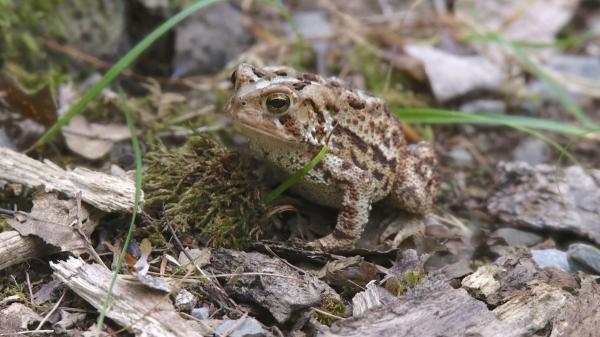
It didn’t take long for the toads to find the new pond.
Among the protagonists of the pond is the American toad (Anaxyrus americanus), a species widely distributed in eastern North America and particularly well adapted to taking advantage of small bodies of water.
Adults spend much of their existence on land, but need fresh water to reproduce. According to the Mountain Lake Biological Station at the University of Virginia, they can live in forests, fields, gardens and agricultural land as long as they have a semi-permanent body of water suitable for their tadpoles.
Its development helps explain why the new pond was colonized so quickly. During reproduction, females lay thousands of eggs in long gelatinous cords. These can hatch in just 3 to 12 days. Tadpoles feed and grow in water for approximately 40 to 70 days, until metamorphosis is complete.
During this process they first develop the hind legs and then the front ones, lose the gills and finally reabsorb the tail. Afterwards they progressively abandon the water and adopt mainly terrestrial life. The Virginia Herpetological Society lists small, shallow, fishless ponds as suitable larval habitats.
Gray tree frogs and green frogs are also now heard at Maggie’s Pond, a sign that the community of frogs and other amphibians has diversified since those first toads.
Why a small pond can become a refuge for many species
Size is not necessarily the deciding factor. Vegetation, depth, water quality, absence of contaminants and connection to surrounding green spaces can determine which organisms manage to establish themselves.
A 2025 study based on more than 800 domestic ponds found that their age, surface area, and especially aquatic and bank vegetation were related to the presence of amphibians, odonates—the group that includes dragonflies and damselflies—and birds. The research also found a negative effect of algaecides on the presence of amphibians.
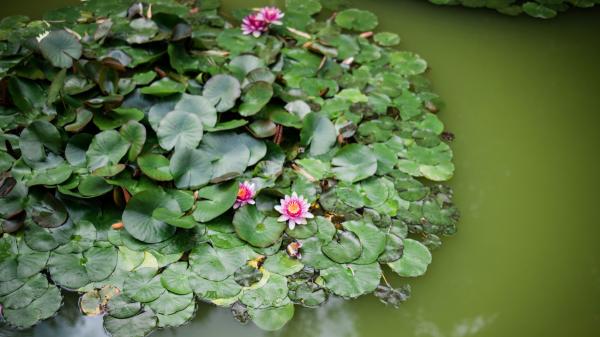
The Johnson family followed, without initially intending it as a scientific experiment, several of these principles. Around the water he incorporated native plant species such as Cephalanthus occidentalis and Pontederia cordatain addition to plants attractive to pollinators. Later he added white water lilies, whose leaves, stems and roots provide shelter and usable surfaces for amphibians and macroinvertebrates.
Studies support the importance of these shelters. Research on 240 urban and 782 non-urban ponds in the UK found comparable numbers of macroinvertebrate species and families between both groups, demonstrating that even ponds in transformed environments can retain considerable diversity.
A work published in 2026 in Diversity and Distributions provides another nuance: after studying amphibians, macroinvertebrates and microorganisms from 32 American ponds for several years, the researchers verified that urbanization modified the composition of the communities, but did not necessarily cause a general reduction in their richness.
Maggie’s Pond alone does not prove that any hole filled with water will become a refuge for biodiversity. It does illustrate a well-established ecological mechanism: creating water, plant structure and shelters opens up a space that different species can colonize. Nine years after that school assignment, where there was mainly grass there is a small food web. And that transformation began with a teenager, a shovel and less than four meters of garden.
If you want to read more articles similar to He dug a small pond in the garden for a school project and 9 years later it has become an ecosystem full of life, we recommend that you enter our Ecosystems category.
