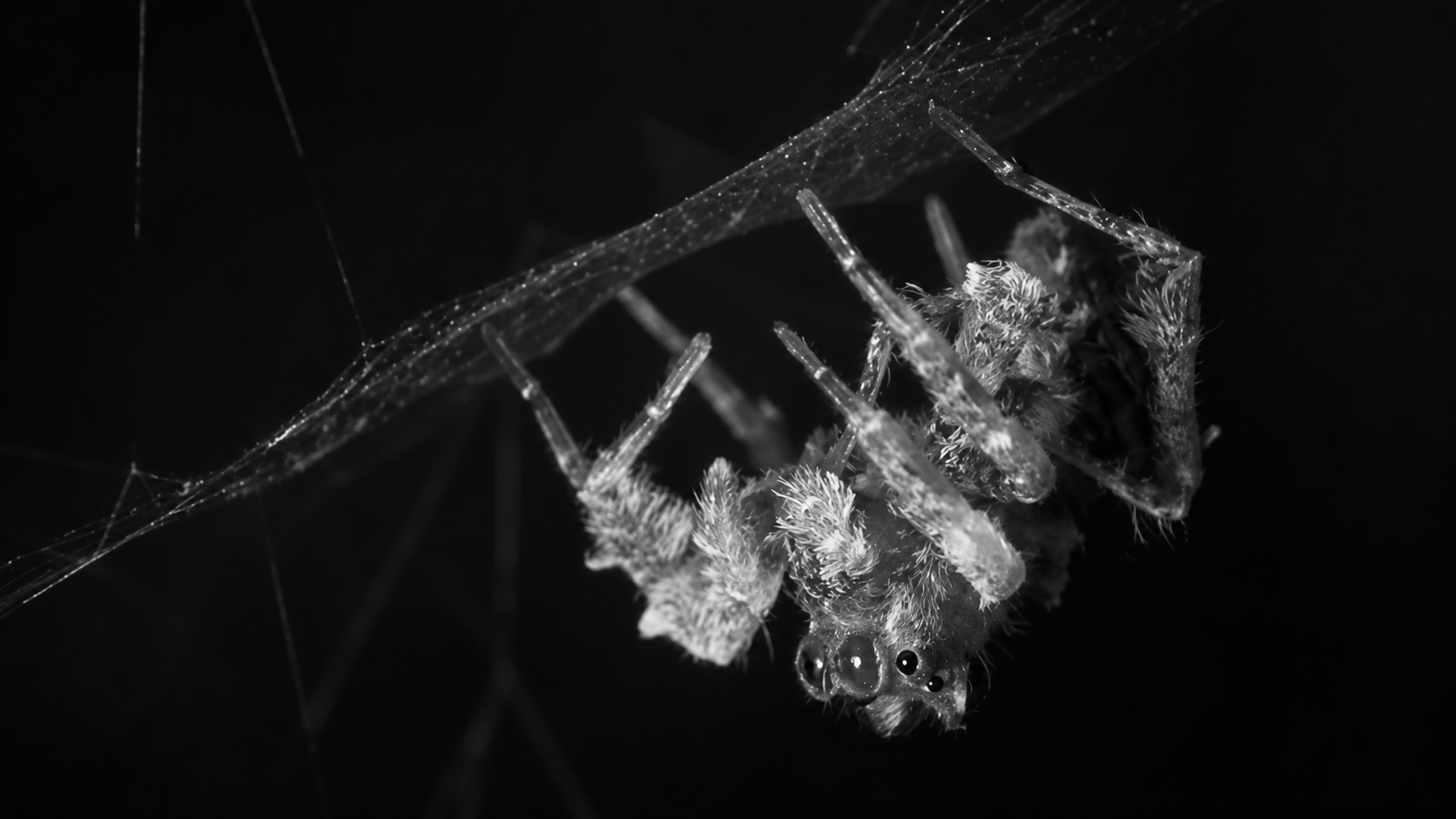
Why do we sleep? Despite being one of the main activities of our day, sleep still remains partly a mystery. Above all, its origins are: when did animals begin to sleep? With what advantages? And why do we continue to do it, if it is true that it is a dangerous activity that leaves us defenseless for hours on end?
One way to find these answers is to look for them in other animals, even if they seem very distant from an evolutionary point of view. An example are spiders: four years ago the news that “perhaps even spiders dream” caused a sensation, and today a study published in PNAS not only confirms this statement, but demonstrates that arachnids also have different sleep phases, including REM sleep.
The sleep of spiders
The 2022 study, conducted by the same team that published the new work, caused a sensation because it was very spectacular: spiders stirring in their sleep like we humans do is not something you see every day. The problem with that study is that it was missing a piece: confirmation that those spiders were actually asleep.
The team therefore focused first and foremost on this detail. To understand more they used spiders of the species Portia fimbriatawhich is part of the Salticidae or jumping spider family: it is considered one of the most intelligent spiders in the world, and is also one of the most studied.
The researchers analyzed the day and night habits of a group of these spiders, each of which was kept in a plastic container “decorated” with everything necessary to imitate its natural habitat, including the duration of light and dark periods.
To understand whether the spiders were actually sleeping at night, scientists used infrared cameras capable of recording even their smallest movements: in this way they were able to identify periods of sleep, characterized by a particular posture very different from that of simple rest.
Even spiders have REM rebound
Observations have confirmed that spiders sleep (and so far…), and that their sleep is not linear but characterized by different phases, similar to that of humans: during deep sleep they reach almost total immobility, but these periods are interrupted by moments of uncontrolled movements of the limbs, mouth and eyes, exactly like us humans when we are in the REM phase.
Even more interesting was their reaction to sleep deprivation: after being forcibly kept awake for an entire night, they were left alone for the next one, during which REM episodes increased by 80%.
The phenomenon is called REM rebound, and it is a way that the body has to compensate for the lack of sleep: it happens to us humans and it also happens to spiders, at least to those of the species Portia fimbriata. According to the authors of the study, it is proof that REM sleep is a physiological necessity that spiders cannot escape. It’s the first time we’ve ever observed REM rebound in an invertebrate, and the discovery brings with it other questions: For example, do spiders dream during REM sleep? Further studies will be needed to find out; in the meantime, however, we have further proof that sleep is a very ancient invention, with evolutionary roots yet to be discovered.
