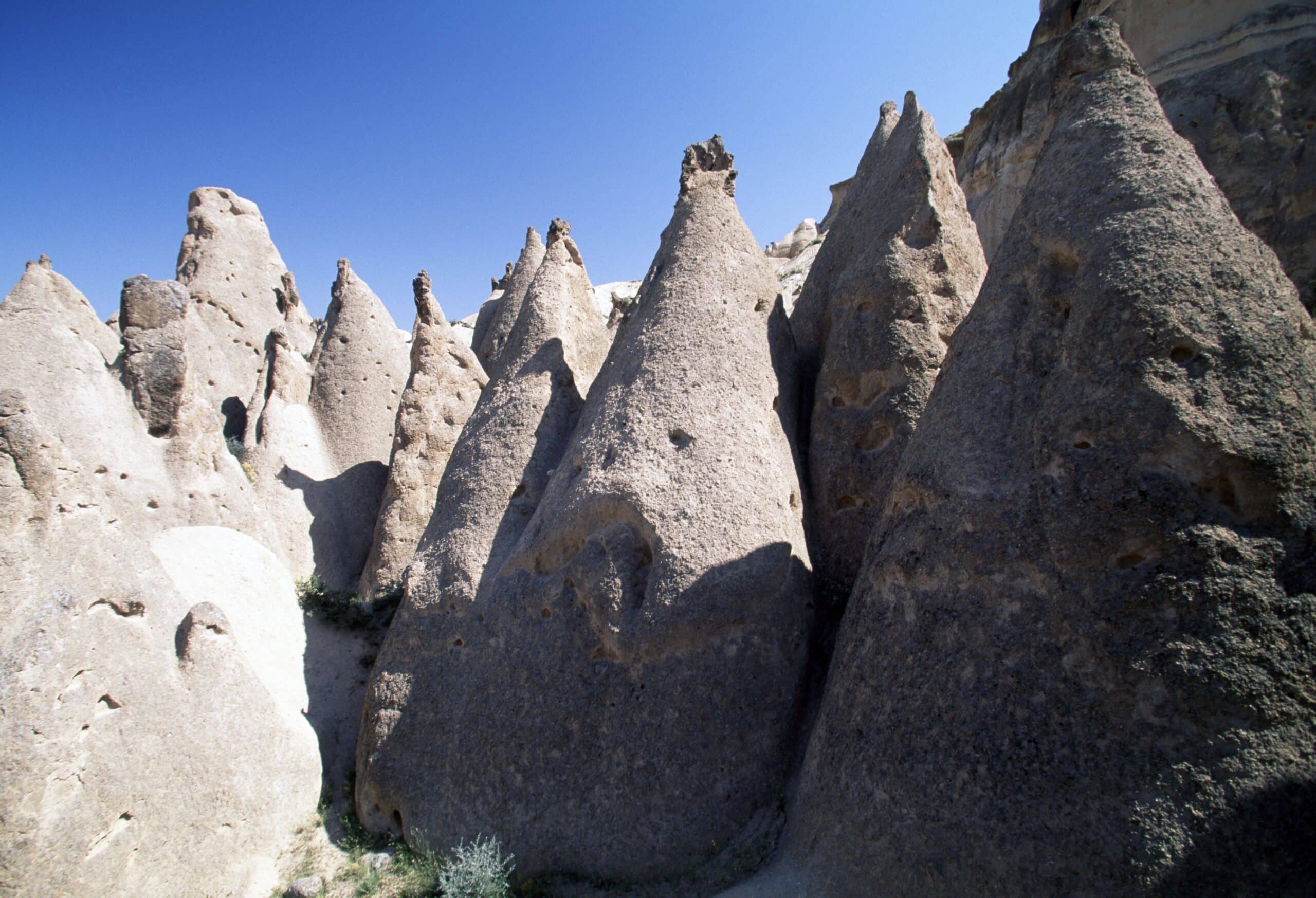
The lunar landscape of fairy chimneys in Türkiye is the result of millions of years of erosive action and now that same action risks destroying them, as happened on Thursday 29 October.
There is still no certainty about the causes of the collapse of one of the fairy chimneys in Cappadocia. According to the region’s governor, Hüseyin Kök, the subsidence was accelerated by the heavy rains that hit the area in recent days. The climate crisis would also contribute to threatening the fragility of these rocky structures by exacerbating alternating periods of drought and violent rainfall. But there is a fact to keep in mind when we talk about one of Turkey’s most iconic tourist destinations: fairy chimneys are an example of an extraordinary geological paradox whereby the same natural processes that created them continue to consume them, causing them to fall and collapse. So much so that last year one of the “hats” was left to collapse without doing anything.
When the collapse occurred
Around 3pm on Thursday 29 October (1pm Italian time) a landslide caused the collapse of a chimney, which was located right at the entrance to the Göreme Open Air Museum, one of the main places to visit the formations. Although it was not a transit area for tourists and pedestrians, two people were unfortunately killed and a third injured. At the moment we don’t know any other details, but it is possible that the rains damaged the structure to the point of facilitating its collapse. Facilitate in this context is a key verb.
The result of erosions and landslides
In Turkish, chimneys are called peri bacaları and they can be admired throughout the central area of Anatolia, a geographical region today entirely included in Türkiye. They give life to an almost lunar landscape which, according to one of the many legends born around these formations, was created by the fairies themselves with the force of their breath. And in fact there is some truth.
But we have to go back to a period between 10 and 30 million years ago, when the Anatolian plateau was characterized by the presence of several volcanoes. Two in particular, Erciyes and Hasan, are still visible today although in a state of quiescence. The frequent eruptions caused the emission of ash, pumice and volcanic fragments and spread them up to a radius of over 100 kilometers. By settling and cooling, this material gave rise to rocks, of variable type and resistance based on the origin: from an explosive eruption mainly tuff was formed, while following lava flows basalt and andesite remained.
Wind and water did the rest
Over time these new rocks have been excavated and shaped by the action of the wind and runoff water, giving life to the famous conical-shaped structures. A study published in Geomorphology he had demonstrated how the appearance of fireplaces depended precisely on the different speeds at which the materials were consumed. The most famous, for example, are also called “mushrooms” due to the presence of a cap, usually harder and more resistant, which protects the underlying rock. In other structures, however, the hats derive from boulders that have detached from the slopes and fallen, depositing themselves on the layers of softer rock.
We have to expect these landslides
Unfortunately, it is not the first time that a collapse has affected one of the chimneys and it will not be the last. Already a couple of years ago some landslides with consequent collapses had been recorded: we are in fact faced with a continuously evolving landscape, fascinating and fragile at the same time.
The air continues to exert its erosive action, while the water penetrates the cracks of the tuff, a highly porous material, and with the first night frosts these small cracks can widen further. Not that it’s new: we’ve known for almost thirty years that humidity and fractures are the two key elements to monitor to preserve the stability of chimneys as much as possible. As if that were not enough, the very morphology of the landscape, with the presence of rocky walls resulting from the stratification of multiple materials, creates favorable conditions for the detachment of boulders and entire blocks.
The collapse we didn’t stop
In 2024, for example, after weeks of evaluations, it was decided not to intervene and not prevent the cap of a chimney from falling in the Paşabağı valley, another rather popular tourist area. A simulation made it possible to estimate the exact point of fall of the rocks and in 2025 a layer of pumice stones was placed on the ground to act as a shock absorber. In this way, the collapse could occur in complete safety. What may appear to be an unexpected decision actually tells us how important it is to understand the natural processes that shape a territory and how it is not always appropriate to hinder them.
We can also expect new lineups
On the other hand, the same phenomena that cause collapses could favor the appearance of new formations. This is suggested by UNESCO, which since 1985 has considered the Göreme National Park and the rock sites of Cappadocia as world heritage sites.
What is being done to protect fairy chimneys
This does not mean that monitoring and protection interventions are not underway, with consolidation and restoration works when possible. In September 2026, the final works were completed which made it possible to secure a total of seven chimneys considered vulnerable, also in the Göreme area.
The protection activities are coordinated by the Turkish authorities, in particular by Kapadokya Alan Başkanlığı, the public body responsible for the management and conservation of the area, which has already declared its intention to continue in this direction. But we must not fool ourselves: unfortunately some of these incredible formations are destined to disappear forever. And perhaps the beauty of this place also comes from its extreme vulnerability.
