
For the CHAPEA mission they were in isolation for over a year to simulate living conditions on Mars and the impact on health and performance.
There is a photo that NASA released on November 2nd. Four people in black hats, sunglasses and overalls stand outdoors, with their arms raised and a beautiful smile. It looks like a party scene and indeed it is. For the first time in over a year, those four breathe air that is not filtered by a habitat system and see a horizon that is not a fake Martian landscape. They weren’t on Mars, though. They were in Houston, in the Johnson Space Center, inside a 3D printed structure. They remained there for 378 days and what they did in there will serve to decide how the first humans will live on the Red Planet.
What is CHAPEA
The full name is Crew Health and Performance Exploration Analog“Crew Health and Performance Exploration Analogue.” It’s a project in which volunteers live and work as if they were really on a mission to Mars, while researchers observe how their bodies and minds react. The goal is not to test rockets or landings, but to study people. According to NASA, the results are used to evaluate the food system and the impact on physical and behavioral health, to decide how to balance risks and resources for a long mission. The second mission, CHAPEA 2, began on 19 October 2025 and lasted 378 days, exactly like the first.
The habitat: a lavacrete house
The “ship” they lived in is a 3D printed home of approximately 158 square meters. It is built with a mixture called lavacrete, a material that recalls the idea of using local soil. It was created by a new generation construction system from the ICON company. The choice of 3D printing has a practical reason: to bring large quantities of construction materials from Earth, to avoid doing so with multiple launches and reaching prohibitive costs. If future settlements can be built with additive technologies, every kilo saved will become a kilo available for more.
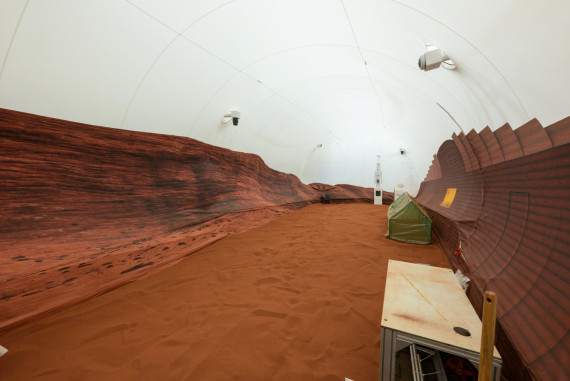
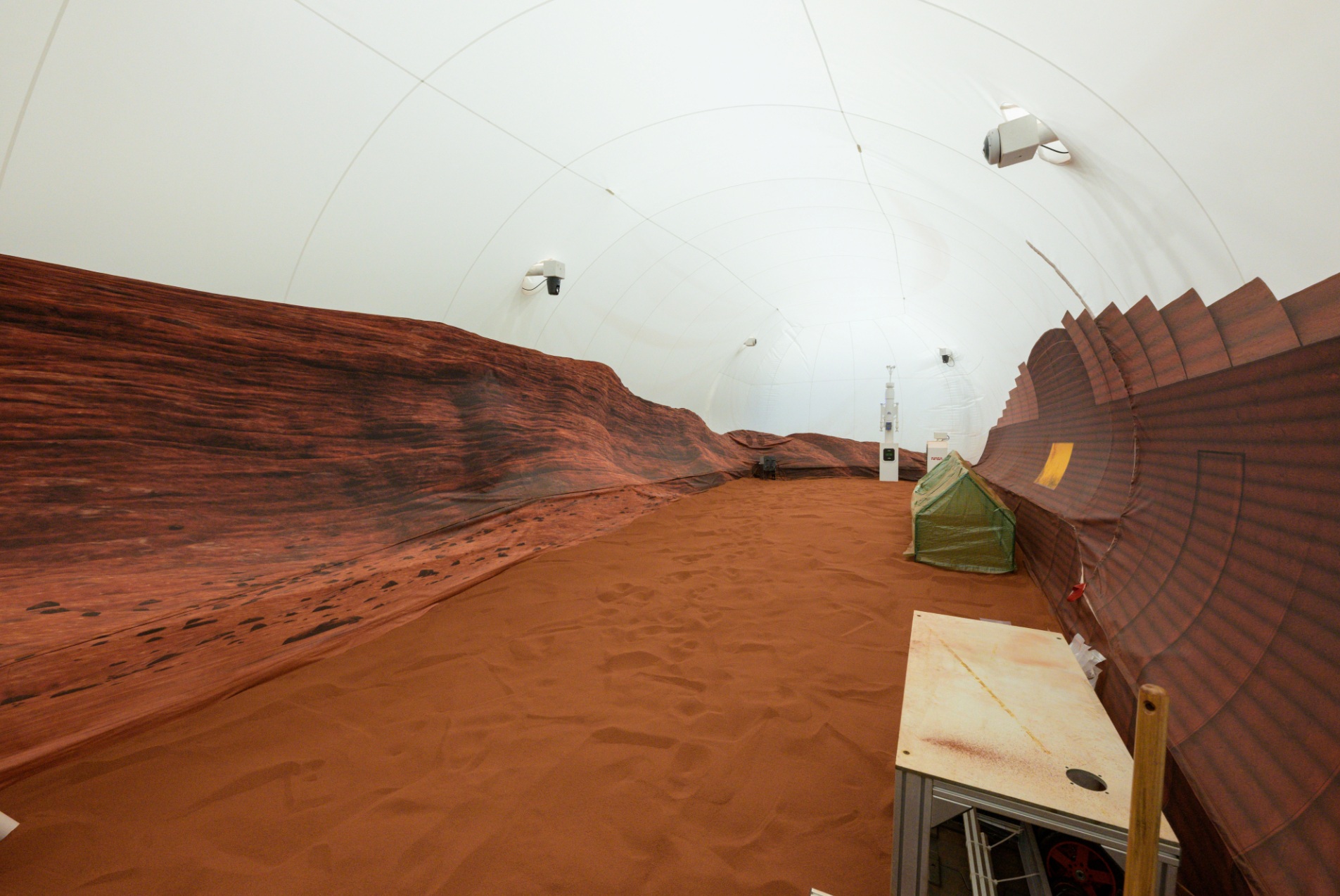
Inside, the structure separates the areas for living from those for working. There are: four private cabins, dedicated workstations, a medical station, common areas, a kitchen and areas for growing food. The four volunteers who lived and worked there had well-defined roles: Ross Elder, commander, James Spicer, flight engineer, Ellen Ellis, medical officer, Matthew Montgomery, science officer.
What they did in 378 days
NASA had structured the long journey with a routine full of activities designed to reproduce life on a long-duration mission. The main ones were these:
Simulated Martian Walks: Several times the crew went out into the simulated sand landscape surrounding the habitat. The images show collection of geological samples, maintenance work on the outside and the procedures for depressurizing the watertight hatch.
robotic operations and maintenance: they operated equipment and repaired faults, including on exercise equipment.
agriculture: in the habitat there is a hydroponic cultivation system. The “astronauts” grew and harvested vegetables. The production of fresh food is one of the great themes of the journey to Mars, for nutrition and psychological well-being.
health and physical performance: physical exercise has played a central role, including exercise bikes and other equipment. Blood samples were taken to monitor the state of health. In one test, a mask measured how well the body used oxygen during exertion.
medical technologies for autonomy: the crew tested a monitoring device that measures blood pressure and other health indicators. He has also participated in demonstrations of AI-based medical systems and training. On Mars there will not be a hospital within reach and this type of instrument could become crucial.
Stress to simulate: distance and unexpected events
The real heart of the experiment was the harsh conditions. NASA lists those that CHAPEA 2 was intended to replicate: limited resources, prolonged isolation, equipment failures and a 22-minute communications delay. That delay changes everything. A question at the control center is answered after almost half an hour, and a smooth conversation becomes impossible. The crew must decide for themselves before they can consult Terra. Halfway through the mission, an episode also occurred that NASA later recounted in a podcast: a simulation of a total communications blackout that lasted two weeks, to understand how one reacts when the wire to home is interrupted.
Not just work
Anyone who has lived with three other people for more than a year knows that work is just part of life. And even during this mission there were moments of leisure: haircuts done in turns, evenings together and musical instruments brought on board in the allocation of personal objects. One image also shows photographs arranged by the crew around a boot print in the simulated Martian sand.
These details have scientific value. Morale, coexistence and the way a group uses its free time are variables as important as the maintenance of systems.
Because it is useful for the Moon as well as for Mars
One point must be underlined. NASA explicitly links the results both to plans for Mars and to the project of a future lunar base (Moon Base). The Moon is the testing ground: many technologies and procedures developed for long-term living far from Earth will be tested there first. With the end of isolation, the less visible part begins, that of data processing. The researchers, including scientific director Grace Douglas, will analyze what they have collected on health, performance, nutrition and group dynamics. At the moment no detailed scientific results of Mission 2 have been published yet, so the real conclusions will come in the next few months. Meanwhile, four people saw the open sky again after 378 days and their year in Houston brought man’s journey to Mars one step closer.
