
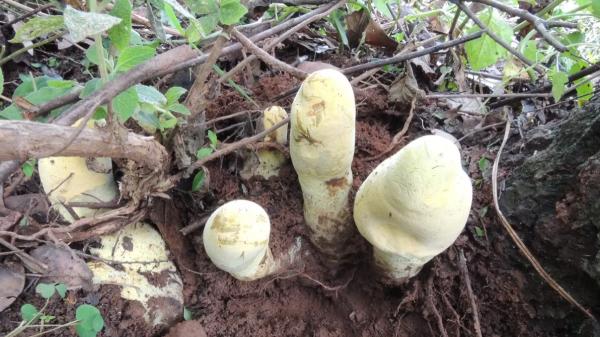
The forests of China have once again surprised scientists with an unusual discovery: a giant mushroom capable of reaching 50 centimeters in height and weighing up to 2.2 kilos. This is a species unknown until now, named Dianjunus rex and nicknamed “D-rex” for its extraordinary dimensions.
But its size is not the only thing that has caught the attention of researchers. Analysis of its DNA suggests that its evolutionary lineage emerged approximately 65 million years ago, shortly after the Cretaceous-Paleogene mass extinction, the event that wiped out non-avian dinosaurs and transformed the planet’s ecosystems.
D-rex, the giant mushroom that reaches 50 centimeters and weighs almost 2.5 kilos
The discovery occurred during several scientific expeditions in the forests of Yunnan province, southwest China. There, researchers from the Kunming Institute of Botany found large whitish structures growing next to the woody roots of Chinese cork oaks.
After collecting samples, studying their physical characteristics and analyzing their genetic information, the team confirmed that they were dealing with a species that had not been previously described. They named her as Dianjunus rexa name that refers both to its imposing size and to the ancient kingdom of Dian.
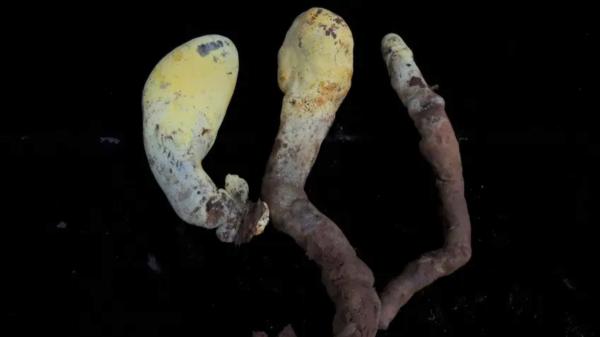
Their vertical reproductive structures, known as stromas, can reach 50 centimeters in height and weigh 2.2 kilos. These dimensions make it the fungus with the largest fruiting bodies known within the group of ascomycetes.
This group constitutes one of the main divisions of the kingdom of fungi and brings together more than 64,000 described species. Unlike the best-known mushrooms, ascomycetes do not produce the typical structures with a cap and foot, but instead release their spores through microscopic sac-shaped structures.
Research has also revealed that D-rex does not simply belong to an unknown species. Their genetic and morphological differences are so important that scientists have had to establish a new genus, Dianjunusand a new family, Dianjunaceae, within the order Xylariales.
Scientists place its evolutionary origin shortly after the extinction of the dinosaurs
One of the most surprising results of the study has to do with the antiquity of their lineage. To calculate it, the researchers used a technique known as a molecular clock, which makes it possible to estimate when different groups separated evolutionarily based on the differences accumulated in their DNA.
By comparing the genetic material of D-rex with that of hundreds of fungi, scientists estimated that the Dianjunaceae family emerged about 65 million years ago. This places its appearance approximately one million years after the Cretaceous-Paleogene mass extinction, which occurred about 66 million years ago.
The temporal coincidence raises an interesting hypothesis. After that extinction, terrestrial ecosystems experienced profound changes and forests were able to accumulate large amounts of dead plant matter. This transformation would have generated new opportunities for organisms specialized in decomposing wood.
Researcher Indunil C. Senanayake, corresponding author of the study, suggests that these environmental changes could have favored the diversification of decomposing fungi associated with wood.
However, scientists have not proven that the extinction of the dinosaurs directly caused the appearance of this family. This is a possible evolutionary relationship that needs further investigation.
Why does this fungus grow so much? Its size could help it disperse spores
Another question raised by the discovery is why D-rex develops such large reproductive structures. Before it was found, the tallest known fruiting bodies among ascomycetes measured approximately 20 to 30 centimeters. The new species far exceeds those dimensions.
One of the explanations that the team is considering has to do with reproduction. By rising above vegetation and organic remains in the soil, their structures could make it easier for air currents to transport their spores over greater distances.
This advantage could be especially useful in dense forests, where vegetation makes dispersal difficult. However, developing a structure of such size also involves a significant expenditure of energy. Therefore, the researchers consider that this characteristic would only have been advantageous if the benefits for reproduction outweighed the cost of producing it.
Additionally, scientists believe that D-rex could use enzymes to break down the complex components of dead wood for nutrients, an ability known in other fungi in the order Xylariales.
China’s forests could hide more unknown mushroom species
The discovery also highlights how much remains to be known about fungal biodiversity. The subtropical forests of Yunnan bring together a wide variety of habitats, relatively stable climatic conditions and numerous interactions between organisms, factors that favor the diversification of species.
Despite this, many of these ecosystems remain poorly studied from the point of view of fungal diversity. The difficult-to-access terrain, the seasonal appearance of fruiting bodies, and the small size or discreet nature of many species complicate their identification.
Researchers hope that new expeditions will lead to the discovery of other unknown fungi and a better understanding of how they have evolved. D-rex demonstrates that organisms with extraordinary characteristics can still appear even in biological groups that have been studied for decades.
If you want to read more articles similar to A giant 2.2 kilo mushroom discovered in China: it measures 50 centimeters and its origin dates back to 65 million years ago, we recommend that you enter our Biodiversity category.
