
Its yellow flowers, sweet aroma and ability to grow quickly have made the mimosa a very recognizable ornamental tree. Every winter, its clusters of small flowers illuminate gardens, parks and paths, especially in northern Spain. However, behind that image lies an environmental problem: it is an invasive exotic species capable of colonizing altered lands and making the recovery of native vegetation difficult.
Originally from Australia and Tasmania, it arrived in Europe in 1824 to be used in gardening. Since then, it has spread throughout different regions of the Iberian Peninsula, becoming a common presence in some landscapes. Its ability to resprout after fires and germinate from seeds that remain in the ground for years explains much of its success.
The mimosa came from Australia to decorate gardens with its yellow flowers
The mimosa, whose scientific name is Acacia dealbatais an evergreen tree native to southeastern Australia and Tasmania. It was introduced to Europe for its ornamental value, thanks to an abundant and striking flowering that appears during the winter and the first months of spring.
Its flowers are grouped in small intense yellow spheres, gathered in clusters. Added to this is the aroma they give off and the contrast with their green leaves, thin and divided into numerous leaflets. It can reach around 15 meters in height and grow quickly, making it attractive even when planted in large spaces.
These characteristics explain why it was frequently used in gardens and parks. It has also been used to fix slopes on roads and other infrastructure. However, the same qualities that facilitated its expansion as an ornamental tree have contributed to it becoming a problem for the ecosystems where it is established.
The Spanish Catalog of Invasive Exotic Species of MITECO includes their presence in different areas of Spain, including Galicia, the Cantabrian coast, western Castilla y León, Extremadura and western Andalusia. Its introduction into Europe has been documented since 1824, although it is not known exactly when it arrived in Spain.
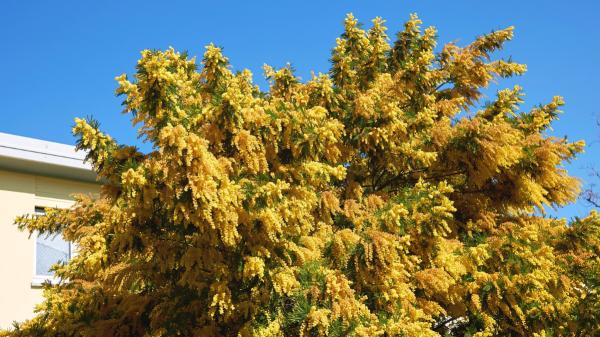
Galicia is one of the territories where it has spread the most
The mimosa is widely naturalized in Galicia, where it occupies low and middle areas of the region. According to MITECO, it can be found up to about 600 meters above sea level and is part of the landscape of numerous places.
Its presence is also explained by its ease of establishing itself in altered terrain. Where natural vegetation has disappeared or been weakened, mimosa can grow quickly and occupy the available space before other native species can recover.
The problem is not limited to new trees appearing in the environment. When it forms dense stands, it competes with local vegetation and can reduce plant diversity. The ministerial catalog itself warns that under its canopy a good part of the vegetation can disappear, which impoverishes plant communities.
In addition, mimosa can modify soil conditions and reproduce by seeds and by the regrowth of its vines and roots. Therefore, cutting a specimen is not always enough to eliminate it: if there are structures capable of producing new shoots or seeds, the plant can grow again.
This expansion capacity turns its control into an environmental management challenge. It is not only about removing visible trees, but also about preventing populations from re-establishing themselves and spreading to nearby areas.
Why fires favor the expansion of mimosa
One of the most worrying aspects of this species is its ability to take advantage of the conditions left after a forest fire. Fire can favor its subsequent expansion and give it an advantage over other plants.
The key is in two characteristics: its seeds can remain dormant in the soil for a long time and high temperatures can stimulate their germination. Once the ground is cleared, new plants encounter less competition and can develop quickly.
Added to this is its ability to resprout after fire. While some native species need time to regenerate from seeds or recolonize an area, the mimosa can grow back and occupy the land quickly.
The result is a process that can make it difficult to recover the original ecosystem. The species takes advantage of the spaces opened by disturbances, forms new populations and competes with the plants that should reoccupy the place. MITECO identifies precisely its ease of germination and resprouting after fires as one of the factors that explain its invasive success in Galicia.
Therefore, the risk does not simply consist of the tree being present in a forest, but rather that it may alter the regeneration of the vegetation after a disturbance. Fire prevention and conservation of natural vegetation cover in good condition are important measures to reduce opportunities for the expansion of this species.
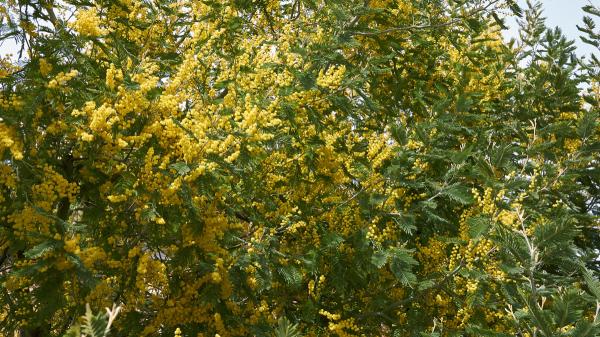
How can this invasive species be controlled?
Mimosa eradication is difficult and expensive, since actions must be maintained and repeated for long periods. Eliminating adult specimens does not guarantee that it will disappear from an area if there are seeds in the ground or roots capable of producing new shoots.
For this reason, MITECO recommends avoiding its use in gardening and maintaining natural vegetation in good condition. When it is already present, the control method must be adapted to the terrain, the size of the population and the possibilities of accessing it.
Among the options contemplated in the ministerial catalog are mechanical methods, which may include the extraction of the plant with its strain when viable. In certain cases, localized treatments on the stumps are contemplated, which must be carried out in a controlled manner and in accordance with the applicable technical indications.
Subsequent surveillance is also essential to detect new outbreaks and prevent the population from spreading again. If interventions are stopped too soon, surviving individuals can regain ground.
The history of the mimosa shows how a plant introduced for ornamental reasons can end up being an invasive species and generate ecological consequences very different from those expected. Its yellow flowers are still striking, but its presence in the natural environment requires distinguishing between its decorative value and its impact on biodiversity. In this case, avoiding new plantations and controlling existing populations is essential to protect native vegetation and promote the recovery of spaces affected by fires.
If you want to read more articles similar to It arrived in Europe in 1824 to decorate gardens and today it is an invasive species: the tree with yellow flowers that expands after fires, we recommend that you enter our Biodiversity category.
