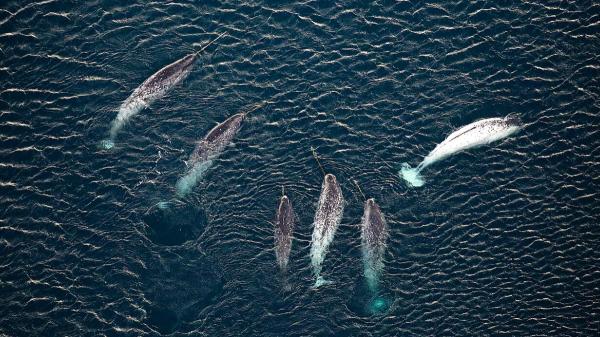
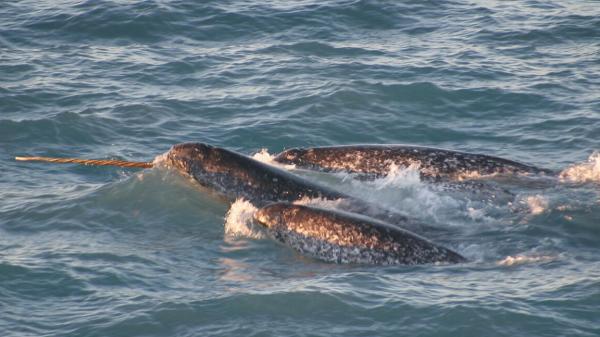
Narwhals, cetaceans known for their characteristic spiral-shaped tusk, have made it possible to discover a worrying transformation in the depths of the Arctic Ocean.
Equipped with scientific sensors, six narwhals collected information in areas of Greenland virtually inaccessible to research ships. The results confirm that the relatively warm waters of the Atlantic are increasingly penetrating into the fjords and reaching the fronts of large glaciers.
The research, published in August 2026 in the scientific journal Science Advances, provides new evidence about a phenomenon known as Atlanticification, which is modifying the conditions of the Arctic Ocean. Its consequences may extend far beyond Greenland, because the warming of deep waters favors the loss of continental ice and contributes to sea level rise.
Narwhals reveal how far the warm Atlantic water is reaching
The scientific team, made up of researchers from the Greenland Institute of Natural Resources, the University of Copenhagen and other institutions, placed measuring instruments on six narwhals that inhabit the Scoresby Sound fjord system in eastern Greenland.
Between 2017 and 2020, the animals carried out dives that allowed them to obtain 2,060 temperature, salinity and depth profiles. Some descended to more than 1,500 meters, while the devices remained installed for periods of between 85 and 332 days.
The information was combined with historical oceanographic records, some from the late 19th century. The results showed that Atlantic waters are reaching basins located up to 300 kilometers into the fjords.
The discovery is especially important because these regions remain covered in ice for much of the year. The narwhals were able to obtain measurements in places where scientific ships find it extremely difficult to navigate.
The researchers verified that the Atlantic water layer, warmer and saltier, is increasing its presence, while the upper layer of polar water, colder and less saline, is losing thickness. In certain basins, the Atlantic influence predominates below 250 meters.
How warm water speeds up glacial melting
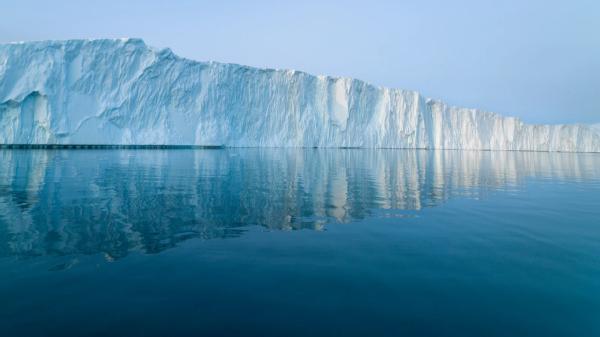
The main danger lies below the surface. Glaciers that flow into the sea have large submerged ice fronts and can lose mass when they come into contact with relatively warm waters.
As NASA explains in its Oceans Melting Greenland project, deep currents transport thermal energy to the bases of the glaciers. Additionally, fresh water from melting ice can rise and drag warmer salt water toward the ice, intensifying underwater melting.
This process can weaken glacial fronts, favor the calving of icebergs and contribute to ice retreat. The depth of the fjords is decisive: some underwater reliefs block warm currents, while others allow them to advance to the glaciers.
The new research identifies greater exposure in areas such as Scoresby Sound and Kangerlussuaq. It also finds a relationship between elevated deep-water temperatures and increased summer discharge of icebergs.
However, scientists caution that it is still necessary to quantify how much of each glacier’s retreat can be attributed specifically to ocean warming.
Greenland melting threatens coastlines around the world
Greenland is home to the second largest mass of continental ice on the planet, after Antarctica. Its progressive loss constitutes one of the main concerns of climatologists due to its repercussions on the oceans and coastal regions.
Data from the Copernicus Climate Change Service indicate that Greenland lost approximately 139 billion tons of ice during the 2025 hydrological year, enough to raise the global mean sea level by about 0.4 millimeters.
The European body also points out that, if the entire Greenland ice sheet disappeared, sea level could rise by around seven meters. This is an extreme scenario that does not represent a forecast for this century, but it illustrates the importance of preserving this gigantic reservoir of frozen water.
The rise in sea level aggravates coastal flooding, favors beach erosion and can facilitate the entry of salt water into aquifers. Its effects also reach Spain, especially the low-lying and densely populated coastal areas.
Fresh water from melting ice can alter large ocean currents
There is another risk that worries researchers: the incorporation of large quantities of fresh water into the North Atlantic, capable of modifying the salinity and density of surface waters. These changes can affect ocean circulation, although the new study on narwhals does not in itself demonstrate an alteration of the great Atlantic currents.
The Intergovernmental Panel on Climate Change (IPCC) warns that ocean warming and the loss of land ice are two fundamental factors of sea level rise.
Greenland gains strategic importance as ice retreats
Greenland’s warming also has geopolitical consequences. The island, an autonomous territory belonging to the Kingdom of Denmark, has become an object of strategic interest for the United States. Donald Trump has reiterated his intention to control this territory, essential for its position between North America and Europe and for its mineral resources.
In October 2026, the US president announced plans to boost oil, gas and mineral exploration, while in November the Greenland Parliament ratified an agreement that expands the US military presence.
The retreat of sea ice can facilitate certain trade routes and economic activities in the Arctic, although the exploitation of its resources continues to pose enormous technical and environmental challenges. Thus, the same warming that threatens glaciers is transforming the strategic value of an increasingly disputed region.
The information obtained by the narwhals will allow us to better understand all these processes and improve climate projections. The discovery also demonstrates the value of using marine animals to investigate regions that are difficult to access. Thanks to their dives, scientists have been able to observe a phenomenon that remained partially hidden under the ice and that can accelerate the transformations of the Arctic.
If you want to read more articles similar to Six narwhals dived to more than 1,500 meters and revealed a hidden threat beneath the Greenland glaciers: the warm water of the Atlantic is already reaching them, we recommend that you enter our Climate Change category.