
What makes a toy truly educational? Let’s discover the features that make the difference through the concrete example of a gaming system designed to truly accompany children’s growth
This article is sponsored by Ravensburger. Here you will find a more comprehensive explanation.
There are toys that immediately capture attention but within a few days end up forgotten in a corner. There are others, however, who return to the game again and again, managing to accompany children through the different phases of their growth without losing meaning.
The difference between the two categories lies not so much in the quantity of stimuli they offer, but in the quality of the experience they make possible.
A well-designed toy allows children not to limit themselves to passive use but to continually explore and reinvent it. It is precisely this process of active discovery that makes the gaming experience truly educational, allowing children to develop cognitive, motor and emotional skills, train concentration and problem solving and nourish imagination and autonomy.
But what characteristics allow a toy to truly accompany children’s growth? Let’s find out below by also analyzing a concrete case.
Leave room for exploration
Children learn profoundly when they can act on the environment, have concrete experiences, repeat, experiment, make mistakes and find new solutions. And this is precisely why not all toys offer the same evolutionary possibilities.
Games that leave little room for the child’s initiative and that direct action in a rigid and preset way reduce play to a predominantly passive experience. However, the case of those that allow children to actively intervene, experimenting, building, modifying and imagining ever new possibilities is different. This game mode allows the child to learn independently through free exploration.
Modular play systems such as BRIO World’s wooden railway tracks fall precisely into this second category. Paths designed to leave room for exploration and creativity and ensure that the child does not simply observe what is happening, but actively participates, planning, creating connections, solving problems and building meanings through play.
A precise idea of a child: competent, active, capable
A truly educational toy is therefore based on a precise idea of the child: competent, curious, active and protagonist in the construction of his own experience.
This can be observed very well in open and modular games. Let’s think, for example, of a little girl who builds a railway route: at the beginning she connects a few pieces in a random way, then she tries to create continuity between the tracks, she notices that a curve doesn’t match, she dismantles a part, she tries again, she adds a bridge, she moves a station, she imagines a new direction for the train…
Even though from the outside it may seem like a simple activity, the little girl is intensely training her planning skills, motor coordination, spatial orientation, divergent thinking and imagination. And, even more importantly, he is experiencing the sensation of being able to concretely impact reality and modify it through his own actions.
In this way the game transforms into a real tool of empowerment, helping children to perceive themselves as capable and effective.
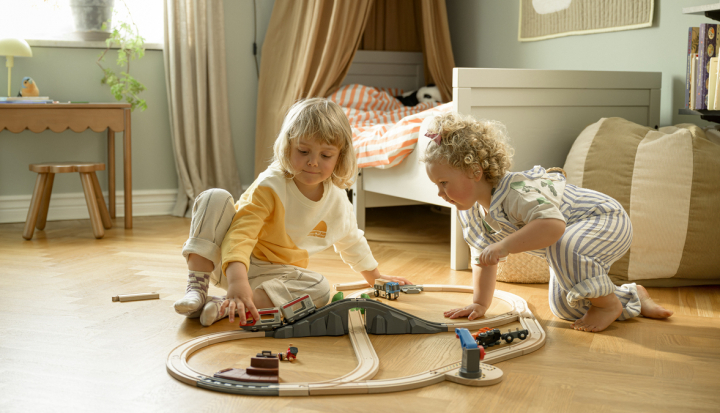
BRIO World play systems support the progressive growth of little ones because they allow the game to be expanded based on the interests and skills of each child: they do not force the little one to follow a single path, but provide a clear structure within which they can imagine, build, modify and start again freely.
And this doesn’t just make a difference for children, but also for parents! When a material really leaves room for the little one’s initiative, the adult does not have to constantly entertain or direct the game but can take on a more discreet role, offering presence and trust and intervening only when needed.
Security as a condition of freedom
When it comes to choosing play materials for preschool boys and girls, it is not possible to separate the issue of autonomy from that of safety. In fact, a child can explore freely only when the environment and objects available to him have been carefully designed.
In this sense, safety is not just a technical aspect to be checked at the end of the production process, but represents a real design choice.
Designing safe play materials means asking yourself from the beginning how children will use that object, what gestures they will make with it, how that game will evolve over time and can be shared with other children and what circumstances may occur during play.
This is especially important in preschool, when play does not always follow a linear or predictable direction. In this phase children act with their whole body, move objects, combine them and sometimes use them in ways that the adult had not imagined. To be truly well designed, a toy must be able to support this freedom without turning it into a source of constant worry!
In BRIO World systems, for example, attention is paid to the absence of small parts in all game elements not only as a response to a safety standard, but also as part of a design that considers the real life of families. In domestic environments, spaces are often shared. Brothers and sisters of different ages get closer, observe, imitate and act each in their own way. If a material is designed to address this complexity, play can occur more calmly and the adult can offer confidence without having to monitor every movement.
In this way, security does not limit autonomy, on the contrary, it makes it possible. It creates the conditions so that children can explore, try, make mistakes and try again within an adequately protected environment, where play represents first and foremost a source of discovery, pleasure and growth.
Quality: what lasts accompanies growth
Another aspect that is often underestimated when choosing toys concerns their durability. Today many objects designed for children seem designed to be desired, purchased and replaced in a short time, rather than to accompany them on their growth path.
However, games capable of lasting over time have a special value, particularly on an educational level. They help reduce the phenomenon of waste and allow children to revisit the same experience several times, approaching it each time with new skills, new questions and new possibilities for action, stimulating imaginative and open play.
A railway path built by a 3 year old child, for example, will not be the same as one built by a 4 or 5 year old. At the beginning the child will focus mainly on connecting the tracks, and then gradually move on to building increasingly more complex scenarios.
At a later time, narration, collaboration with other children and the planning of more complex projects will also appear in the game. The toy, therefore, remains the same, but the experience is transformed and increasingly enriched.
The quality of game materials is therefore more than an aesthetic issue, but also has to do with the educational aspect. A sturdy toy, well made, pleasant to handle and capable of withstanding daily use implicitly communicates to the child that what he is using and what he is doing has value.
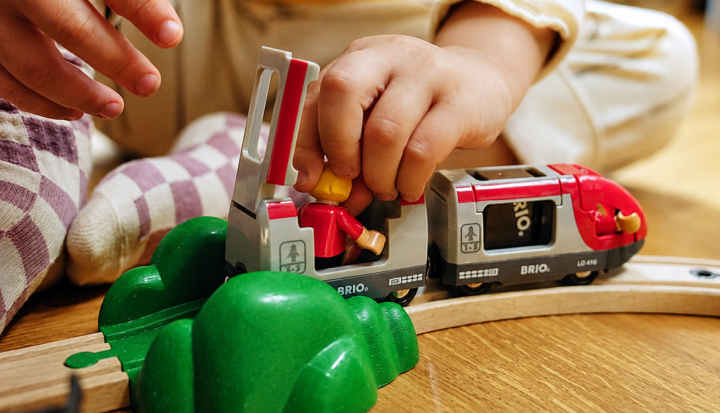
In the case of BRIO World systems, the choice of materials such as wood, metal and resistant plastics and the desire to maintain high compatibility between systems over time are designed precisely to ensure that the game does not end in a single package, but can gradually grow together with children and their families. A toy capable of lasting over time, which does not easily lose its meaning and which can be handed down from one child to another tells of a different approach to childhood, less focused on the incessant accumulation of new objects and more attentive to the quality of the experiences that those materials make possible, to the care with which they are chosen, used, preserved and, one day, entrusted to others.
Choose less, choose better
This idea of care naturally leads to the theme of responsibility: that of families, who choose which objects to allow into children’s daily lives, and that of those who design those games, selecting materials, processes and solutions capable of supporting safe, long-lasting and conscious use.
In the BRIO World systems, this attention is manifested in the choice of quality materials, in the use of FSC certified wood and in the compatibility between the different elements, designed to grow together with children and accompany them along different stages and skills.
Naturally, no toy alone can address the issue of sustainability, but every daily educational choice can orient itself in a direction more or less in line with the values we want to transmit to children.
Choosing few materials, well made, safe, open and capable of accompanying multiple stages of growth also means teaching care, continuity and responsibility.
Not just toys, but possibilities for growth
A well-designed toy stands out precisely for this: it does not pretend to replace children, nor does it rigidly guide their actions. Instead, let them have space. It gives them opportunities to interact with the material starting from their own questions, their own interests and their own time. Opportunity to experiment, to make mistakes, to correct yourself and try again.
For this reason, when choosing a toy for our children, the most useful question to ask is not so much: “What does he do?”but: “What does it allow the child to do?”. Does it allow him to act actively, to imagine, to build, to concentrate and to feel capable?
From this perspective, game systems like BRIO World offer an interesting example of growth-focused design. They are open materials, perfectly combinable with each other and resistant, designed not to run out in just one way but to accompany the child over time, supporting autonomy, creativity and confidence in one’s own abilities.
The best games are those that open up possibilities, keep the pleasure of discovery alive and accompany boys and girls on their growth path, developing their fine motor skills.
