
They are among the games most loved by children of every generation, as they allow them to build, imagine and shape small worlds to explore. But what characteristics should a railway circuit have to truly accompany growth and discovery?
This article is sponsored by Ravensburger. Here you will find a more comprehensive explanation.
Some games are able to resist time and fashion, are able to speak to different generations and have an immediate, almost universal appeal on boys and girls. Among these we certainly find trains, apparently simple play objects, but which in the eyes of little ones contain an extraordinary wealth of possibilities.
Part of their charm comes from the fact that the train is an object close to real life, easily recognizable even by the little ones, but at the same time it opens the door to different game scenarios every time. A train can set off on a long journey, stop at the station to pick up and drop off passengers, transport animals or materials, cross bridges and overcome obstacles. Inside a railway circuit, children rediscover aspects of the world they know and have the opportunity to transform and guide them according to their imagination.
A “small world” to lead
For a young child, the world around him is interesting but also very complex. Many things happen every day that he cannot yet fully predict or control: times and movements are decided by the adults in question, objects function according to rules yet to be discovered, events follow one another with a logic that is not always easy to understand. And the game can become a precious key to begin to orient yourself in this complexity!
By playing, boys and girls can relate things, create connections, discover that every action has a consequence. Through a railway circuit, such as those of BRIO World, they can for example experience how, by adding an extra track, the train’s route lengthens, or that by inserting a curve its direction changes or even that, by inserting a switch, the train can take a different route. It is, after all, a “small world” with a precise logic, which children can understand, guide and, above all, continuously modify.
A game that helps you feel competent
One of the reasons why playing with trains maintains such a strong appeal over time lies precisely in the way in which it responds to a profound need of young children: the need to exercise a certain control over the experience.
Adults often associate the need for control with something rigid: wanting to decide everything, not wanting to accept changes, struggling when faced with unexpected events. In young children, however, the need for control is something absolutely physiological and linked to growth and finds one of its most natural spaces of expression in play.
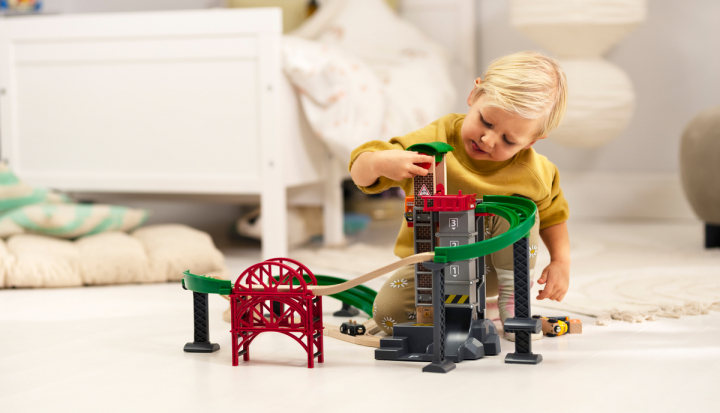
The train circuit offers a clear structure, made up of tracks, curves, stations, bridges and switches, but within which the child can freely exercise his own “direction”. He can lead the game as he wishes, plan, make decisions and solve unexpected events, thus strengthening his self-esteem and sense of self-efficacy. From a pedagogical point of view, playing with BRIO World trains offers boys and girls an orderly but not rigid system, understandable but not poor, with rules but at the same time full of possibilities. For the game to proceed it is necessary that the tracks match and that the precise function of some elements is understood and respected, but within this framework the child has full control of his own actions. He can shape the route, decide where the train will go, what will happen along the journey, observe the effects of his own choices and discover himself, one step at a time, more and more capable.
Through a simple and concrete experience, boys and girls experience being able to impact the world through their decisions and actions and can feel competent and capable.
Intelligent details that support thought
In the case of BRIO World wooden railway circuits, children are not faced with a toy that does everything by itself but with a system to understand, build and continually modify.
Each of its elements implies a precise action: a track suggests a connection, a curve allows you to change the direction, an exchange allows you to choose between two paths, a magnet allows you to attach the load through an intuitive mechanism that the child quickly understands and masters, a bridge or a tunnel transform the space and make the journey more complex.
All the elements are concrete and easy to use and at the same time precious for the development of thinking, as they invite boys and girls to observe, make hypotheses, make attempts and find solutions to unexpected events.
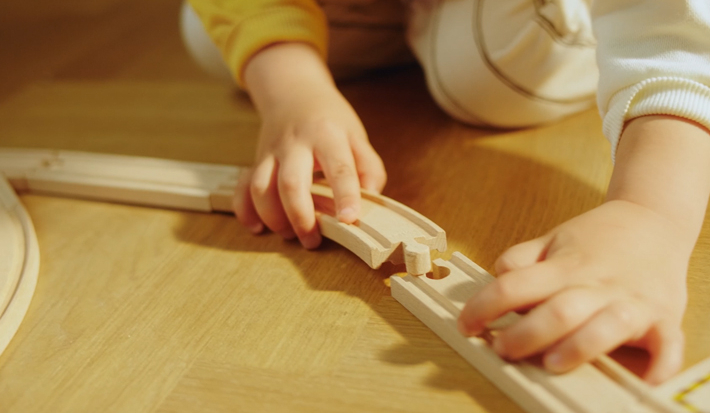
To be able to join two tracks, for example, the child must observe the shape of the pieces, then he must understand which way to turn them, try to bring them closer and, finally, check if they actually fit together. While the hands act looking for the joint, the gaze guides the movement and the thought anticipates the result. What if the piece doesn’t fit? In this case the child must work hard to find a different solution and make his project work.
An apparently simple action such as joining some wooden tracks allows not only to train fine motor skills and hand-eye coordination, but also to develop logical and divergent thinking.
In fact, any error does not completely block the game. A track inserted backwards or a path that does not close become signals to be read. The child immediately sees that something is not working and can intervene, try again and start again. The solution therefore remains within his reach and this makes the experience challenging but not frustrating. This is also why carefully designed wooden railway systems, such as BRIO World, are able to offer challenges suited to children’s abilities without taking away the pleasure of discovery.
It is precisely this richness hidden in simplicity that makes the toy train game such an interesting game from an educational point of view. As they build each path, children are also building confidence in their abilities.
A world that grows with children
Another reason why toy trains continue to interest children over time is that they do not remain tied to a single stage of development. Indeed, it is a game that grows together with the child because it can be experienced in ever new and different ways depending on age, skills, interests and curiosities of the moment.
A 3-year-old, for example, will focus mainly on the motor action of joining some tracks together, connecting the carriages and making the train move back and forth.
Step by step, however, the game begins to expand. As the child grows, he will begin to plan increasingly longer routes, adding curves, climbs, descents and tunnels, causing unexpected events to appear, which will be followed by the search for new solutions. Now it no longer moves the train just for the motor pleasure of making it slide, but with the aim of reaching a specific destination, delivering something, transporting someone, etc.
Over time, the child begins to weave real stories, with the appearance of increasingly rich and complex characters and situations. Through the circuits of the train, he no longer limits himself to building a structure in space, but creates a small world within which he can give shape to his own questions, his own interests and his own experiences. The material is always the same, familiar and for this reason reassuring, but the experience changes.
Playing with trains, therefore, accompanies boys and girls on a journey of discovery that grows together with them. From a simple concrete experience of construction and movement it becomes, over time, an opportunity to plan routes, resolve unexpected events, imagine stories, journeys and adventures.
And perhaps it is precisely this ability to combine simplicity and richness, concrete action and imagination, rules and freedom, that makes the Brio World train a game so resistant to fashion and time.
