
Few industries are as associated with the development of modern societies as cement. Roads, bridges, homes, hospitals or energy infrastructures depend on a material whose production exceeds 4,000 million tons annually worldwide.
But this success has a considerable environmental counterpart: cement manufacturing is responsible for approximately 7% to 8% of global CO₂ emissions, a figure comparable to that of some of the most polluting countries on the planet.
Reducing that carbon footprint has become a priority for researchers, companies and governments. Now, a study led by MIT scientists provides an important piece to solve that puzzle.
The work, published in June 2026, explains in detail a phenomenon that until now was incompletely known: why the injection of carbon dioxide during cement mixing allows carbon to be stored and, at the same time, increase the mechanical resistance of the material.
How CO₂ can make cement stronger
The idea of using CO₂ in concrete manufacturing is not completely new. For years there have been carbon mineralization technologies that introduce this gas into fresh cement mixtures so that it reacts chemically and is trapped in the form of calcium carbonate.
The novelty of the MIT study is that, thanks to advanced real-time Raman spectroscopy techniques, researchers have managed to observe for the first time what exactly happens during the first moments of that chemical reaction.
The results show that carbon dioxide is not limited to filling gaps within the material, as was partly believed until now. It actually triggers a different chemical sequence in the cement hydration process.
This transformation alters the internal microstructure of the material and favors the formation of compounds that improve its mechanical behavior. As a consequence, the trials carried out recorded increases in early resistance close to 13%.
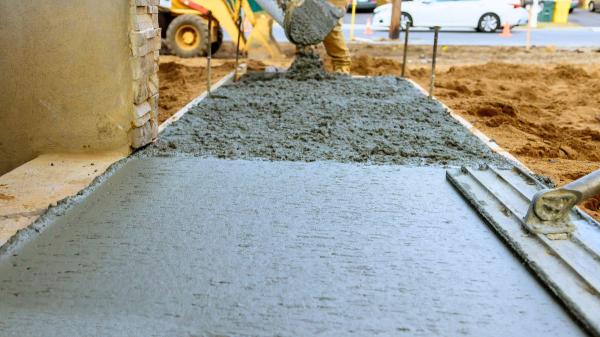
The great challenge: reducing the emissions of an industry responsible for 8% of the world’s CO₂
One of the main problems with cement is that a very significant part of its emissions does not come from the energy used in factories, but from the chemical reaction itself that transforms limestone into clinker, the basic ingredient of Portland cement. Even if all cement factories ran on renewable energy, huge amounts of CO₂ would still be produced during that process.
Any technology capable of capturing part of that carbon and storing it permanently within the material itself arouses enormous interest.
Previous research has shown that some CO₂ injection systems can sequester significant amounts of carbon without compromising the structural performance of concrete.
A rigorous scientific study published in 2024, for example, concluded that certain cement carbonation processes allow up to 45% of the CO₂ used during the treatment to be stored while maintaining the final resistance of the material intact.
The MIT work now provides a more solid scientific explanation of why this phenomenon occurs and why, under certain conditions, the result can even exceed the mechanical performance of conventional concrete.
The future of low-carbon concrete still faces challenges
The research also fits into a broader trend that seeks to transform concrete from a climate problem to part of the solution. MIT itself recently published another study in which it quantified for the first time the capacity of buildings and infrastructure to reabsorb carbon dioxide throughout their useful life through natural carbonation processes.
According to their calculations, the cement present in American buildings absorbs more than 6.5 million tons of CO₂ annually, an amount equivalent to about 13% of the process emissions generated by cement manufacturing in the country.
In Spain, where the debate on the decarbonization of construction is gaining weight, several lines of research are advancing in the same direction. Researchers from the Polytechnic University of Madrid have been working for years on strategies to reduce the carbon footprint of buildings and infrastructure through more efficient designs, the use of cements with lower clinker content and new structural solutions that reduce material consumption.
The UPM Civil School has recently hosted specialized meetings on the future of low-carbon concrete. During one of those days, sector experts recalled that construction will continue to need large volumes of concrete for decades, so the key is not only to replace materials, but also to make what is already used much more sustainable.
MIT researchers insist that significant challenges remain before these techniques can be widely implemented. It is necessary to adapt industrial processes, optimize costs and ensure that the carbon dioxide used comes from captured sources and not from new emissions.
But the discovery helps resolve a scientific mystery that had been accompanying carbon mineralization technologies for years.
In a context in which the International Energy Agency considers that the cement industry will be one of the most difficult sectors to decarbonize, any progress is especially relevant.
Cement will continue to be essential to build cities, infrastructure and homes. The question is whether it will be possible to manufacture this material by trapping part of the carbon that today contributes to global warming. The MIT study suggests that the answer could be starting to take shape within the mix itself.
If you want to read more articles similar to Cement that captures CO₂ and becomes more resistant: the advance that could change one of the most polluting industries in the world, we recommend that you enter our Other ecology category.
