
For years it was one of the most popular pets in Spain. Small, cheap and seemingly easy to care for, the Florida tortoise found its way into thousands of homes without many people knowing that it could live for decades and grow much larger than expected.
The problem began when numerous specimens were released into rivers, lagoons and ponds. What seemed like an innocent gesture has ended up becoming a major environmental problem, since this species competes with native turtles, alters aquatic ecosystems and can even transmit diseases. We explain why the Florida turtle is considered one of the most worrying invasive species in the country and what is being done to stop its expansion.
The pet that ended up becoming an invasive species
For years, the Florida tortoise was one of the easy pets to have. It was sold as a small, cheap, silent and supposedly easy-to-care animal. Many people bought it for children or as their first pet without taking into account that, in reality, it could live for many years, grow much larger than expected and need much more demanding care than it seemed at first.
When these turtles are acquired as hatchlings, they fit in the palm of your hand and convey a false sense of comfort. However, they require large aquariums, powerful filtration, dry basking areas, temperature control, UVB lighting, and adequate nutrition. That is, they are not a “minimum maintenance” pet, but rather a reptile with specific and constant needs. Many families discover this too late, when the animal has already grown and maintaining it is no longer so simple or so cheap.
For a long time, the commercialization of the Florida turtle normalized the idea that it was just another domestic animal, when in reality it is an exotic species. This perception caused thousands of specimens to end up in private homes without people fully understanding their behavior and needs, nor their environmental implications.
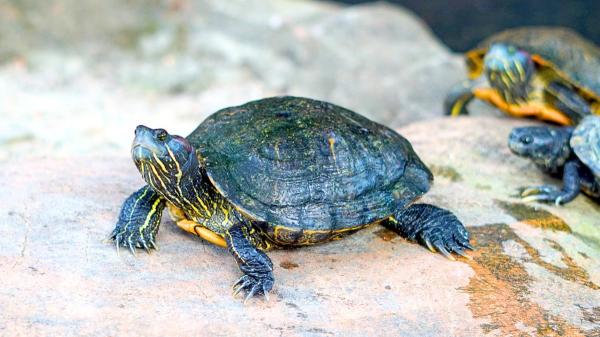
This endangers the galapagos and Spanish aquatic ecosystems.
Although it may look like just another turtle, the Florida turtle can displace native species, alter the balance of wetlands and become a very difficult problem to eradicate once it establishes itself in the natural environment.
Pet abandonment is the source of the problem
It all starts from the moment the turtle begins to not fit in at home. Some people, mistakenly thinking they are doing the right thing, choose to release it into ponds, rivers, lagoons or urban parks. At first glance it may seem like a compassionate gesture, but in reality it is one of the main ways in which this species has ended up colonizing natural spaces in Spain.
The Florida turtle is considered an invasive species because it is not native to Spain and, once released into rivers, lagoons, reservoirs or ponds, it can adapt quite easily to the environment and alter the ecological balance.
In other words, it’s not just that it lives here, but that its presence harms native species and aquatic ecosystems. In fact, the Ministry for the Ecological Transition includes it in the Spanish Catalog of Invasive Exotic Species.
How it affects the turtles and the rest of the native fauna
One of the main problems is that it competes directly with native pond turtles, such as the European pond turtle and the leper pond turtle. They compete for food, space and, above all, for the best areas to sunbathe, something essential for these reptiles. The Florida tortoise is usually very resistant, adaptable and competitive, which gives it an advantage over local species that already face multiple threats.
In addition, it can also act as a powerful predator of small fish, amphibians, aquatic insects and invertebrates, altering the natural dynamics of wetlands. When an introduced species begins to occupy ecological niches that do not correspond to it in that environment, the impact is not limited to a single animal, but can extend to the entire ecological chain. That is why its presence is not anecdotal, but potentially harmful to biodiversity.
It can also become a public health problem.
As if that were not enough, it can also represent a health risk, since some exotic turtles can act as carriers of pathogens, such as salmonella, and transmit parasites or diseases that affect both other animals and, in certain cases, people. This makes the problem not only ecological, but also public health and environmental management.
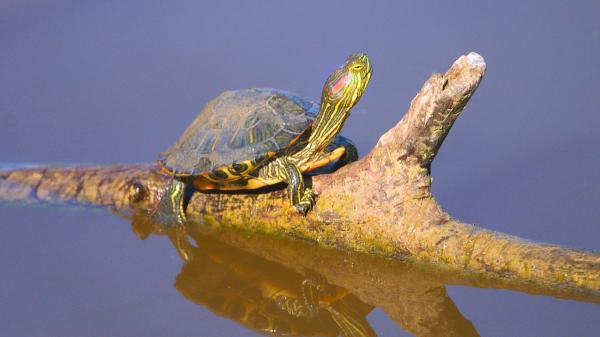
What is being done to stop the expansion of the Florida turtle
The expansion of the Florida tortoise in Spain is not being combated with a single measure, but rather through several protection plans aimed at reducing its impact on the native fauna. The main objective is not only to remove specimens from the natural environment, but also to protect native species such as the European pond turtle and the leper pond turtle, which compete with it for food, shelter and sunning areas. To achieve this, administrations combine prevention, control, surveillance and habitat conservation.
One of the most important pillars is prevention. In these types of environmental problems, preventing new releases is much more effective than trying to correct the damage when the species has already established itself. For this reason, Spanish regulations strictly limit the possession, trade, transport and release of invasive exotic species. Added to this are awareness campaigns to remember that abandoning a turtle in a pond or river is not an act of “liberation”, but rather an action that can seriously harm the ecosystem.
Another key front is the control and removal of specimens in wetlands, peri-urban parks, lagoons and other aquatic environments where these turtles are already present. In many cases, specific traps are placed, controlled captures are carried out and technical monitoring is carried out to prevent populations from continuing to grow or reproduce.
Conservation plans for native species are also essential. It is not enough to act against the invader, but we must also reinforce the protection of local fauna. This means conserving and restoring habitats, improving the quality of wetlands, reducing other human pressures and applying specific protection regimes to the most vulnerable wildlife species. In Spain, this work is articulated through Law 42/2007, the development of the List of Wild Species under Special Protection Regime and the conservation strategies that serve as a basis for the plans applied by the autonomous communities.
If you want to read more articles similar to Thousands of people had it as a pet and today it is one of the most worrying invasive species in Spain, we recommend that you enter our Biodiversity category.
