
Hares and rabbits are very similar animals because they have large ears, a pair of long front teeth, a compact body, long legs and a V-shaped nose. Both belong to the order Lagomorpha, but there are substantial differences between them in response to their adaptive needs to the environment. Sometimes they are considered synonyms, but this is not entirely correct. Two different names are used because there are particular characteristics for each one. Some of the differences between rabbit and hare are that the rabbit has smaller ears, the hare is larger, and hares are faster.
If you would like to know when it is a rabbit and when it is a hare, we invite you to read this Evidence Network article where you will learn the characteristics of each one and, therefore, the difference between rabbit and hare, as well as their similarities.
Characteristics of rabbits
- They belong to all genera of the family Leporidae except Lepus.
- They build burrows underground with the help of their claws.
- They are herbivorous feeders.
- They have gregarious habits, that is, they prefer to keep several individuals together.
- The young are born dependent on the mother, who provides them with warmth, food and shelter.
- They are born with eyes closed, unable to hear and without hair.
- On average they run at 50 km/h.
Learn more about the Rabbit in this other article.
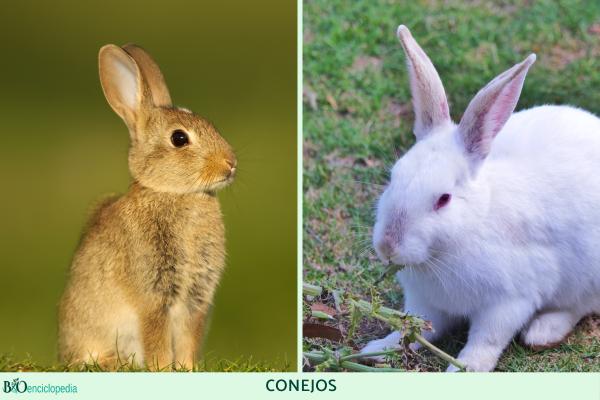
Characteristics of hares
- Hares belong only to the genus Lepus.
- They have very long and large ears.
- The babies can run from the moment they are born.
- They are independent of the mother when they are born.
- The babies are born covered in hair and with their eyes open.
- The eyes are larger and more complex.
- They are very fast, reaching 70 km/h.
- They are herbivores, but some species can eat carrion.
- They have solitary habits.
After knowing the characteristics of each one, we will now see the main differences between hare and rabbit.
Ears
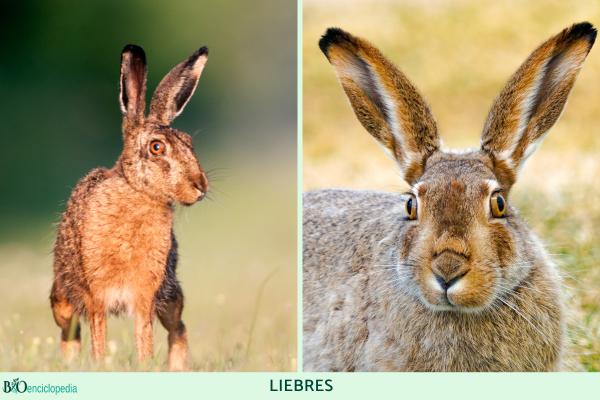
The first obvious difference in these lagomorphs is the ears; and is a great example of how similar groups develop variations to adapt to their environment as an adaptive response.
The ears are always large in lagomorphs, because they serve to dissipate excess heat, helping to keep them cool.
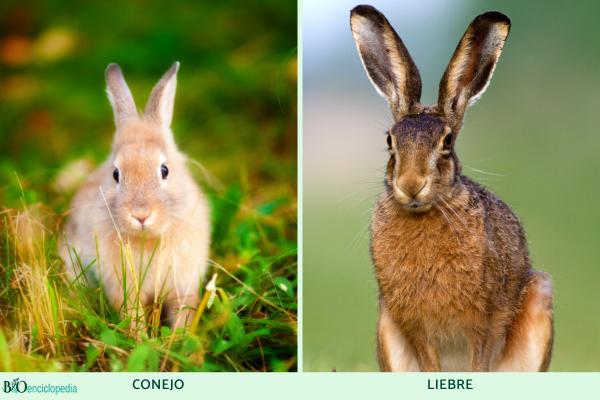
However, we can notice that the hare’s ears are much larger and elongated, measuring between 35 to 70 centimeters long, depending on the species. In addition, they are visibly larger in relation to the body. Although rabbits also have large ears, they measure 5 to 20 centimeters long. This is mainly because hares are exposed to higher temperatures than rabbits that live in shelter, as we will explain later.
Habitat
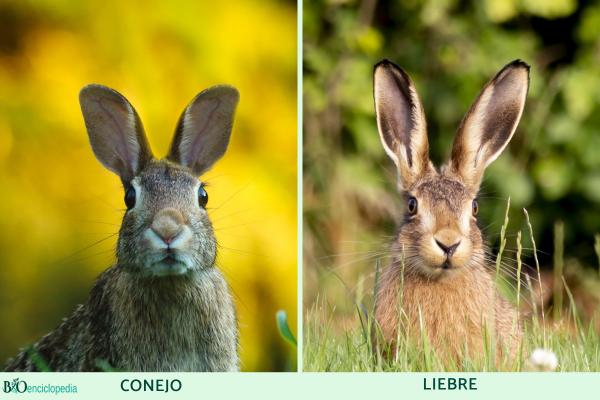
Rabbits are skillful builders of underground burrows, where they make their nests to sleep, protect their young, and protect themselves from potential predators. In contrast, hares do not build complex burrows but only make shallow holes or depressions in the ground.
Another important characteristic about the habitat is that rabbits prefer areas protected by vegetation, while it is more common to find hares in open fields.
Young
It is very interesting that the development of offspring is different for hares and rabbits; and it also responds to the difference between open habitat and closed habitat that each one has. Starting with the gestation time, that of hares is 40 days, while that of rabbits is only 30 days.
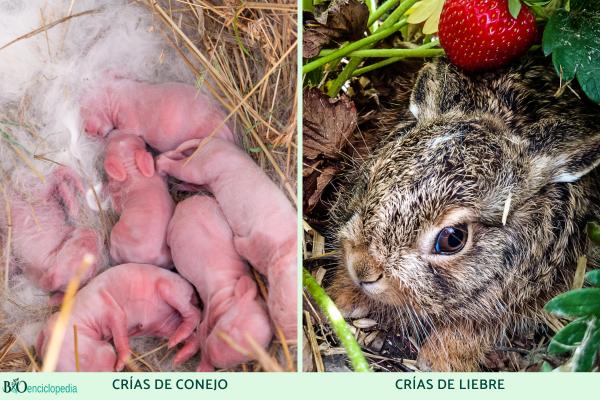
This is because hare babies are born with the full ability to walk and run, in addition to being already covered with fur and with open eyes, implying that they are completely capable and independent of moving and detecting danger. The extra time in the mother contributes to the offspring being born more developed.
On the contrary, rabbit babies are born pink without hair, with closed eyes and, of course, without knowing how to walk. Additionally, rabbits are completely dependent on their mother to maintain their body temperature, so it takes them a couple of days to become independent from them.
Size
Size is another of the visible differences between rabbits and hares. Hares are larger than rabbits. The latter measure a maximum of 50 centimeters, but hares reach a maximum of 70 centimeters in length.
Size, on the other hand, is evidenced by weight. Rabbits weigh about 2 kilos, although today there are many breeds of rabbits (some have been bred by people precisely to be very large and others very small), while hares reach 4 kilos, that is, double. The size is also larger in certain morphological structures, such as the hare’s long hind legs, long, narrow ears, and elongated snout.
Behavior
Another important difference is visible in behavior. Rabbits tend to be more gregarious, staying in groups. However, hares are more solitary. This is partly due to the ability to defend themselves.
Rabbits tend to hide from danger, but hares run when they feel threatened, thanks to their greater ability to maintain high-speed races. Hares can run at 70 km/h, while rabbits run around 50 km/h.
Similarities between rabbit and hare
- They have long hind limbs, with four toes on each.
- The front limbs are short and have five fingers.
- The tail is short and provided with a lot of hair.
- They have large ears and excellent hearing.
- They have large side-view eyes, since they are prey and require alertness to their surroundings.
After getting to know the difference between a hare and a rabbit better, we encourage you to get to know a specific species that is very peculiar: the Arctic Hare.
If you want to read more articles similar to Difference between rabbit and hare, we recommend that you enter our Biology category.
- Rabbits, Hares and Pikas: Status Survey and Conservation Action Plan. (1990). Switzerland: International Union for Conservation of Nature and Natural Resources.
