
Lagomorphs are mammalian animals with large ears, long incisors and long hind legs. The families Ochotonidae and Leporidae are included. Some examples of lagomorphs are the American pika (Ochotona princeps), the Japanese hare (Lepus brachyurus) and the European rabbit (Oryctolagus cuniculus). Stay here, reading BIOencyclopedia, if you want to know more about what lagomorphs are, their characteristics, types and examples, among more details, such as the differences between lagomorphs and rodents.
What are lagomorphs?
Lagomorphs are mammalian animals that belong to the order Lagomorpha. Within this order are, on the one hand, the Ochotonidae family that groups the pikas and, on the other hand, the Leporidae family that groups the rabbits and hares.
It is a very ancient order, since it is estimated that the aforementioned differentiation originated 37 million years ago.
Characteristics of lagomorphs
- They are mammals with mammary glands and a body full of fur.
- They are medium-sized animals.
- They have large incisor teeth that grow non-stop, so they must gnaw constantly.
- Their ears are large and they use them not only to hear very well, but also to cool themselves.
- They have very fine senses of hearing and smell.
- Its eyes are located in the highest part of its head, and each one on each side, which makes it possible for its vision to be almost 360 degrees, which serves to quickly detect predators. Despite the peculiarity of their eyes, they cannot distinguish colors.
- Their sense of taste is also very fine, as they have 17,000 taste buds.
- Its hind legs are very long and its front legs are short. These characteristics have been developed by lagomorphs based on their vital need to escape from their predators. This is also the case with their powerful legs that help them in a quick escape.
- They are very clean animals, so they have learned to groom each other. When there are no other companions to help them in this task, they clean their backs alone, managing to turn 180 degrees with their flexible neck.
Types of lagomorphs
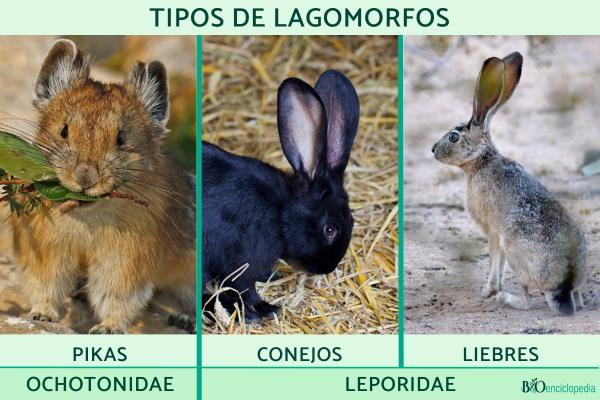
There are two types of Lagomorphs, which correspond to the two families that are grouped together, being Ochotonidae and Leporidae.
- In the Ochotonidae family are pikas, an animal much smaller than rabbits and hares.
- In the Leporidae family there are hares and rabbits. In this other post you can read more about Rabbits.
Examples of lagomorphs
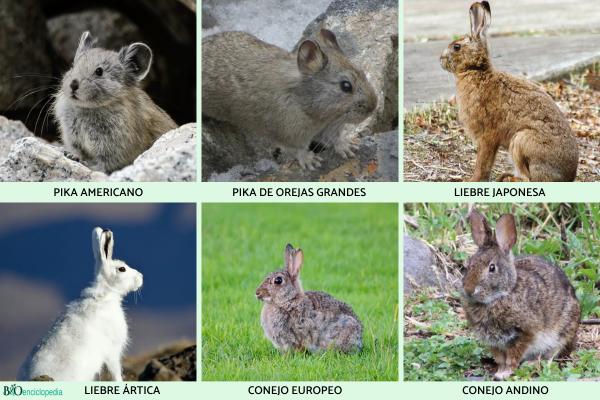
- American pika (Ochotona princeps): It lives in the mountains of North America and is so small that it barely measures 10 centimeters without counting the tail.
- Big-eared pika (Ochotona macrotis): lives from 1 to 3 years. Their claws are sharp and their paws are padded, suitable for climbing rocky areas.
- Japanese hare (Lepus brachyurus): is solitary, lives in eastern Asia, and likes to eat all kinds of flowers.
- arctic hare (Lepus arcticus): As its name indicates, it lives in arctic regions, so it has learned to dig holes in the snow to enter there and take shelter. Learn more about the Arctic Hare here.
- European rabbit (Oryctolagus cuniculus): this is the rabbit that is used as a pet.
- Andean rabbit (Sylvilagus andinus): lives in Colombia, Venezuela, Peru and Ecuador. He likes moors and mountain forests.
Differences between lagomorphs and rodents
Lagomorphs and rodents have some similarities, for example their teeth grow constantly and therefore they must wear them down by gnawing, but they also have several differences. Let’s look at some of the latter.
- To begin, you should know that lagomorphs are rabbits, hares and pikas, while rodents are, for example, mice or squirrels.
- Now, the main morphological difference is their teeth. Lagomorphs have 6 incisors, four above and two below, while rodents have 4 incisors, two above and two below. Rodents’ teeth are covered in enamel and lagomorphs’ teeth are not.
- The hair is also different in both. In lagomorphs the fur completely covers their extremities, while in rodents they are exposed.
- The ears are an important distinctive feature. The ears of lagomorphs, for the most part, are large and long, they even tend to fall on themselves, which helps them self-regulate their body temperature. The ears of rodents, on the other hand, are almost always short and round.
- Another interesting difference is their type of diet. All lagomorphs are herbivores without exception and only drink breast milk when they are young, while rodents vary what they eat depending on their species. For example, guinea pigs, vizcachas and lemmings only eat vegetables, while gerbils, rats, mice and hamsters are omnivores.
- The bone structure of both is different. Lagomorphs have larger hind legs, with which they can move more quickly and agilely, in addition to having an extra bone in the pelvis, called the aconeal bone, which gives them greater mobility. Furthermore, their bodies are very elongated. In contrast, rodents have visibly shorter hind legs, and their bodies are shorter and more compact.
- Lastly, and perhaps most importantly, is that they belong to different orders. Although we suddenly believe that they look quite similar, lagomorphs belong to the order Lagomorpha and rodents belong to the order Rodentia. This fundamental difference means that they are classified into different categories, since their anatomical, taxonomic and genetic characteristics are unique and are not shared between the two.
Now that you have learned all this about what lagomorphs are, their characteristics, types and examples, we encourage you to learn about the Difference between rabbit and hare.
If you want to read more articles similar to Lagomorphs: what they are, characteristics, types and examples, we recommend that you enter our Biology category.
- Lagomorpha Characteristics. (2021). United Kingdom: IntechOpen.
- Aparicio Martínez, LF (1976). Mammals: Rodents, Lagomorphs. Spain: Hiares Editorial, SA
