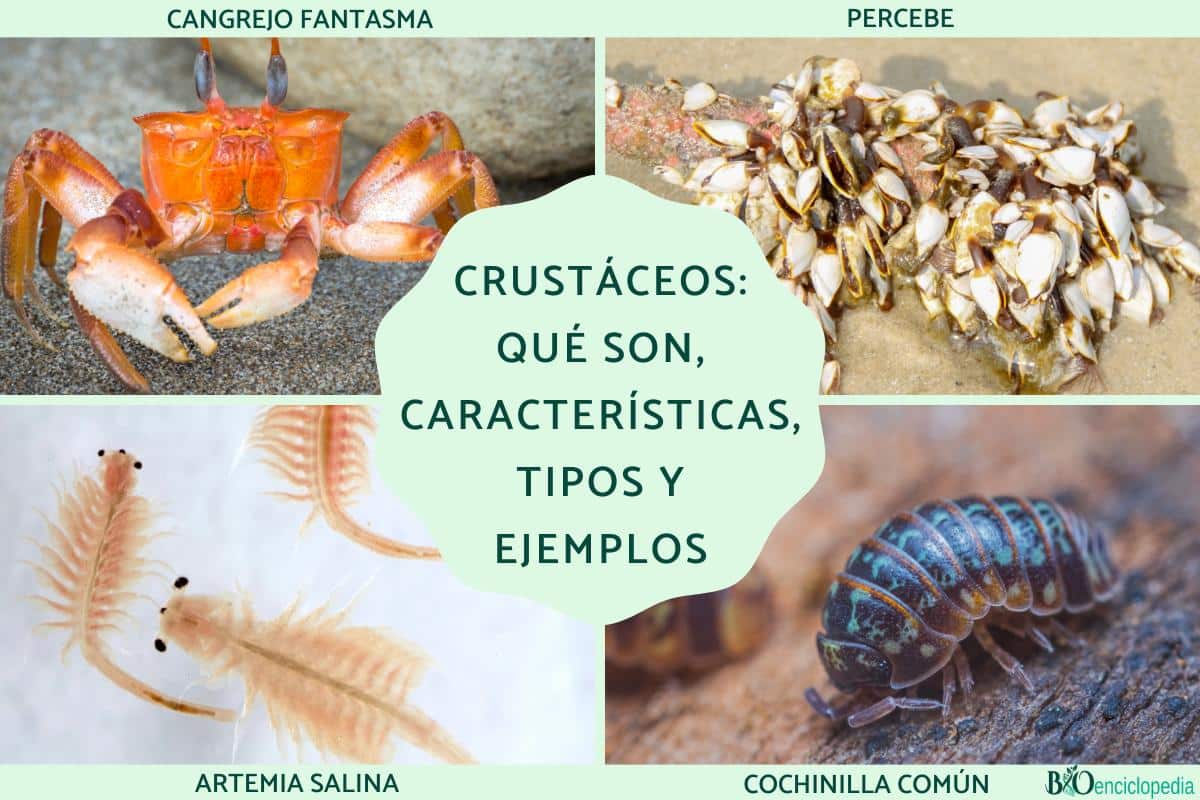
Crustaceans are arthropod invertebrate animals. They have an exoskeleton, two antennae and biramous appendages. Some of its types are the Brachiopoda Class, the Copepoda Class, the Theocostraca Class, etc. The animal world is complex and made up of numerous different phylum or phyla. One of them is the phylum or phylum Arthropoda, which consists of invertebrate, articulated animals with an external skeleton. Within this group is the subphylum or subphylum Crustacea or crustaceans, which includes crabs, shrimp, among others.
If you want to know more, we invite you to read this BIOencyclopedia article where we will tell you what crustaceans are, their characteristics, types and examples, among other aspects.
What are crustaceans
The animal world is complex and made up of numerous different phylum or phyla. One of them is the phylum or phylum Arthropoda, which consists of invertebrate, articulated animals with an external skeleton. Within this group is the subphylum or subphylum Crustacea, which groups crabs, shrimp, among others.
Thus, crustaceans are invertebrate and arthropod animals, with a segmented body, with articulated legs and an exoskeleton. Therefore, any organism that belongs to the subphylum or subphylum Crustacea is called a crustacean.
Characteristics of crustaceans
- They are identified because they have a head, thorax and abdomen. Some may have a joined thorax and abdomen.
- They are dependent on water or a certain degree of humidity.
- They stand out because they are the only arthropods with two pairs of antennae and legs with two branches, called biramous appendages. These are primitive traits that allow them to be placed with a single common ancestor. On the head they also have two pairs of maxillae and one pair of mandibles.
- They breathe through gills, and some have a modified respiratory system to be able to breathe in a more terrestrial environment but that has some humidity.
- They have locomotor appendages, whether for walking or swimming. Sometimes they can be modified into pincers that are used to defend themselves or to obtain food. They are modified in two types. The legs used for feeding are called maxillipeds and those used for walking are called pereiopods. So how many legs do crustaceans have? They have eight pairs of legs on the thorax, of which 3 are maxillipeds, and 5 are pereiopods, which means that 3 pairs are feeding appendages and 5 are actually walking legs.
- They can have a very thick and heavy exoskeleton made of minerals.
- They exist in different types of association: they can be terrestrial, sedentary or parasitic.
- Mollusks can sometimes be confused with crustaceans, so it is important to know that the main difference between crustaceans and mollusks is that the latter have a soft body and a hard shell, but crustaceans have a hard exoskeleton that covers them completely. Mollusks are not segmented, but crustaceans are. Finally, crustaceans belong to the phylum Arthropoda, but mollusks have their own phylum called Mollusca.
Types of crustaceans
- Water fleas and related species (Class Brachiopoda): are freshwater crustaceans that live in zooplankton or in temporary bodies of water. They measure from a few millimeters to 5 centimeters. When conditions are not favorable, the eggs can survive in a dormant stage.
- Copepods (class Copepoda): are very small crustaceans, and are found in plankton. They can be free-living or parasitic.
- Barnacles, barnacles and related animals (Class Theocostraca): they can become cemented to the substrate, or they can be parasitic.
- Ostracods (class Ostracoda): they have an articulated shell with two valves in which they are enclosed, and the limbs emerge from them. They have antennas with which they can move. They live in fresh water and can also be marine crustaceans, associated with vegetation.
- Crabs, krill, shrimp, isopods, scale insects, prawns, prawns, and related species (Malacostraca class): it is the most diversified group of all crustaceans. Inside are two orders. The order Decapoda has a curved shell on the head with a fused thorax, and the order Isopoda has no shell and terrestrial habits.
- Remipedia Class: They are crustaceans that live in deep sea caves. They don’t have eyes. They have 30 appendages with which they swim.
- Class Cephalocarida: they have a flattened cephalic region, and they all live associated with the seabed, both at shallow depths and at more than 1000 meters.
- Class Tantulocarida: they are microscopic and are usually parasites.
- Class Ichthyostraca: they are parasites of vertebrates. It is a new class whose members previously belonged to the maxillopods.
- Class Mystacocarida: they are microscopic. They live among the grains of sand in marine systems.
Reproduction of crustaceans
Reproduction is varied in crustaceans depending on the group. Depending on the sex, they can be:
- Dioecious
- Hermaphrodites
- Sequential hermaphrodites, that is, they alternate sex
Regarding the type of reproduction, this can be:
- Sexual: here an egg is produced as a result of fertilization. From it emerges a larva with one eye called a nauplius and typical of the group, which can have different stages of differentiation depending on the group for which they receive different names. Finally the adult emerges, which is the one that has the capacity to reproduce.
- Parthenogenesis: Some species can divide by parthenogenesis, where the females do not need fertilization from the male, and the eggs segment on their own.
Examples of crustaceans
Japanese giant crab (Macrocheira kaempferi)
It is the largest arthropod in the world, with a paw span of 4 meters. This size is due to the fact that they can float very well in water, an example of which are that those that are aquatic are larger than those that are terrestrial. It lives in the depths of the Pacific Ocean. It can live up to a century.
Find out more about the Japanese Giant Crab here.
common mealybug (Armadillidium vulgare)
These are well-known arthropods that appear in forested or humid areas, recognized because they curl up into a ball when touched. They are black and consist of many plates, 1 to 2 centimeters long. This is an example of terrestrial crustaceans that can live in terrestrial ecosystems.
Balano or sea acorn (Semibalanus balanoides)
These crustaceans are very peculiar because they do not move. They are like hardened mounds with a calcareous shell, and it is thanks to this that they are extremely resistant to desiccation. They live in the intertidal zone, so they require this strategy to survive when the tide is low. It is common to see them attached to boats or on rocks.
Artemia salina
It is one of the small crustaceans, just 1 to 1.5 centimeters long. It has pedunculated eyes on the sides of the head, and a soft body. It can be found in saline ponds around the world, tolerating high levels of salinity. If there is drought, the eggs can survive for several years. It is usually marketed as live food for fish.
Barnacle or goat’s footLepas anatifera)
They are maxillopods that are related to the barnacles, and like them, they are fixed to the ground. They have a flexible peduncle, and on it they have the calcified structure that is normally purple in color. It lives in the Atlantic Ocean.
Other examples of crustaceans
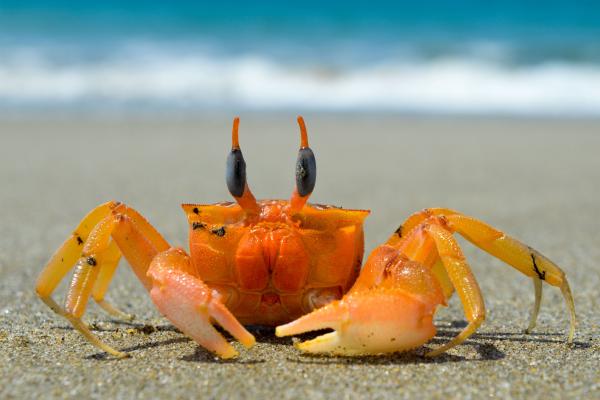
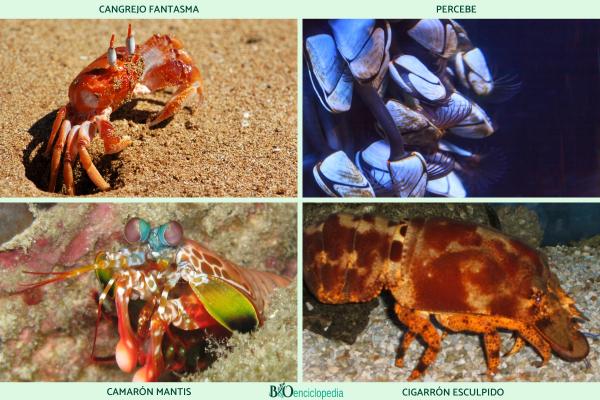
- Ghost Crab (Ocypode gaudichaudii)
- Red Sea ghost crab (Ocypode saratan)
- Yeti crab (Kiwa tyleri)
- hermit crab (Paguroidea)
- Marble shrimp (Saron marmoratus)
- Norway lobster (Nephrops norvegicus)
- Giant swimming ostracod (Gigantocypris sp.)
- Freshwater shrimp (Gammarus plex)
- mantis shrimp (Odontodactylus scyllarus)
- Glacial copepod (Calanus glacialis)
- Daphnia (Daphnia magna)
- Sculpted cigar (Parribacus antarcticus)
- aquatic mealybug (Asellus aquaticus)
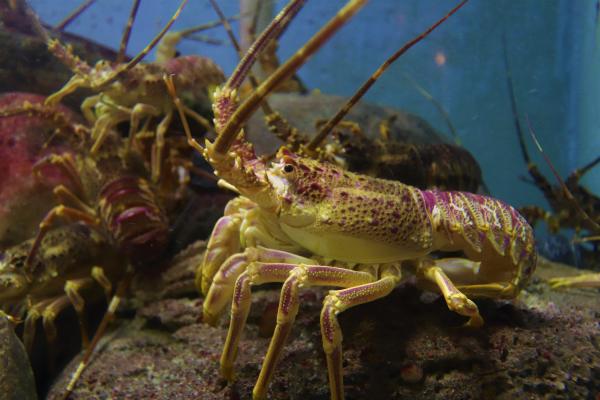
- Striped-footed lobster (Panulirus femoristriga)
After discovering what crustaceans are, their characteristics, types and examples, we recommend discovering other curious animals. Discover here the different types of sea snails.
If you want to read more articles similar to Crustaceans: what they are, characteristics, types and examples, we recommend that you enter our Biology category.
- Beatty, R., Beer, A., & Deeming, C. (2010). The book of nature. Great Britain: Dorling Kindersley.
- Saxena, A. (2005). Text Book of Crustacea. India: Discovery Publishing House Pvt. Limited.
