
When the warm season that announces the end of winter approaches, a very surprising phenomenon can be observed in the Mediterranean pine forests, where several caterpillars walk in long lines. This is the pine processionary (Thaumetopoea pityocampa), a moth that spends most of its life in the caterpillar phase. The pine processionary cycle includes the adult, egg, larva, chrysalis and moth. The time when it is seen is at the end of winter and the beginning of spring. It is found in Europe, Asia and Africa, specifically, in the pine forests of the Mediterranean area. They are a major forest pest and can cause mild to severe health problems. The treatment to control when there is a pest can be the direct removal of the pockets or nests, with traps and other means, or using chemical methods.
If you want to know more, we invite you to read this BIOencyclopedia article, where we will tell you what the life cycle of the pine processionary is like, its season, where it is found and the treatment, among many more details to take into account.
Characteristics of the pine processionary
- Its scientific name is Thaumetopoea pityocampa.
- It is an organism that in adulthood is a moth, but the most relevant stage is that of a caterpillar.
- The caterpillars are covered in hairs.
- They are brown in color and the stinging hairs are white.
- The diet of the pine processionary is based on needles, which are the leaves of the pine pine spp., and sometimes from cedar Cedrus spp.
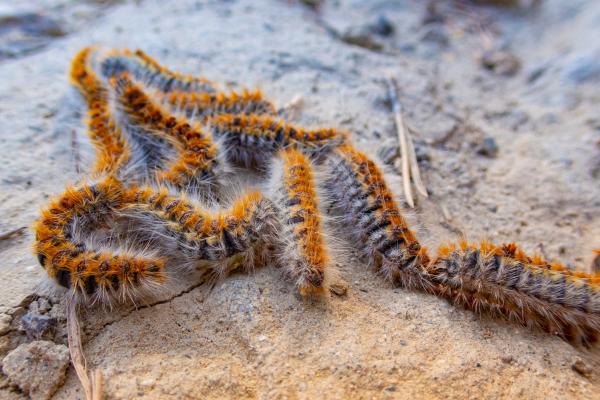
Life cycle of the pine processionary caterpillar
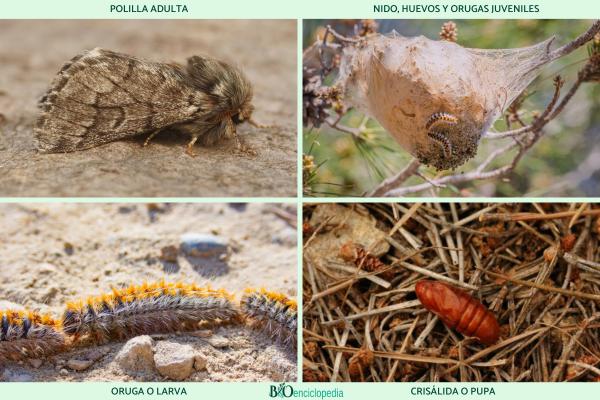
The life cycle of the pine processionary includes the phases of adult, egg, larva or caterpillar and chrysalis, which becomes a new adult and repeats the cycle. The reproduction of the pine processionary begins in summer, exactly in June, July and August when the processionary is in the adult phase.
- Two adults mate between the afternoon and evening to avoid exposure to predators.
- The result of fertilization are eggs, arranged in nine or seven rows in pine needles, and are encapsulated in a long reddish covering. Eggs can be found from June to September.
- After a month, the caterpillars emerge, which is the predominant stage. It lasts from July to April where they begin to feed on pine needles.
- After 30 days, approximately between February and April, the typical processions of this species begin. The caterpillars come down from the trees and go in a row, for which they secrete silk threads that serve as a conductor between them. In warm areas, the caterpillar phase is shortened.
- They build pockets, which are silk shelters, into which they enter and exit to feed at night. These pockets are built as they advance in search of new sites.
- Once they reach a place that has a temperature of approximately 20 ° C, the caterpillars burrow to begin the next phase.
- The caterpillar encloses itself in a chrysalis that it forms from March to August, but it can spend a prolonged diapause during the twelve months of the year, and in cases even several years. In February it begins to go down to the ground to bury itself. All the food it acquired during the caterpillar phase will now help it endure this phase without food.
- Once the imago formation period is over, the adult moth emerges from the chrysalis. The moth state lasts very few days, during which it reproduces and does not feed. With this the cycle of the pine processionary ends.
Now, how long does the procession last? They usually live one year, most of them in the caterpillar phase, although some communities that live in colder areas can live up to two years.
Time of the pine processionary
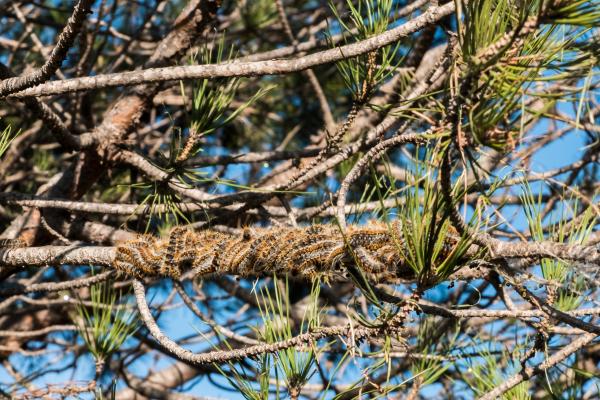
The pine processionary caterpillar is particularly observed during winter, which is when pine trees are dormant and most vulnerable. It is common to see the nest of the processionary hanging from the pines like white skeins.
The months of April to May are when the pine processionary descends to the ground to bury itself as soon as the heat arrives.
Where is the processionary caterpillar found?
It is a caterpillar typically found in the Mediterranean. It lives in Europe, Asia and North Africa, always associated with pine forests on which it feeds. Unfortunately, it has reached America as an introduced species.
You may be wondering at what temperature the pine processionary dies; and the answer is that taking into account that they live in a Mediterranean climate, if they spend several days at -10 °C they die.
Pine Processionary Damage
The pine processionary causes harmful effects on pine trees, because they feed on them during the caterpillar phase. By feeding on the leaves they cause defoliation of the tree and, in fact, they can cause total defoliation of the tree, that is, they can leave the pine tree completely leafless. If this occurs in quantity, it can destroy the pine trees in a specific area.
However, they only consume adult leaves, not buds, so if the pine has buds in spring, they will help the tree continue to renew itself.
Processionary caterpillar bite
Caterpillars have stinging hairs that, when released on the skin, cause allergic reactions. They can come loose upon direct contact with them, but they can also detach them and they can float through the air. Through this route they can enter through the nose, throat and eyes.
There may be encounters between dogs and the processionary caterpillar, especially where they are curious and get too close. They can also be entered through the aforementioned routes.
Skin symptoms upon contact with processionary include a burning sensation on the skin, redness, blisters and itching. If entering through the nose or mouth, the stinging hairs can reach the lungs and cause respiratory irritation. It may reach other organs and the body may respond with anaphylactic shock.
To treat wounds, it is recommended to wash the affected area well with water, apply cold, take an antihistamine to reduce the allergic reaction and go to the nearest health center to attend to the situation.
Treatment for the pine processionary caterpillar
- There are traps to capture the processionary moth. There are those that use sexual pheromones to attract the male caterpillars, and lock them inside. This reduces the population of males. There are others that simply reduce the area in which they can walk on the bark of the tree, until they enter a bag where they can be picked up with less risk.
- Another more accessible option to do at home is to spray soapy water on the processionary nests. Tobacco can also be used in this format.
- Consider manually removing pockets and nests to prevent them from returning to their habitat. This is a great alternative as it does not involve substances that affect the pine. Once processionary nests are located in the ground, they can be rummaged to remove and manually kill the caterpillars.
- In addition to home methods, it is possible to use phytosanitary products to combat pine processionary. It is recommended to use one based on Bacillus thuringiensisa bacteria that, when ingested by the caterpillar, destroys its digestive system.
After learning all this about the pine processionary caterpillar, we recommend you read about the Hoopoe, a bird that lives in the same habitat and feeds on these caterpillars and other invertebrates, so it has a role in biological control of these caterpillars that can become pests.
If you want to read more articles similar to Pine processionary: cycle, season, where it is found and treatment, we recommend that you enter our Biodiversity category.
- Muñoz López, C., Cobos Suárez, P. (2011). Forest health. Spain: Mundi-Prensa Editions.
