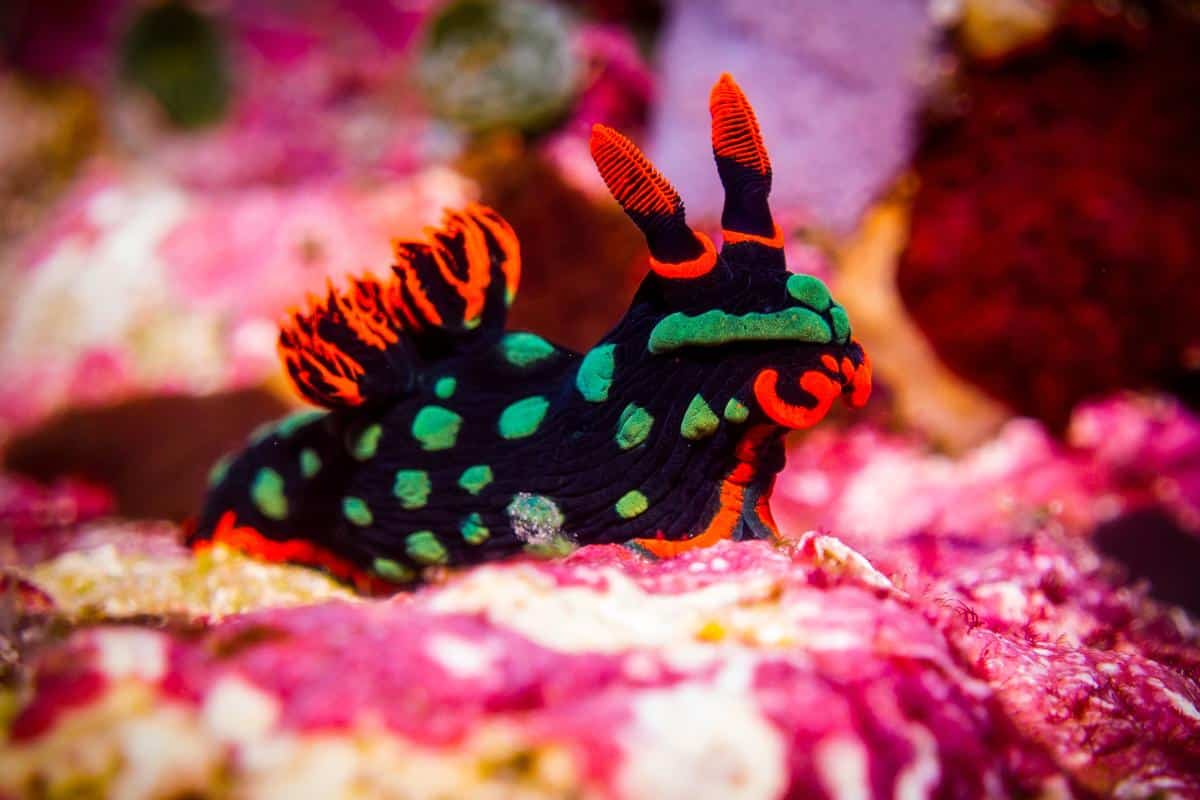
Nudibranchs are marine invertebrate animals, with characteristics such as the absence of a shell and hermaphroditism. Some examples are the Spanish dancer (Hexabranchus sanguineus) and the blue dragon (Glaucus atlanticus). Certainly, the marine world is home to a wide variety and number of animals. There are particular and colorful animals called nudibranchs, whose name gives an indication of what they are like. We invite you to read this BIOencyclopedia article to learn more about what nudibranchs are, their characteristics, examples and reproduction.
What are nudibranchs and their classification
To better understand what nudibranchs are, let’s review their classification:
- Kingdom: Animalia
- Phylum: Mollusca
- Class: Gastropoda
- Subclass: Heterobranchia
- Infraclass: Opisthobranchia
- Order: Nudibranchia
Therefore, from the above we can say that nudribranchs are marine animals, gastropod invertebrates that lack a shell. Just like this last characteristic, there is another very important one for your knowledge and it comes from the meaning of nudribranchia. This word means naked gills. They also classify within the infraclass Opisthobranchia, which means gills at the back. For this reason, sea slugs are also known as opisthobranchs.
Now, within nudibranchs there are two large categories that correspond to particular morphological characteristics:
- Dorids: they have gills in the anus, in the form of feathers.
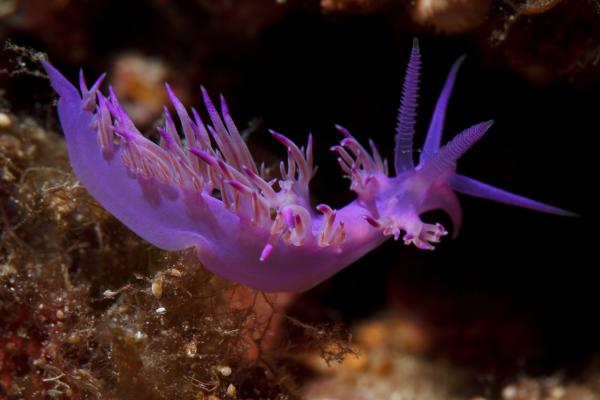
- Aeolids: it does not have gills per se, but rather they are extensions called cerata. These, in addition to being used for gas exchange that is used for breathing, are used for digestion. They are distributed throughout the mantle of the nudibranch.
Let’s now review in more depth what the characteristics of these animals are.
Characteristics of nudibranchs
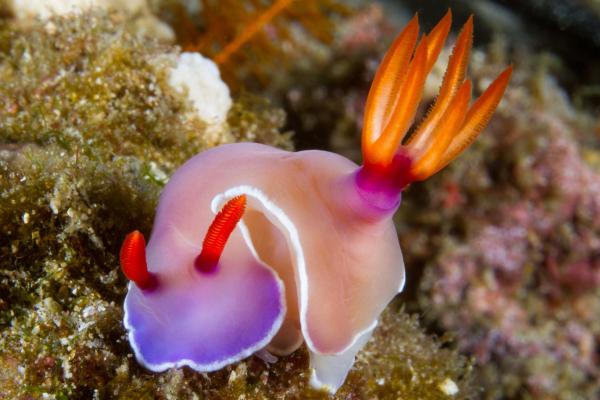
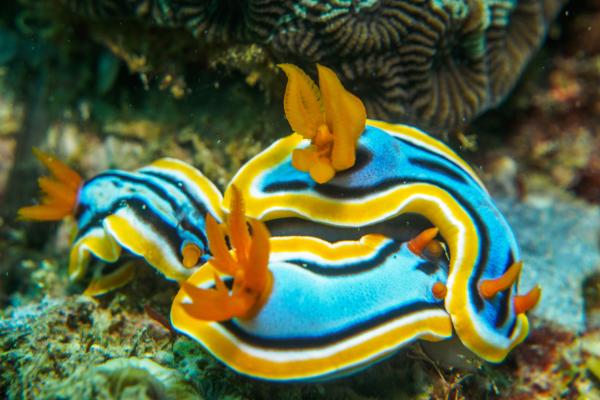
- They have a vermiform appearance and, being gastropods, they are related to snails and slugs, which is why they can also be called sea slugs. Just like the latter, they lack a shell and their mantle is exposed.
- The size of nudibranchs is very varied. They range from 4 cm to 40 cm.
- They have gills outside their body, unlike marine animals that have them inside. When looking at a photograph of them, we will see that at the end opposite the mouth it has a feather-like crown. These are the gills. Those that have many extensions coming out of their body are those that belong to the aeolids, such structures being the cerata.
- Other important parts of nudibranchs are the rhinophores, which are the olfactory organs with which they perceive their environment. They are two extensions on the head, which could look like ears.
- To move they crawl, like snails. This lower part is known as the foot.
- They have very peculiar colors, because they use them to camouflage themselves with the coral reefs they inhabit, or to warn their predators that they are dangerous. This is a defense mechanism that they had to acquire because they lack a shell to protect them.
Examples of nudibranchs
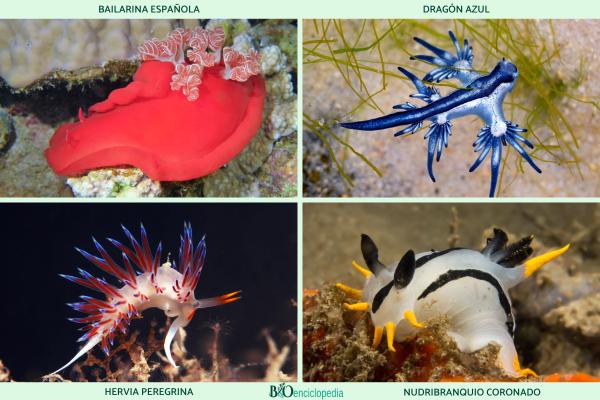
Below, we present some species of nudibranchs:
- Spanish dancer (Hexabranchus sanguineus): is one of the largest nudibranchs, measuring 40 centimeters long. It lives in the Philippines and has that common name because of its color and its undulating swim.
- Blue dragon (Glaucus atlanticus): is one of the few nudibranchs that float, and is striking because it has extensions in its cerata. Combine blue stripes with white. It is extremely poisonous, despite its 4 centimeters long.
- Hervia peregrina (Pilgrim Cratena): is one of the nudibranchs of the Mediterranean. It measures 5 centimeters and has red, purple and blue cerata that extend from the white mantle.
- Crowned nudribranch (Polycera capensis): It is one of the most popular types of nudibranchs, because it has contrasting black stripes on a white background, and yellow details. It lives on the South African coast.
Where do nudibranchs live?
The habitat of nudibranchs is always the marine habitat and on the ground thereof. Most of these species live in warm areas, and the tropics are where there is the most variety. However, there are also a few species that can be found at other depths and at latitudes more towards the poles.
Nudibranch Behavior
- Nudibranchs are nocturnal animals, which carry out their activities on the seabed, called benthos, so they are benthic animals.
- Although they appear to be passive animals, they are active predators.
- They use defense mechanisms, such as the application of poison obtained from third parties and aposematism to warn that they are dangerous animals if they are ingested. In this link you can learn more about Aposematism: what it is, characteristics and examples.
What do nudibranchs eat?
- The diet of nudibranchs is carnivorous. They feed on jellyfish, sea sponges, bryozoans, tunicates, anemones, barnacles, or even other nudibranchs.
- They are specialists, meaning that each species feeds specifically on one of the animals mentioned.
- Those that feed on hydrozoids, such as jellyfish, have the capacity to store the poisonous nematocysts of their prey. These are later used to defend themselves from predators and to obtain food. Not all nudibranchs are poisonous, only those that feed on animals that are poisonous are.
Reproduction of nudibranchs
- Each nudibranch has both male and female sex organs within itself, a condition known as hermaphroditism.
- When it is breeding time, two nudibranchs join together to join male and female.
- They are oviparous animals that lay ribbon-shaped eggs. A larva, called veliger, is born from them and is found floating in the plankton. This has a rudiment of shell and will be lost as its development progresses.
- As it grows, the nudibranch will settle towards the seabed to complete its benthic life.
After learning all this information about what nudibranchs are, we encourage you to discover the Types of marine snails.
If you want to read more articles similar to Nudibranchs: what they are, characteristics, examples and reproduction, we recommend that you enter our Biology category.
- Oceans New edition: The secret world of the deep sea. (2023). Spain: DK.
