
What for many was garbage abandoned on the beaches and other points of the Brazilian island of Itamaracá became the raw material for a home. Edna Dantas and her daughter, Maria Gabrielly Dantas, collected thousands of glass bottles and incorporated them into the walls of a house that they ended up building with their own hands.
The project, known as Casa de Sal, began during the pandemic and was born from a very specific concern: the large amount of waste that accumulated in the environment after periods of greatest tourist activity. The mother and daughter’s response was unusual: instead of considering the bottles useless waste, they decided to give them a second life as construction material.
The bottles that ended up abandoned ended up forming the walls of the house
The story began on the island of Itamaracá, in the Brazilian state of Pernambuco. Edna and Maria Gabrielly began collecting glass bottles that they found on beaches, mangroves, abandoned land and other places where waste had accumulated.
In 2021, when the project was still in development, they had already managed to collect around 6,000 containers. As Maria Gabrielly explained to UOL Ecoa at the time, all the bottles were collected, sanitized and prepared before incorporating them into the construction. Many came from a radius close to the home.
Over time, the number increased to more than 8,000 recycled glass bottles, which ended up forming part of the walls of the house.
The idea was not simply to place bottles as a decorative element. Mother and daughter had to develop a way to integrate them into the structure so that they could form stable walls.

This is how they managed to build walls with thousands of glass bottles
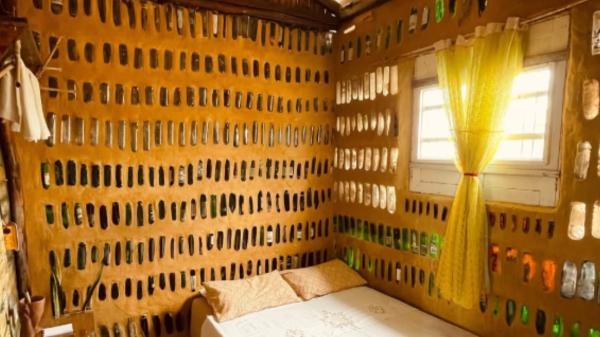
One of the most striking features of the Casa de Sal is the way the bottles are placed.
Instead of arranging them horizontally, Edna and Maria Gabrielly placed them vertically and alternated their orientation in the different rows. In this way they managed to compensate for the differences between the base and neck of the containers and keep the walls level. The spaces between the bottles were filled with a mixture of cement and sand.
The structure of the house also incorporates other recovered materials. Reused wood is part of the construction and recycled pallets were used for some interior divisions. Empty toothpaste tubes were even used to make cover elements.
Thus, glass is not the only waste used: the house was born from the intention of reusing materials that would normally end up becoming garbage.
From thousands of abandoned waste to a seven-bedroom house
Construction began on May 1, 2020, in the middle of the pandemic. For approximately the first year and a half, mother and daughter built the main structure and progressively expanded the project until it became a functional home.
The result is a seven-bedroom house, built primarily from reclaimed materials.
And there is an added effect that is especially striking. As the bottles are placed vertically on the walls, natural light passes through some glass areas and creates reflections and beams of light inside. What began as a solution to use waste ended up also becoming an aesthetic feature of the home.
The history of the project itself also demonstrates that reusing waste does not necessarily mean using it exactly for what it was manufactured for. A glass bottle stops being just a container when it is incorporated into another process and becomes part of a wall.
A house that turns recycling into a form of construction
The Salt House is striking for its dimensions and the 8,000 bottles used, but its environmental interest lies precisely in what happens before these materials reach the walls.
Instead of abandoned packaging remaining in the environment, it was collected, cleaned and transformed into a resource. It is an idea related to one of the fundamental principles of the circular economy: trying to keep materials in use for longer and reduce the amount of waste that ends up discarded.
The project also focuses on a problem that is especially visible in tourist areas. After peak periods, a large amount of packaging can end up abandoned on beaches and other natural spaces. In Itamaracá, Edna and Maria Gabrielly decided to act directly on part of that waste.
The House of Salt is, therefore, much more than a house built with bottles. It is the result of looking at waste from another perspective: what someone throws away can become raw material if a way is found to use it.
And perhaps that is the most interesting part of this story. The 8,000 bottles did not disappear because they were recycled in the conventional way, but rather they completely changed their function. They went from being abandoned containers to being part of a house that today shows, literally on its walls, how far the reuse and recycling of a material can go.
If you want to read more articles similar to They collected 8,000 glass bottles over two years and ended up building a seven-bedroom house, we recommend that you enter our Recycling and waste management category.
