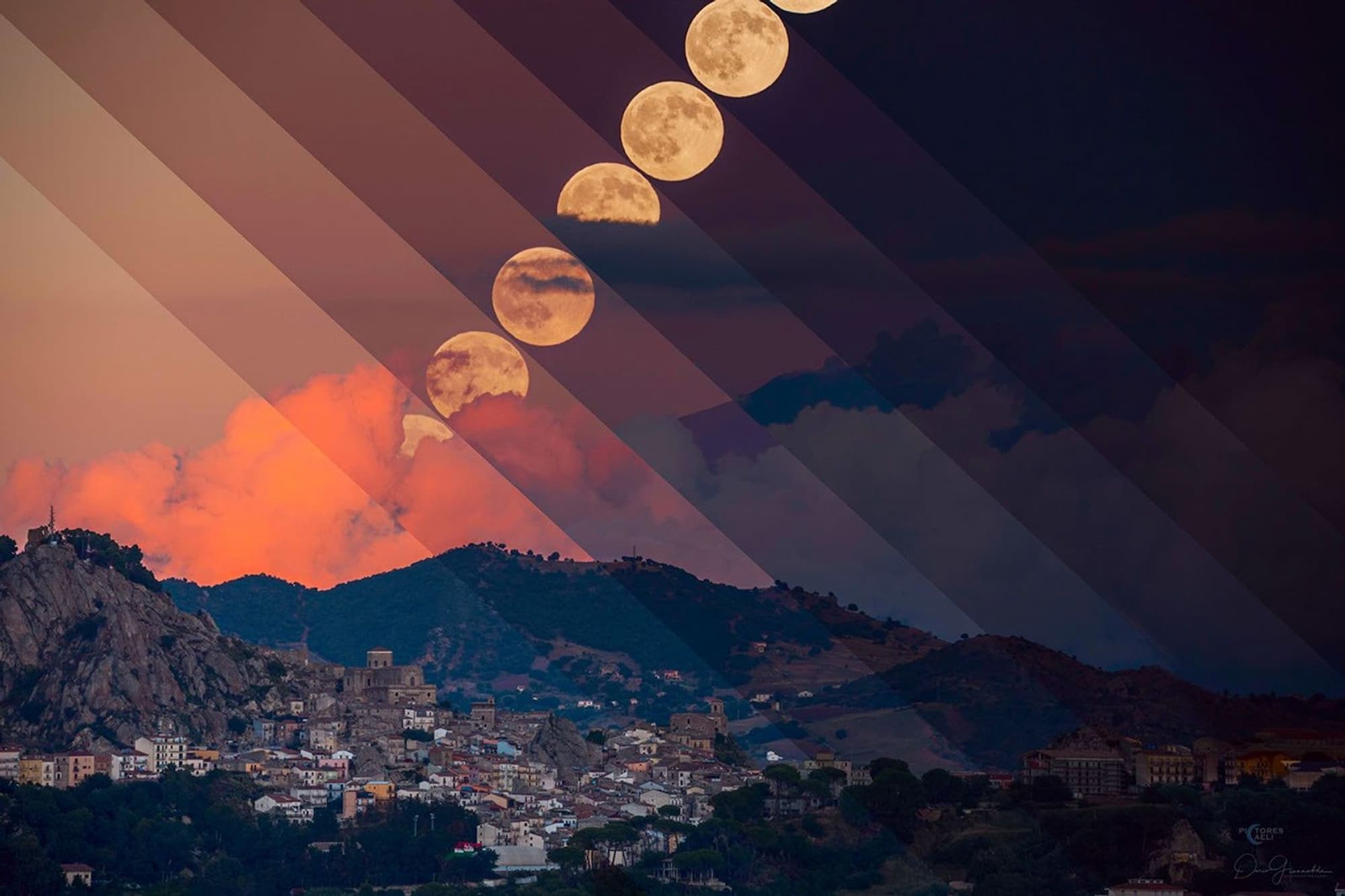
A composite shot, immortalized in Sicily, shows the rising of the full Moon between the Belt of Venus and the ashes of the erupting Etna.
This image taken in Sicily has conquered the NASA, which selected it as Astronomy Picture of the Day (APOD) — the astronomical photo of the day — with the title “Harvest Moon Trail With Venus Belt and Erupting Mount Etna”. The image was created by the Italian astrophotographer Dario Giannobile, representative of the Landscape Astrophotography Research Section of the Union of Italian Amateur Astronomers (UAI).
The photograph was taken last weekend just outside the town of Nicosia, in the province of Enna. Through a complex composition and rigorous geographical and perspective planning, Giannobile made the line of sight of the town coincide with the profile of the Etna volcano erupting just as the full moon rose.
A mix of astronomical and atmospheric phenomena
The image is a composite photograph that captures and follows the apparent movement of the Moon across the sky as darkness advances during twilight. During the full moon phase, in fact, the moon and the sun are in opposition, allowing our satellite to rise exactly as the sun sets..
In the foreground stands the Belt of Venus, the characteristic pink band that appears in the sky opposite the Sun immediately after sunsetbelow which we can distinguish the darker and bluish shade projected by the Earth’s shadow on our atmosphere. Higher in the background, ash and gas fumes emitted by erupting Etna interact with twilightwhile lower clouds reflect anti-twilight colors as the sky darkens.
What is the “Harvest Moon”?
In the Northern Hemisphere, September’s Full Moon is traditionally named Harvest Moon (i.e Harvest Moon), as it is the full Moon closest to the autumnal equinox.
The name dates back to agricultural tradition: in the days around the equinox, the full Moon rises for several consecutive evenings at very short time intervals compared to the rest of the year. Before artificial lighting, this continuity of moonlight in the evening hours allowed farmers to complete their work in the fields.
