
At the end of the 19th century, Sierra Espuña had very little to do with the landscape we know today. Overexploitation of forestry, grazing and logging had left the mountain practically treeless, with serious erosion problems and a high risk of flooding. It was then that a forestry engineer decided to face a challenge that seemed almost impossible: recover the lost forest.
His name was Ricardo Codorníu y Stárico, an engineer born in Cartagena in 1846 and considered one of the pioneers of conservationism in Spain. In 1889 one of the great forest restoration actions of the time began in Sierra Espuña, in Murcia. The project extended over nearly 5,000 hectares and used methods as surprising as throwing seeds into inaccessible areas using blunderbusses.
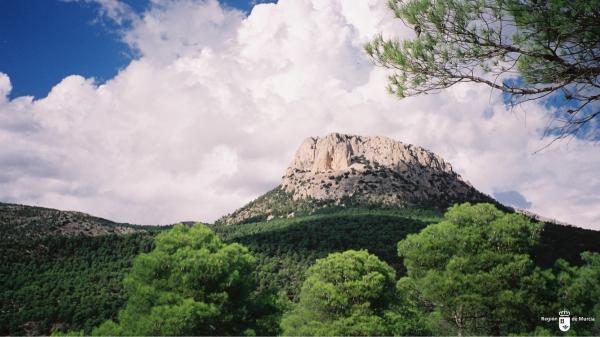
The result can still be seen today. That mountain range that had been left practically bare became an extensive forest landscape that is currently considered a model of hydrological-forest restoration.
Sierra Espuña was on the verge of becoming a desert landscape
For centuries, human pressure had profoundly transformed Sierra Espuña. The wood was used for different activities, while grazing, charcoal production, mining and the expansion of agricultural areas progressively reduced the vegetation cover. At the end of the 19th century, the result was a very degraded mountain with little protection against erosion.
The situation also had consequences on water. Without a forest with a forest mass capable of retaining the soil, torrential rains could cause serious floods in an area already affected by flooding.
The alarm increased after episodes such as the Santa Teresa flood of 1879. In this context, in September 1888 the Repopulation Commission of the Segura Basin was established, made up of forestry engineers José Musso Moreno, Ricardo Codorníu and Juan Ángel de Madariaga.
The engineer who wanted to return the trees to an almost bare mountain
Ricardo Codorníu was one of the fundamental figures of that restoration. Born in Cartagena in 1846, he had trained at the Forestry School and developed an intense defense of forests and nature conservation throughout his life. The Region of Murcia remembers him as “the Apostle of the Tree”.
When the Sierra Espuña project was launched, the objective was not simply to plant trees. It was necessary to recover the soil, control runoff and ensure that the new forest masses could survive in a very deteriorated terrain.
The work began under the direction of Musso and, from December 1895, was directed by Codorníu, with the collaboration of Madariaga. The research published by the University of Murcia allows us to clarify a figure that usually appears in popular stories: Codorníu was not the only one responsible for the 5,000 hectares. The restoration was a process developed over decades and in which several engineers participated.
Seeds shot with blunderbusses to reach the most inaccessible areas
The most striking part of that story came when we had to act in places where it was extremely difficult to access. In the sources on the restoration it is remembered that blunderbusses were used to throw seeds in areas that were difficult to access. The Ministry for the Ecological Transition itself has presented Sierra Espuña as a historical example of restoration of a degraded area and mentions the curious technique of planting “with cannon shots.”
But that striking image was only a small part of a much more ambitious intervention.
The engineers studied the terrain conditions and selected the species that could best adapt to each area. Different species of pine were mainly used and also other species such as holm oak where conditions permitted. According to research by the University of Murcia, during the first phase more than 3,256 hectares were repopulated and more than 4.3 million trees were planted.
240 kilometers of roads, hundreds of thousands of terraces and kilometers of dikes
The great transformation of Sierra Espuña was not achieved only with trees. The restoration required a true work of forestry engineering to try to recover the soil and control the water.
Roads, paths, nurseries and different infrastructures were built to facilitate plantations and protect the land. The work also incorporated numerous dikes and retention systems to reduce erosion and stop runoff.
The magnitude of the performance was extraordinary for the time. The informative documentation about the project includes 240 kilometers of roads and paths, 144 kilometers of slope dikes and some 420,000 terraces, in addition to forest nurseries intended to produce the plants necessary for repopulation.
The purpose was clear: to ensure that the water stopped dragging the soil down the mountain and that the new vegetation could settle and develop.
From a devastated mountain to almost 5,000 hectares of forest
The results progressively changed the landscape. The restoration did not end with Codorníu: in 1901 the Commission was replaced by the Segura Hydrological-Forest Division and, since 1903, the work continued under the direction of the engineer Ramón Melgares Góngora. By 1924, the total repopulated area had reached 4,894 hectares.
It is a figure that helps understand the true dimension of the project. It was not a one-time planting, but rather a prolonged action over decades that completely transformed the landscape.
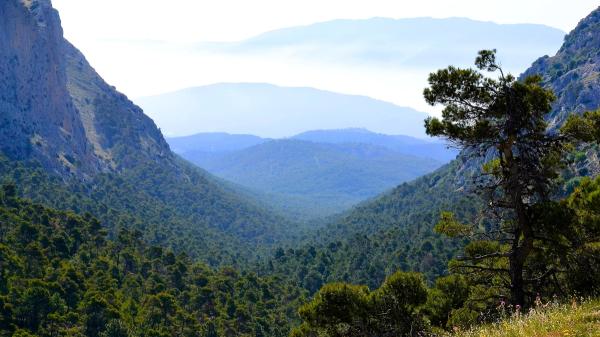
Today, Territorio Sierra Espuña considers that process a European model of hydrological-forest restoration. The old degraded lands gave way to the forest landscape that currently characterizes this natural space, with repopulated pine forests and much more abundant vegetation in ravines and humid areas.
Codorníu’s legacy remains green more than a century later
The story of Sierra Espuña demonstrates the extent to which environmental restoration can change a landscape when maintained for generations. What at the end of the 19th century was a seriously degraded territory ended up becoming one of the great forest areas of Murcia.
Recognition also came decades later. In 1931, Sierra Espuña was declared a Natural Site of National Interest, consolidating the protection of a territory whose recovery had begun more than forty years before.
Codorníu died in 1923, but his legacy remained in the forests he helped recover. Today, when visitors tour Sierra Espuña among pine forests, ravines and old forest infrastructure, it is difficult to imagine that that mountain was practically naked.
If you want to read more articles similar to In 1889 a Spanish engineer reforested 5,000 hectares with cannon fire: more than a century later, Sierra Espuña is one of the great green lungs of Murcia, we recommend that you enter our Ecosystems category.
