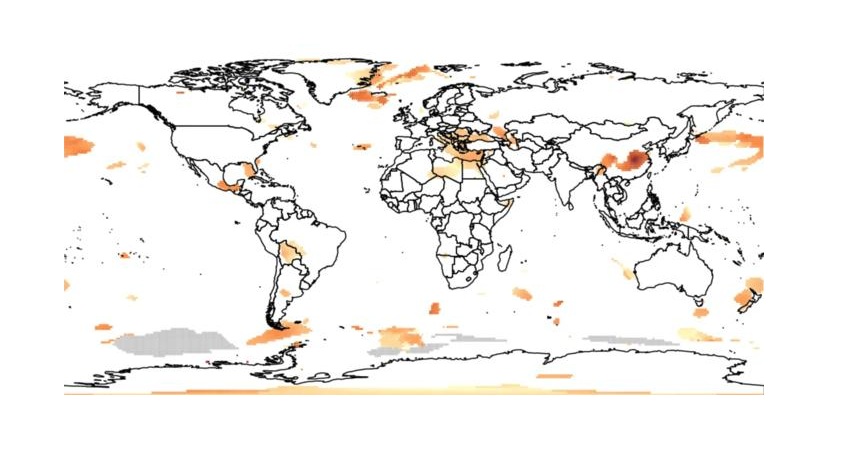
It was 1975 when geochemist Wallace Broecker coined the term global warmingincluding it in the title of his article published in Science “Climatic Change: Are We on the Brink of a Pronounced Global Warming?”. Since then the neologism has become a common term, the subject of more and more scientific studies: one of the latest in chronological order, published in Nature Communicationsidentified the areas of the world where global warming is happening fastest, and since when. “We wanted to provide a clearer picture, region by region, of where warming is actually accelerating and when this acceleration began,” explains Claudie Beaulieu, coordinator of the research.
The authors analyzed five large databases of surface temperatures recorded from 1970 to 2024, looking for times when the rate at which a given area was warming changed. The study made it possible to identify some areas where temperatures have increased faster: Bolivia, the eastern Mediterranean, the North Pacific and New Zealand.
Mexico and China, the “hottest” areas
The largest acceleration would have occurred in the Gulf of Mexico and southeast China: here the pace of warming would have increased approximately tenfold since 2012 and fivefold since 2013. “Our study shows that regional warming accelerations emerged in distinct waves, with onset dates ranging from the 1980s to the 2010s, depending on the geographic area,” Beaulieu points out.
Air too clean?
Although the study does not provide definitive answers as to the reasons for these increases, the authors hypothesize that part of the blame may lie with the decrease in atmospheric aerosols, particularly those containing sulphur. These tiny particles in fact reflect the sun’s rays, creating a sort of shield and cooling the atmosphere: in China the drop in sulfur dioxide emissions linked to the closure of coal-fired power plants may have contributed to increasing the rate of global warming.
In addition to this, natural phenomena such as El Niño (which would explain in particular the exceptional increase in the two-year period 2023-2024) and oceanic oscillations such as the PDO (Pacific Decadal Oscillation) or the AMO (Atlantic Multidecadal Oscillation) could also play a role.
Impacts on populations and ecosystems
Even a small increase in the speed of warming can translate into a disproportionate increase in the probability of extreme climate events: the most populous and less developed regions and ecosystems, which are more adaptable to gradual temperature increases, would suffer the greatest consequences. “The hope is that our work can provide tools and support to better predict impacts at the local level and focus interventions where they are most needed,” concludes Beaulieu.
