
Space weather threatens satellite infrastructure, planetary communications and air transport: to protect us the NASA is building an over -size sun sail.
Our global economy supports more and more satellite infrastructures, intelligent electric networks, planetary communications and air transport, but there is an invisible threat that is hiding behind these activities: the space weather. This set of cosmic phenomena, generated by the activity of the sun, could have devastating consequences for our technologies.
What is the space weather? It includes all the variations of the space environment between the sun and the earth, and can manifest itself in the form of solar storms, brilliant and, above all, expulsions of coronal mass (CME). These are enormous jets of plasma and magnetic fields that can reach speeds of 2,000 km per second (about 7.2km/hour) and hit the earth in a few tens of hours.
In addition to giving spectacular boreal aurores, CME can damage satellites, disturb telecommunications, put electrical networks out of use and represent a serious danger for astronauts in deep space.
Already happened. We have already lived it in the past. The Carrington event of 1859, the most powerful solar storm ever recorded, caused fires and blackouts to telegraphic systems in North America and Europe. In 1972, a similar event touched the astronauts of Apollo 16, while in 2022 Spacex lost 39 Starlink satellites due to a geomagnetic storm.
The new frontier of space forecast. To cope with these risks, a team of heliumfisics – led by NASA experts and industrial partners – is working on a new constellation of satellites called Swift (Space Weather Investigation Frontier). The goal is to increase the alert time for extreme solar events so as to protect civil, military and commercial infrastructures.
Currently, the monitoring satellites positioned at the Lagrange L1 point (it is a point in space where the severity of the earth and the sun balances themselves, allowing an object to remain stable between the two), about 1.5 million kilometers from the earth, offer a maximum notice of 40 minutes. Swift aims to bring it to 60 minutes, thanks to the introduction of an innovative satellite in orbit beyond L1, 2.1 million kilometers from the earth.
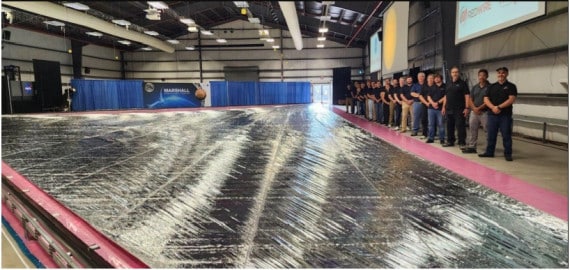

Pushed by the sun, without fuel. To reach such a remote orbit, where normal chemical propulsion systems would quickly exhaust fuel, the Swift team has created a revolutionary system, even if already experimented: a sunny sail. This type of propulsion uses the pressure of sunlight, i.e. photons, to generate push. The sail – an ultralight membrane, similar to a gigantic mirror – can balance the gravitational attraction of the sun, keeping the probe in position without burning fuel.
The prototype of the mission, called Solar Cruiser, will be launched in 2029. With an area of over 1,650 m² (more than six tennis courts), it will be the largest sun sail ever made, exceeding pioneering projects such as Ikaros (Japan), Nanosail-D2 (NASA), and Lightsail (Planetary Society). Once in orbit, Solar Cruiser will guide the road to the complete constellation Swift: four satellites, of which three with chemical propulsion positioned in L1 and one, the most advanced, driven by the sail beyond the point of gravitational balance.
A network of alert. The data collected by Swift will significantly improve the ability to predict and model the space weather. The implications are vast.
Satellite operators will be able to maneuver the devices to avoid deterioration or fall in orbit, electric networks will be able to protect themselves from potentially catastrophic tension peaks, airlines will be able to deviate polar routes, reducing exposure to crew and passengers radiation, astronauts on a mission to the moon and Mars will be able to protect them in time, the armed forces will be able to maintain the functionality of critical communications and Satellite surveillance and also boreal auror enthusiasts will be able to plan their travels with greater precision.
A race against time. According to estimates by the National Oceanic and Atmospheric Administration (Noaa), potential damage from an extreme space weather event could reach 2,700 billion dollars globally. The growing militarization and marketing of space – between lunar missions, asteroidal extraction and orbital tourism – makes it even more urgent to have an effective monitoring network. Swift could become our best shield against the energy of the sun itself.
