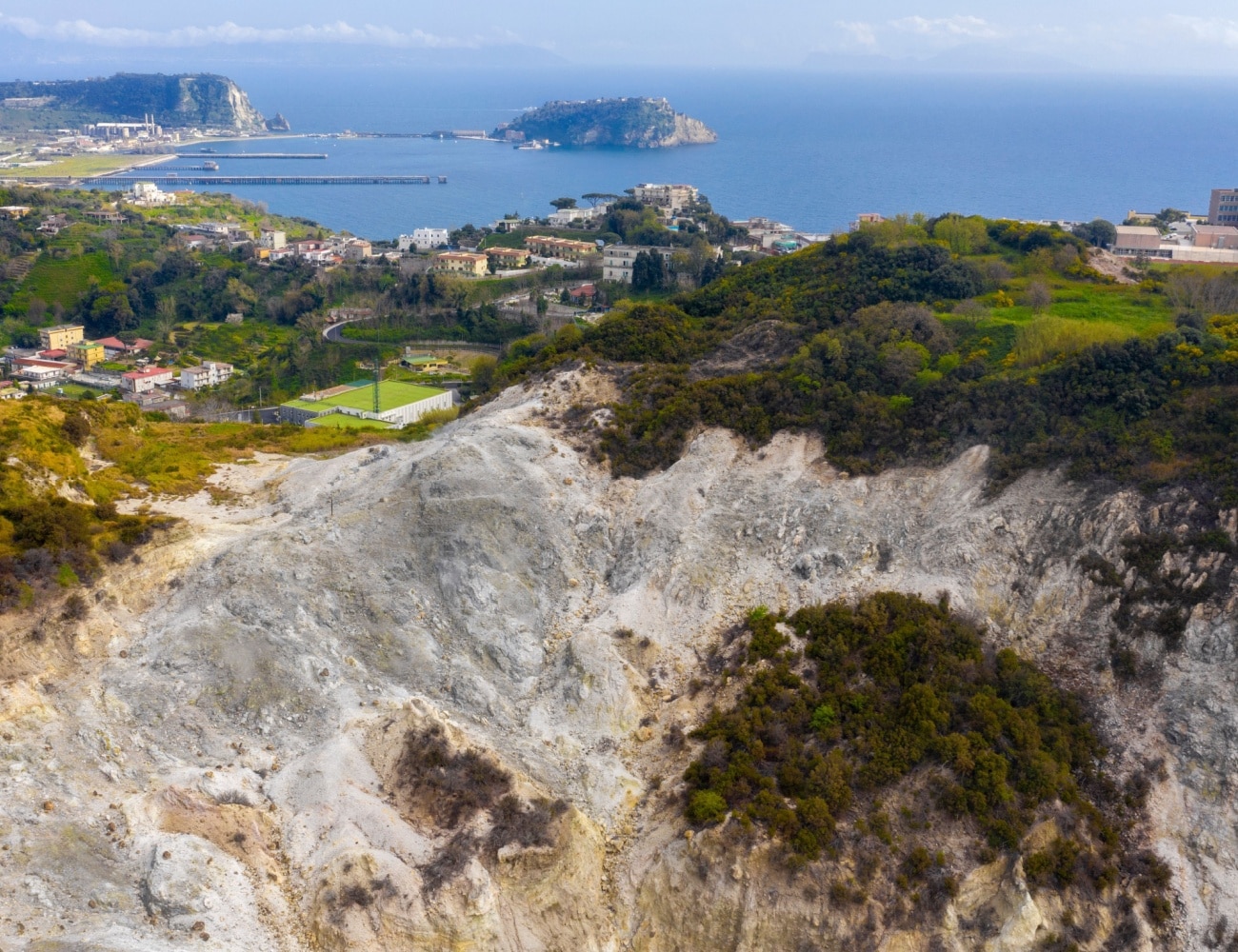
The cavity emits a constant seismic signal: this “resonance” allows you to trace the flows of fluids in depth and identify volcanic risks to the Flegrei fields.
An international group of researchers led by the University of Pisa, in collaboration with the Ingv (Vesuvian Observatory) and the GFZ Helmholtz Center of Potsdam, has revealed a cavity hidden at 3.6 kilometers deep under the Flegrei fields, the note volcanic caldera near Naples extremely dangerous for its possible eruptions. The study, published on Nature Communications Earth & Environmentopens new prospects on the dynamics of magmatic fluids and on volcanic risk assessment.
The “resonant” cavity. The cavity, about 1 km long, 650 meters wide, with an average thickness of just 35 centimeters (therefore it is more an extended fracture than a cavity) and an estimated volume around 220,000 meters, is connected to the deep tank that causes the lifting of the soil, bradisism, and the natural fumaroles in the Solfatara and Pisciarelli area.
The content has not yet been confirmed: there may be high pressure gases or magmatic fluids. According to Giacomo Rapagnani, the first author of the study and learning in Pisa, the cavity has emitted a seismic signal, for at least seven years, at a constant frequency of 0.114 Hz, demonstrating stable dimensions and composition during this period. This “resonance” allows you to trace the flows of fluids in depth and identify potentially dangerous structural variations.


The Campi Flegrei. The entire area, monitored by the Ingv, crosses a phase of bradisism that began in 2005, with a lifting of the soil that reached peaks of about 3 cm per month. From 2018 over 100 earthquakes have been recorded: the strongest one, of magnitude MD 4.6, took place on 30 June 2025. According to some seismic geologists, seismicity increases with the intensification of the lifting: when the deformation accelerates, frequency and magnitude of earthquakes also grow, which in some cases – albeit very rare – can reach intensity of up to 5.
Prevention strategies. Another study published on Science Advances It suggests that the current “Unrest” (a term used by geologists to indicate a phase of anomalous activity in a volcano that does not necessarily precedes an eruption) is guided by an accumulation of pressure in a geothermal tank under Pozzuoli, fueled by underground fluids: a discovery that confirms the idea that is not only the skill of magma unique cause of seismicity and deformation. The research indicates that managing water flows or reducing the hydrostatic pressure of the tank could be an effective preventive strategy.
Monitoring. According to Francesco Grigoli, co -author of the latest research and professor in Pisa, the integration of sophisticated techniques for seismic and geophysical analysis represents a qualitative leap in the mitigation of volcanic risks.
Only by interpreting large heterogeneous data sets can significant precursors signals from environmental and geological noise can be distinguished.
This discovery represents a fundamental element for a surveillance plan: the detection of stable resonances in VLP signals (seismic signals with a very low frequency, used in volcanology to study what happens within a volcano, at great depth), coupled to the management of underground water resources, can translate into a useful preventive alert tool, a real approach of “preventive medicine” geological.
