
The choice of heating system directly influences energy consumption, monthly expenditure and the level of comfort in a home. With rising energy prices and greater concerns about efficiency, more and more people are looking for alternatives that offer better performance with a lower environmental impact.
Therefore, we are going to dedicate this Evidence Network article to telling you which are the most efficient heating systems so that you can make a comparison in your home.
What are the most efficient heating systems?
Aerothermal
The aerothermal heat pump is currently one of the most efficient heating systems for homes. It works by extracting energy from outside air (even at low temperatures) and transferring it inside the home through a circuit. Instead of generating heat by burning fuel, what it does is transfer it, which allows it to achieve very high performance.
The main advantage of aerothermal energy is the coefficient of performance. For every kWh of electricity it consumes, it can generate between 3 and 5 kWh of heat. This translates into significant energy savings compared to traditional electric or combustion systems. Furthermore, if it is combined with a photovoltaic self-consumption installation, the operating cost can be reduced even further.
Geothermal
Geothermal energy is one of the most efficient and stable heating systems that exist, since it takes advantage of the thermal energy stored in the subsoil. At a few meters deep, the ground temperature remains practically constant throughout the year, allowing heat to be extracted in winter and dissipated in summer using a geothermal heat pump.
Its operation is similar to that of aerothermal energy, but instead of capturing energy from the air, it obtains it from the ground through vertical probes or buried horizontal collectors. This thermal stability allows it to achieve even higher performance, with performance coefficients that can be between 4 and 6, making it one of the most efficient options on the market.
condensing boiler
The condensing boiler is an efficient evolution of traditional gas or diesel boilers. Its main difference is that it takes advantage of the heat contained in the combustion gases before expelling them outside. Instead of wasting that heat, it recovers it through an exchanger that condenses the water vapor generated in combustion, thus increasing the performance of the system.
Thanks to this process, it can achieve efficiency of over 100% on the lower heating value of the fuel, which represents a saving of between 15% and 30% compared to an old conventional boiler.
Underfloor heating
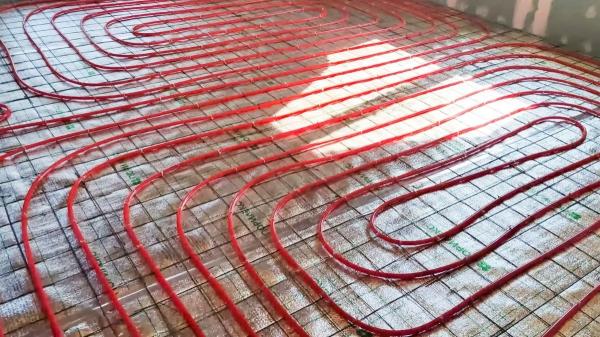
Underfloor heating is one of the most efficient heating systems from the point of view of comfort and energy consumption. It works through a network of pipes installed under the pavement, through which low-temperature hot water or electricity circulates to generate heat. This heat is distributed evenly from the ground upwards, heating the space by radiation.
One of its great advantages is that it works with flow temperatures much lower than traditional radiators (between 30 and 45 °C in water systems), which makes it the ideal complement for heat pumps such as aerothermal or geothermal. By requiring less temperature to achieve the same level of comfort, energy consumption is considerably reduced.
Biomass
Biomass heating, especially using pellets, is an efficient and more sustainable alternative to traditional fossil fuels. This system uses pressed organic waste (usually wood pellets) as an energy source that is burned in a boiler or stove specifically designed for this fuel.
Its efficiency is high, since modern pellet boilers can achieve efficiency of over 85–90%. In addition, the cost of fuel is usually more stable than that of gas or diesel, which provides some predictability in spending in the medium term. From an environmental point of view, it is considered renewable energy, since the CO₂ emitted during combustion is equivalent to what the tree absorbed during its growth.
Signs that you need a more efficient heating system
It’s not always easy to know when it’s time to change your heating system, but there are some clear signs that your current installation is no longer as efficient as it should be. These are some of the most common:
- Increasingly higher energy bills with no real increase in usage.
- Difficulty maintaining a stable temperature in the home.
- Cold areas or thermal differences between rooms.
- Frequent noises or recurring breakdowns in the boiler or current system.
- Equipment more than 15–20 years old.
- Strange odors or irregular combustion (in gas or diesel systems).
- Poor performance even after performing periodic maintenance.
If you identify several of these situations, you may not only need a specific repair, but also consider a more modern and efficient solution.
Tips to maximize the efficiency of your current system
Before considering completely changing your heating system, it is worth making sure that you are making the most of the one you already have. Let’s see some tips to increase efficiency:
- Smart programming: Adjusting operating hours to your daily routine avoids unnecessary consumption. Keeping the house at 21°C all day is not the same as programming the heating to lower the temperature when no one is home or at night.
- Use of efficient thermostats: Some models learn your habits and automatically optimize the system’s on and off, avoiding consumption peaks and improving overall efficiency.
- Periodic maintenance: Cleaning burners, checking exchangers or purging radiators improves performance and extends the useful life of the equipment.
- Improved insulation: Checking windows, doors and possible air leaks can make a big difference.
- Adjust the appropriate temperature: Keeping the home between 19 and 21 °C is usually sufficient for adequate comfort in winter. Raising the temperature beyond that range increases consumption without providing a proportional benefit in well-being.
If you want to read more articles similar to The most efficient heating systems: save energy and reduce your bill, we recommend that you enter our Energy Savings category.
- Which heating system is best for me? What is the ideal heating for my house? Elnur Gabarron. Available at: https://www.elnur.es/que-sistema-de-calefaccion-me-conviene-mas-cual-es-la-calefaccion-ideal-para-mi-casa/
- Efficient heating systems to reduce energy consumption in homes. Sustainable architecture. Available at: https://arquitectura-sostenible.es/sistemas-calefaccion-eficientes/
