
Let’s do an experiment, and know that you are not the first to participate: since 1929, people all over the world have been subjected to the protocol invented by the psychologist Wolfgang Köhler. Look at this image:
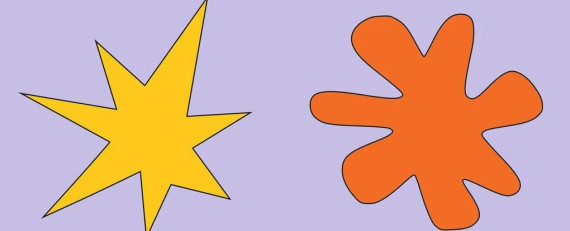

Which of the two forms is “Bouba” and which is “Kiki”? For almost a century, the overwhelming majority of people have responded that the jagged shape on the left is “Kiki,” while the rounded shape on the right is “Bouba.” Well, apparently we are not the only animals to think this way: a study by the University of Parma published in Proceedings of the Royal Society B: Biological Sciences It shows that dogs also share our opinion.
Bouba or kiki?
The so-called bouba/kiki effect, which according to psychologists demonstrates that the names we give to objects are not arbitrary but reflect the way we pronounce the words themselves, is agreed upon by a percentage of people ranging between 95% and 98%, at least according to the studies conducted so far. To find out whether a similar effect also applies to dogs, the Italian team recruited 70 domestic dogs and their owners. In the first experiment, 51 of these dogs were placed in a room with two screens (and as many speakers) on opposite sides.
At this point, the master would sit in the middle of the room, without looking at either screen. Which, for 15 minutes, showed images of the classics Bouba and Kiki, alternating from one screen to the other and accompanied by a human voice pronouncing the two words (also alternating between the two speakers). The second experiment eliminated any possible human interaction: the owners wore headphones with which they listened to music at full volume, so as not to know where the sounds “bouba” and “kiki” came from.
And this is just the beginning
Thanks to a GoPro camera system and an AI capable of tracking the movement of the dogs’ heads, the researchers were able to verify that they too show a clear preference for the association between “bouba” and the round shape, and “kiki” and the pointed one. Preference amplified in the second experiment, the one with the human “out of the picture”: it is possible that, in the first, the owners influenced the animals in some way, even if it is only a hypothesis that the authors themselves consider “unlikely”.
Obviously, a single study is not enough to unequivocally demonstrate that even dogs consider bouba a round word and kiki a prickly one. However, the study is a starting point to delve deeper into the issue, and also study the way in which dogs interact with our language and our way of using words.
