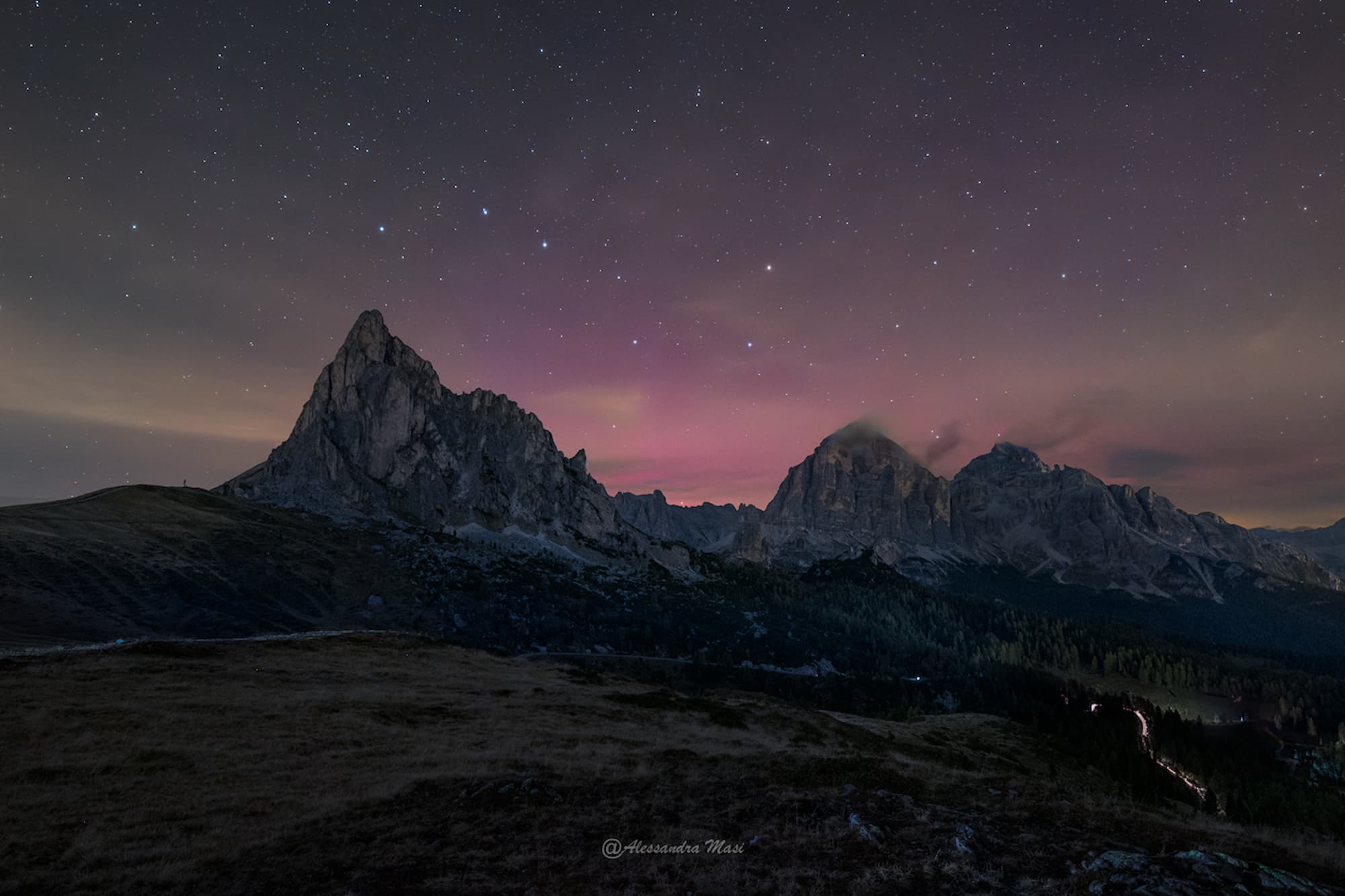
On October 10, 2026, an aurora borealis was observed and photographed among the peaks of the Dolomites. Here’s what happened, how the phenomenon is explained and where it is possible to observe the Northern Lights.
Between 19:15 and 20:30 UTC on 10 October 2026, the sky above Cortina d’Ampezzo showed a spectacular reddish hue. The images were captured from Passo Giau, one of the most evocative Alpine passes in the Dolomites, overlooking the spectacular Tofane massif, peaks recognized by UNESCO as a World Heritage Site.
In the photograph (taken by Alessandra Masi, who in the past saw one of her shots chosen by NASA for the Apod) we observe a very intense red luminosity that stands out above the thousand-year-old rock. It is an aurora borealis, a phenomenon normally visible only in regions close to the Arctic Circle, but which on this occasion reached Italy (in the past it has happened very rarely).
What is the Northern Lights
The Northern Lights are a luminous phenomenon that occurs in the Earth’s upper atmosphere. Put very simply: the Sun emits charged particles that travel into space and, once they reach the Earth, these are deflected by the magnetic field towards the polar regions.
Here they come into contact with the gases present in the atmosphere, especially oxygen and nitrogen, which react and emit light. The result is a light show similar to that of neon lamps, in which energy is transformed into colour.
Because the sky turned red
The colors of the aurora depend on the type of gas involved and the altitude at which the interaction occurs. The red color, which dominates in the image taken from Passo Giau, is caused by oxygen molecules located at very high altitudes in the atmosphere (over 200-300 km).
The predominance of red indicates that the aurora was observed from a great distance, a typical characteristic of more intense events.
Where the Northern Lights can be observed
Normally the Northern Lights are visible in regions close to the Arctic Circle, such as Norway, Sweden, Finland, Iceland and Canada.
However, during particularly strong solar storms, the phenomenon can extend southwards and become observable also in central Europe and the Italian Alps. To be able to see and photograph them, some favorable conditions are essential: clear skies, absence of clouds and very low light pollution, typical characteristics of the high mountains such as the Giau Pass and the Ampezzo area.
A rare event in these latitudes
The auroral event of October 10, 2026 was triggered by a strong G3 class geomagnetic storm, caused by the impact of a coronal mass ejection (CME) that started from the Sun a few days earlier.
Class G3 geomagnetic storms, in addition to providing breathtaking natural scenes, can cause temporary interference to satellites, electricity grids, GPS systems and high-frequency radio communications, which is why the Sun’s activity is constantly monitored by astrophysics and space meteorology centers around the world
.
