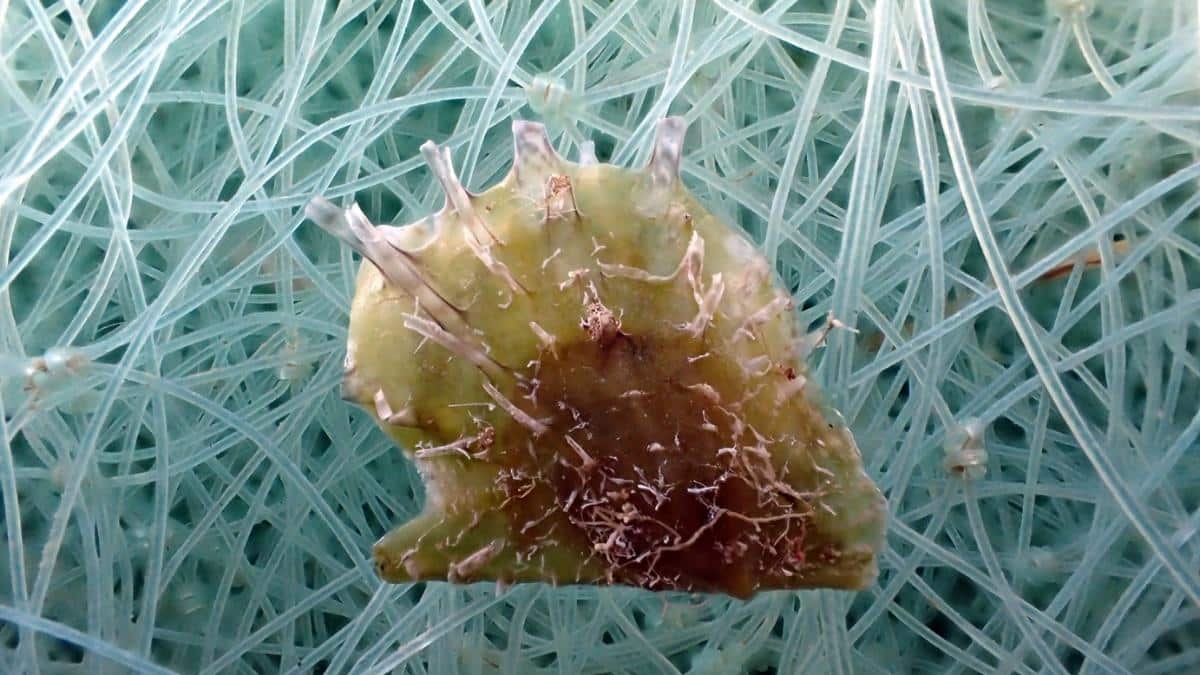
An oyster of tropical origin is expanding its presence in the western Mediterranean and scientists have already confirmed its arrival at different points on the Spanish coasts. It is about Pinctada radiataa species from the Red Sea that entered the Mediterranean after the opening of the Suez Canal in 1869.
Now, more than a century later, its expansion has gained new momentum. The increase in water temperature and its great capacity to disperse its larvae are helping it find increasingly suitable conditions in the western Mediterranean.
A study coordinated by the Torre de la Sal Aquaculture Institute (IATS-CSIC) has followed its progress through a network of 132 measurement points spread across eight countries. The results show that the species already extends along a good part of the Spanish coast and that researchers maintain surveillance to find out how far it can reach.
The invasive oyster has already settled in several parts of the Spanish coasts
Pinctada radiata It is a warm-water pearl oyster that arrived in the Mediterranean from the Red Sea through the Suez Canal. For this reason it is part of the so-called Lessepsian migrant species and is considered the first invasive species recorded in the Mediterranean after the opening of this artificial route.
For decades, its presence was concentrated mainly in the eastern Mediterranean and in the south-central area of the basin. However, the new data shows an important change: the species is moving westward across the board.
In Spain, the oldest records obtained through the monitoring network date back to 2016, in the Balearic Islands. From there, the species has appeared in other places, including the Columbretes Islands, in Castellón, and different areas of the peninsular coast. The records currently reach Agua Amarga, in Almería, although at the moment no settlements have been observed beyond this point.
In the Columbretes it has also been possible to observe how this process occurs. The species was detected for the first time in larva collectors in 2020, but it was not until 2022 when researchers confirmed its settlement in the natural environment.
The presence map thus draws an expansion that currently covers from the western Spanish Mediterranean to the Andalusian coast.

A network of scientists has been following the progress of this species for years
The research has made it possible to reconstruct this expansion thanks to a network of 132 monitoring points distributed in eight Mediterranean countries and data collected between 2015 and 2024. The work brings together information from numerous research teams and constitutes, according to its authors, the most complete analysis carried out to date on the expansion of Pinctada radiata in the Mediterranean.
One of the most interesting elements of this research are the larva collectors. These are simple, economical and easy-to-install structures that allow you to check which species are settling in a certain area.
On the Columbretes Islands, these devices have been used since 2003 to study nacra (Pinna nobilis), a critically endangered Mediterranean bivalve. The team led by Diego Kersting discovered that the same collectors could also be used to detect the arrival of invasive species such as Pinctada radiata.
The system has a particularly important advantage: it can detect the presence of a species before it forms visible populations in the natural environment.
The case of Columbretes is a good example. The oyster appeared in the collectors in 2020 and two years later its settlement was confirmed. For researchers, this demonstrates the potential of this network as an early warning system against new biological invasions.
The warming of the Mediterranean is opening the door to this tropical species
The advance of Pinctada radiata It is not explained solely by its dispersion capacity. Researchers also point out the increase in water temperature as one of the factors that is favoring its expansion through the western Mediterranean.
The species comes from tropical waters and needs relatively high temperatures to develop. As the Mediterranean warms, some areas that may have previously been less suitable are beginning to offer more favorable conditions for their survival and reproduction.
In the Columbretes, for example, the water temperature has increased around 1.5ºC since 1990, according to the researchers cited in the information about the study.
The expansion is also not uniform throughout the Mediterranean. Records show that some colder areas continue to act as barriers for the species, while other areas of the western Mediterranean already present favorable conditions for its establishment.
Added to this is its ability to disperse large quantities of larvae through ocean currents, which makes it easier for it to colonize new places when it finds the right conditions.
Why is the expansion of this invasive oyster so worrying?
Pinctada radiata It is not just any invasive species. It is included among the 100 invasive species considered most dangerous in the Mediterranean due to its possible effects on marine ecosystems.
In the areas of the eastern Mediterranean where it has been established for the longest time, its expansion has already been related to the displacement of native species and alterations in marine communities and the food chain.
Its presence in the western Mediterranean does not necessarily mean that these same impacts are already occurring with the same intensity on the Spanish coasts. Precisely for this reason it is important to follow its expansion from the first phases of colonization.
The problem is that a species that manages to establish itself can be much more difficult to control than another that has just been detected. That is why researchers consider it essential to quickly know where it appears and how its population evolves.
Surveillance will be key to knowing how far it can go
The case of Pinctada radiata shows how the warming of the Mediterranean can modify the natural borders of certain species. An oyster adapted to tropical waters that for decades had a much more limited presence in the western Mediterranean is now finding new opportunities to advance.
For this reason, researchers advocate maintaining and expanding monitoring networks. Collectors make it relatively easy to detect new arrivals and can provide information before an invasive species becomes widespread.
In Spain, monitoring will be especially important to determine if Pinctada radiata continues to advance towards new areas of the coast. For now, the records reach Agua Amarga, in Almería, but scientists are already studying how this expansion is evolving.
The case of this tropical oyster is, ultimately, another example of how an increasingly warmer Mediterranean is changing living conditions underwater and facilitating the arrival and expansion of species that previously faced greater barriers to establishing themselves.
If you want to read more articles similar to Scientists warn of the expansion of an invasive tropical oyster along the Spanish coasts: the warming of the Mediterranean favors its advance, we recommend that you enter our Biodiversity category.
