
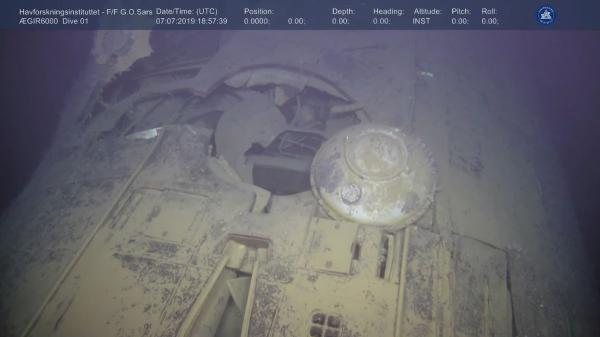
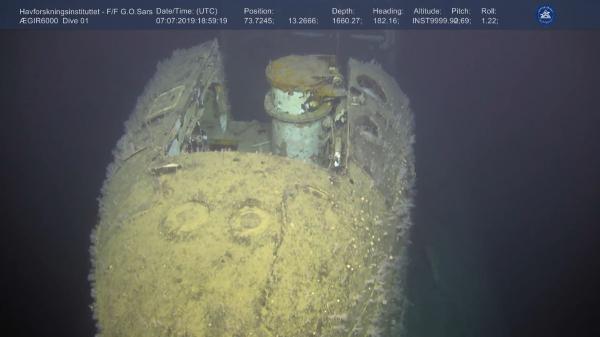
Almost 1,700 meters deep, in the icy waters of the Norwegian Sea, lies one of the most disturbing symbols of the Cold War. The Soviet nuclear submarine K-278 Komsomolets, sunk in 1989 after a devastating fire, is once again raising international concern after Norwegian scientists confirmed that it continues to release radionuclides into the ocean.
The discovery reopens a debate that has been latent for more than three decades: what to do with the sunken nuclear submarines of the former USSR and to what extent they still represent an environmental risk.
The most recent study, published in the Proceedings of the National Academy of Sciences (PNAS), detected persistent radioactive leaks in the submarine’s reactor area, although without conclusive evidence of significant damage to nearby marine fauna.
The news once again puts the spotlight on a wreck that has been of particular concern to Norway for decades, one of the countries most exposed to any possible pollution in the Arctic and the Barents Sea.
The accident of the K-278 Komsomolets, the most advanced submarine of the USSR
The K-278 Komsomolets was not just any submarine. It was part of Project 685 Plavnik and was the only example of its class built by the Soviet Union. Designed in the midst of a technological race with the United States, it incorporated extraordinary innovations for the time, especially an internal titanium hull that allowed it to reach record depths.
In 1984 he managed to descend to more than 1,000 meters, an impressive figure even by today’s standards. The submarine was intended as a technological laboratory for future generations of Soviet nuclear submarines.
But on April 7, 1989 everything changed. A short circuit caused a fire in one of the engineering compartments while it was submerged near the Norwegian island of Bjørnøya. Although the crew managed to emerge, the fire continued to spread for hours. Eventually, the submarine sank with its nuclear reactor and two torpedoes with nuclear warheads still on board. In the end, 42 crew members died, many of them from hypothermia while awaiting rescue in waters close to two degrees Celsius.
The fear of an “underwater Chernobyl”
From the moment of the sinking, Norway demanded exhaustive investigations into the condition of the wreck. The fear was clear: that the nuclear reactor or atomic warheads would release plutonium and other radioactive materials in one of the most important fishing regions of the North Atlantic.
The USSR organized oceanographic expeditions just months after the accident. According to archives and later reconstructions, Moscow initially tried to minimize environmental risks, claiming that the leaks were “insignificant.”
However, the issue never completely disappeared from the Norwegian diplomatic agenda. For years, Oslo pushed to maintain regular monitoring in the area. In 2019, high levels of radioactive cesium had already been detected in samples taken near the submarine’s ventilation ducts. Those records were up to 100,000 times higher than the normal values of the surrounding sea, although very localized.
The official Norwegian position has been relatively cautious. Authorities maintain that, at the moment, there are no signs of significant contamination in fish or food chains. But they also recognize that the progressive deterioration of the helmet could increase the risk over the decades.
Russia and the toxic legacy of the Cold War
The Komsomolets is not the only problematic Soviet submarine. After the collapse of the USSR, Russia inherited a huge aging nuclear fleet and a long list of radioactive waste accumulated in the Arctic.
One of the best-known cases is that of the submarine K-27, deliberately sunk by the Soviet Union in the Kara Sea in 1982 after suffering serious failures in its experimental liquid metal reactors. For years, Norwegian and Russian experts discussed the possibility of recovering the submarine for fear of future leaks.
There are also concerns about other reactors, nuclear compartments and military waste deposited for decades in Soviet Arctic areas.
The difference is that the Komsomolets remains relatively accessible for scientific monitoring and continues to be the subject of periodic international campaigns. Partly because it is located much closer to fishing routes relevant to Norway.
An environmental and geopolitical problem
Norway and Russia have cooperated for years on joint nuclear security programs in the Arctic, even during periods of political tension. However, the Russian invasion of Ukraine and the deterioration of relations between Russia and the West complicated many mechanisms of scientific cooperation.
At the same time, the Arctic gains strategic importance due to melting ice, new sea routes and energy resources. This makes environmental risks in the region even more sensitive.
Nuclear safety experts also point out that many of these wrecks were designed with decades of military service in mind, not spending centuries corroding at the bottom of the ocean.
For now, scientists insist that the contamination detected near the Komsomolets remains localized and limited. But the recent discovery shows that the submarine continues to slowly degrade underwater.
Thirty-seven years after sinking, the nuclear ghost of the Cold War is still “alive” at the bottom of the sea.
If you want to read more articles similar to Norway discovers that an old USSR nuclear submarine continues to release radiation: the story of the Komsomolets, we recommend that you enter our Pollution category.
