
Blocks of carbon dioxide ice may have carved out so-called “gullys”: structures that line the dunes and slopes of some craters on Mars.
In recent years, scientists have advanced several hypotheses to explain the origin of the “gullys” on Mars — structures that furrow the dunes and slopes of some Martian craters — trying to understand whether they were shaped by liquid water, ice, carbon dioxide or combined processes. Now a new hypothesis suggests that blocks of carbon dioxide (CO₂) ice may be primarily responsible for the formation of these channels and not the action of liquid water, as other researchers have hypothesized. One of the scholars who contributed decisively to this discovery is Dr. Lonneke Roelofs, planetary geologist from the University of Utrecht (the Netherlands).
The study. The research, published in the journal Geophysical Research Lettersshows how blocks of CO₂ ice can “carve” channels into Martian sand dunes through a process completely new to Earth science.
«It was like watching sandworms in the movie Dunes», says Roelofs. «The blocks moved independently along the slope, digging the ground with surprising effectiveness».
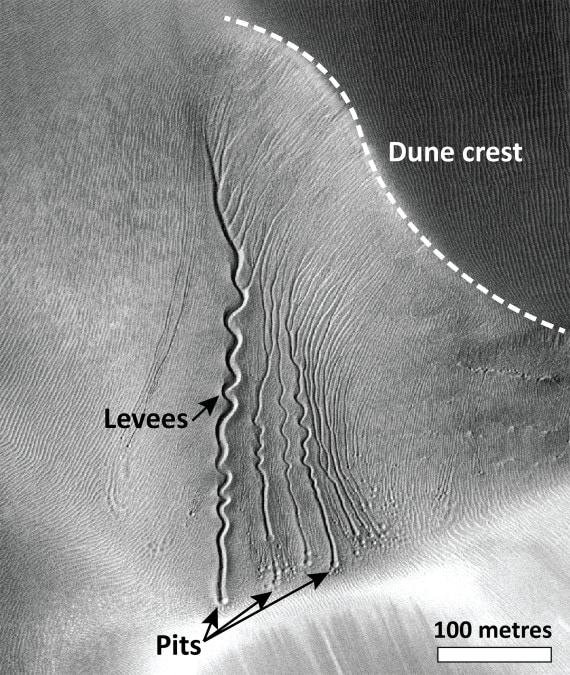

The phenomenon of sublimation. During the Martian winter, when temperatures drop to –120°C, the planet’s thin atmosphere allows layers of dry ice (solid carbon dioxide) to form on dunes in the Southern Hemisphere. With the arrival of spring, the dune slopes warm up rapidly. The blocks of ice, up to 70 centimeters thick and over a meter long, begin to break away and slide downwards. Due to the rarefaction of the atmosphere and the strong thermal contrast between the hot sand and the cold ice, the lower part of the blocks sublimates — that is, it passes directly from the solid to the gaseous state without melting.
This process generates enough gas pressure to lift the block, causing it to slide and burrow into the ground. “In our simulation we saw how the pressure of the gas swept away the sand in all directions,” explains Roelofs. «The block ended up trapped in a small cavity, but continued to move slowly downwards. In the laboratory tests we carried out, a block of CO₂, at the end of its slide, left behind a long channel with sandy ridges on the sides: just like the ones we see on Mars.”
Terrestrial experiments in the “Mars chamber”. To test this hypothesis, Roelofs and student Simone Visschers went to the Open University of Milton Keynes (UK), where there is a special Martian chamber capable of reproducing the low pressure and extreme temperatures of Mars.
There they recreated sandy slopes with different inclinations in the laboratory by dropping blocks of dry ice from above. When the angle of descent was correct, the blocks began to burrow on their own, behaving like “moles” or “sandworms”.
The images and data collected showed that the phenomenon produces gullies identical to those observed by NASA’s HiRISE satellite in the Matara crater region. Furthermore, the irregularities in the path of the gullies appear to be due to wind crests and local variations in the sand grain size, which deviate the trajectory of the blocks during the descent.
Implications for Martian geology. Roelofs’ discovery provides experimental proof of a long-proposed hypothesis: that Martian gullies are not the result of erosion by liquid water, but of cryogenic processes linked to CO₂ ice. This mechanism also explains why such structures are found only in certain regions and seasons, and why evidence of recent water flows is missing.
It is a unique phenomenon, never observed on Earth, since here carbon dioxide does not reach the solid state in the natural conditions of our planet. Roelofs had already contributed, in 2024, to a study on the sublimation of CO₂ ice as a cause of Martian debris flows, which form channels on crater walls. The new research extends these findings, showing that the same physical principle can also explain gullies.
Why does Mars continue to intrigue us? Studying the processes that shape the surface of Mars is not only a way to better understand the Red Planet, but also to revise our understanding of Earth.
Analyzing a different planetary system allows us to discover new natural mechanisms and reflect on how terrestrial life is linked – and limited – to the conditions of our planet.
