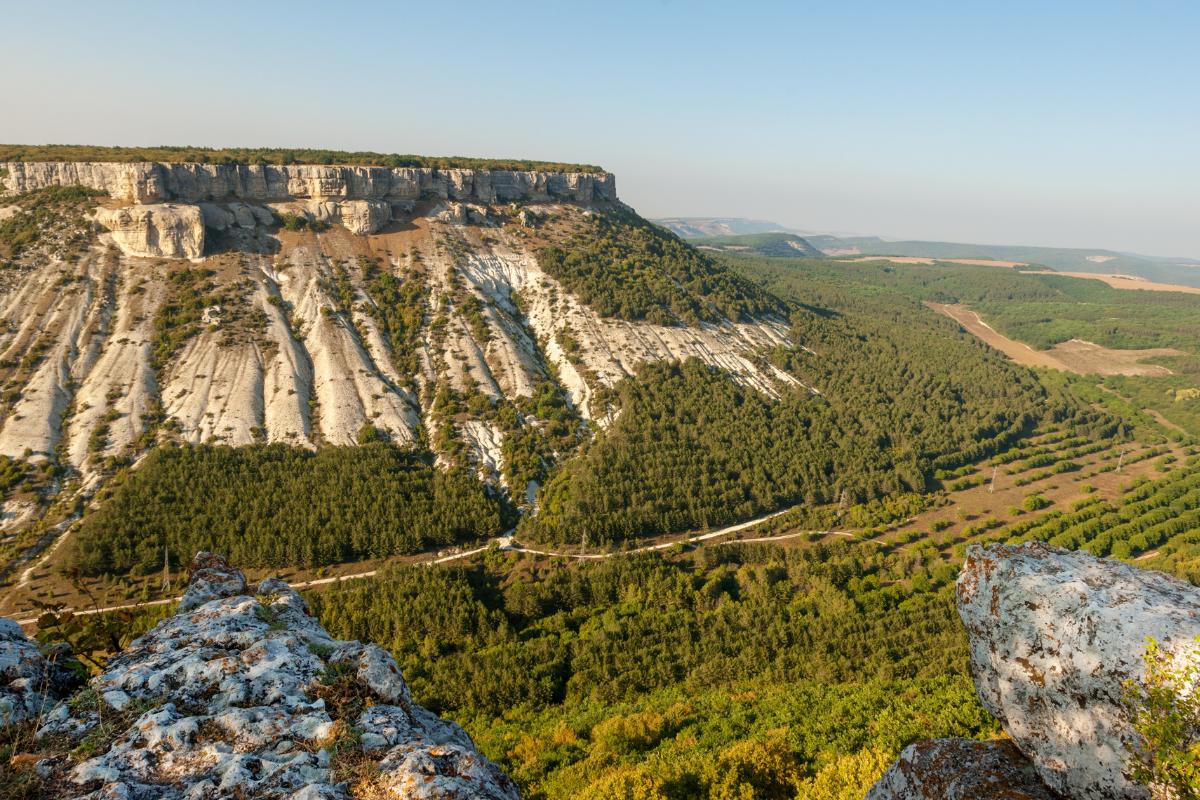
A plateau is an extensive flat or slightly undulating surface that is above 500 meters above sea level. The plateaus can be formed by volcanic, tectonic and erosive processes. Some examples are the Tibet and Decan plateau. If you want to learn more about this type of relief, do not miss the following ecology article about What is a plateau, how is it forms and examples.
What is a plateau
A plateau is a extensive flat or slightly undulating surface that is at a considerable altitude above sea level, usually by Above 500 meters above sea level. Its origin may be due to different geological processes such as tectonic lifting, erosion of old mountains or the emergence of underwater platforms. In many cases, the plateaus are old mountains that have been eroded by the continuous action of the wind, the rain and other erosive agents.
According to the region of the world, there are several smaller relief accidents that have similar characteristics to the plateaus, although on a smaller scale. These forms of the relief receive different local names:
- Altiplano or Altiplanicie: It is a high and extensive plateau, which is generally between two or more recent mountainous chains.
- Butte: In the United States and Canada, it refers to an isolated and prominent hill, with steep slopes and a flat top of small size.
- Chapada: In the center-west and northeast of Brazil, it is high rock formation (greater than 600 meters) with a very flat upper part.

How a plateau is formed
The plateaus can be formed through various geological processes and their origin varies according to the region and environmental conditions. Here are what are the main training mechanisms:
Volcanic formation
The plateaus that are generated by volcanic activity do so through the outcrop of magma from the terrestrial mantle or by the extrusion of lava through cracks in the cortex. In the first case, the magma ascends and causes a lifting of the terrain forming large flat surfaces at high altitude. In the second, the lava spreads horizontally on the surface, cools and accumulates in successive layers that build a plateau.
Tectonic formation
The tectonic plateaus originates from the movement of the tectonic plates, which generates uprisings of large blocks of the earth’s crust. They usually have a considerable size and uniform altitudes.
Erosion formation
Some plateaus are formed by the erosion of high geographic mountains or accidents. The wind, the water and even the glaciers present in cold regions of the planet, slowly wear the terrain until leaving flat surfaces between mountain ranges. This training process can lead to dissected plateaus, which are very eroded plateaus cut by rivers and broken by narrow and deep valleys.
Examples of plateaus
- Tibet plateau. Known as “The roof of the world”, the Tibet Plateau is the highest and largest plateau in the world. It is located at the intersection of Central, South and Eastern Asia that has an average elevation of 4500 meters.
- Decan Plateau. The Decan plateau is a great high plateau that extends for most of the central-south territory of India. Its altitude varies between 80 and 750 meters above sea level and occupies an area of 800,000 km².
- Columbia plateau. It constitutes a wide Pacific Plateau in the northwest of the United States crossed by the Columbia River and located between the waterfall mountain range and the rocky mountains.
- Mesetas and Low of Extrandine Central Patagonia. The Extrandine Patagonia region from the Colorado River to Tierra del Fuego in Argentina has an endless plateau landscape crowned by sandy gravels and, to a lesser extent, by basaltos. This type of relief that is extended by hundreds of kilometers was caused by river currents produced during the fusion of the mountains.
- Center table (Mexican Altiplanicie or Mexican Central Plateau). It is located between the Sierra Madre Occidental and Sierra Madre Oriental of Mexico, covering territory of the states of San Luis Potosí, Guanajuato, Aguascalientes, Zacatecas, Jalisco and Querétaro. The majority of the territory consists of an extensive plateau with some isolated mountains, of which the Sierra de Guanajuato and the Cuatralba Sierra stands out.

Difference between plateau, plain and mountain
Here are the main differences between plateau, plain and mountain:
- Altitude: The plateaus have a moderately high height, usually over 500 meters above sea level. The plains, on the contrary, are low plains of very little altitude (less than 200 meters above sea level). Finally, the mountains have large heights (more than 1000 meters above sea level), with inclined slopes.
- Origin: The plateaus can be generated by tectonic movements, volcanic activity or erosive processes. The plains are usually formed as a result of the sedimentation produced by the erosion of the high parts, and the evaporation of the lakes. On the other hand, the mountains are born from a process called the deformation of the cortex, which occurs when two parts of the lithosphere collide and produce that the slabs are stacked over others, so that the earth’s cortex rises and deforms gradually.
- Surface: The plateaus have a flat or gently undulating surface, despite their altitude. The plains are also flat, but they are at lower altitude. The mountains, on the other hand, have irregular surfaces, with spikes, valleys, slopes and streams.
If you want to read more articles similar to Plateau: What is it, how it is formed and exampleswe recommend that you enter our category of other environment.
- Simeoni, A. (2008). Mesetas and low of Extraandina Central Patagonia. The investment of the relief. Available at: https://repositorio.segemar.gov.ar/handle/308849217/1368
