
Eyes to the sky: the solar storm will have its peak between 1 and 2 September, spectacular boreal aurores could also be seen in Italy (especially in the North).
A geomagnetic storm between 1 and 2 September is coming: its effects, for example spectacular boreal aurore, could also be visible from Italy, more likely in the north. Here’s when and how this solar storm was generated …
When it was formed. On the evening of August 30, 2025, the Sun produced a significant solar eruption: a class M2,7 class, which was produced at 10:02 pm Italian time, from the active region 4199 (Beta classification), positioned in the center of the solar disc. Initially he left at 9:11 pm UTC, he reached the peak at 22:02 and ended at 10pm: 41 – a duration higher than the average, so as to cause a CMA (expulsion of a coronal mass or a huge cloud of plasma and magnetic fields that the sun launches in space) complete and asymmetrical, visible as “Halo” in the Lasco C3 images around 22:30.
The expulsion of plasma is directed towards the earth, in the images we do not see it as a jet on the one hand, but as a circular halo (“Halo cme”) that seems to wrap the whole sun album, but it is a perspective effect: the cloud is coming towards us, so it seems to surround the sun like a ring.
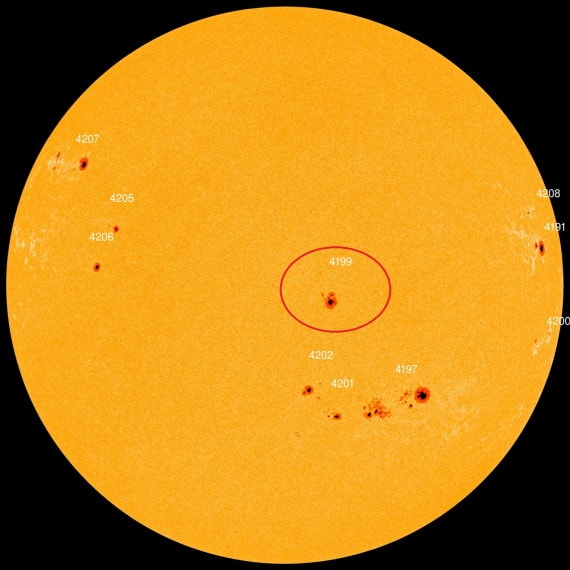

What is going on. This CME, directed towards the Earth, has activated a warning of geomagnetic storm with G2 values (moderate) for September 1st and G3 (strong) for September 2nd.
The expected impact between the evening of 1 and 2 September can give rise to disorders in the electricity grid, in the on -board electronics of satellites, in GPS systems and in radio communications HF. Low orbit satellites may undergo greater aerodynamic resistance and increase the risk of incorrect orientation or errors in the GPS ranges.
The auror … in Italy? An accumulation of energy -charged particles, like this, can give life to spectacular boreal ear. In the presence of G3 -G4 conditions, the Aurora can go to unusually low latitudes: in the United States, it could be visible up to Pennsylvania, Iowa and Oregon.
What does it mean for Italy? In the past, exceptional solar storms have also made the aurora visible from our territory: as in the nights between 10 and 11 May 2024, when the aurora has been clearly observed in many areas of northern Italy. Although a G3 storm does not generally give visual guarantees in Italy, the contemporary presence of a high-speed solar wind flow or a region of co-croting interaction (CIR) can increase geomagnetic intensity and favor the phenomenon, making it visible here too.
In the past, similar geomagnetic thunderstorms have allowed even observations to Rome, Naples, and in other areas of Central and Southern Italy.
What to monitor. Serene skies and low levels of light pollution are fundamental requirements to spot the aurora. To follow the event it is useful to keep up to date on the SWPC/Noaa website: to know the intensity of the storm and the possibility of the most extensive lights.
The values to keep an eye on. For those wishing to follow even better, the event is suggested to keep an eye on the KP and DST indices. The KP (Planetary K Index) index has a scale ranging from 0 to 9: the higher the value, the more intense the geomagnetic activity is. Calculated every 3 hours as the media of the data of 13 geomagnetic observers distributed in the world, it measures the fluctuations of the Earth’s magnetic field caused by the sun wind and by the expulsions of Coronale (CME). With a kp 0–2 the activity is low, visible only in polar areas. With a KP 3–5 there are the possibility of lower latitudes. With a KP 6–9, the aurore can also be visible in Central Europe or Northern Italy.
The DST index (disturbance Storm Time Index) instead measures the intensity of geomagnetic storms observing the variation of the magnetic field in the equatorial area. It is expressed in Nanotesla (NT) and can take negative values: DST near 0 are quiet conditions, with DST between −50 and −100 moderate storms occur, with DST below –100 the geomagnetic storms are intense. It is useful for understanding how much the Earth’s magnetosphere is compressed and how much it can influence satellites, GPS and electric networks. While the KP is more useful for predicting the ear, the DST is more technical and used to evaluate the impact on space and terrestrial infrastructures.
