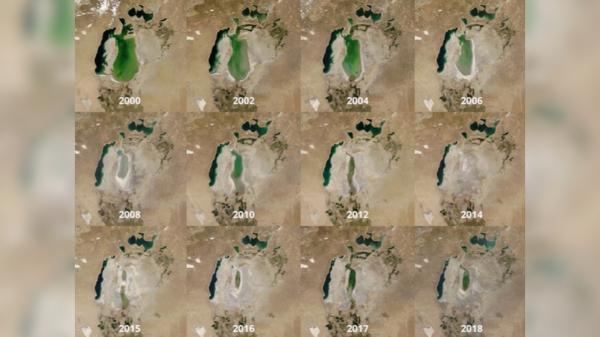
The Aral Sea, one of the greatest ecological disasters in history, could have a second chance thanks to a scientific proposal as ambitious as it was unexpected: to cover part of its old bottom with water again. A team of Spanish researchers proposes recovering a part of this enormous lake to stop the CO₂ emissions generated by its drying.
Since it began to disappear in the 1960s, the ancient bed has released hundreds of millions of tons of carbon into the atmosphere. Now, a study published in the journal Science suggests that recovering part of the flooded surface could prevent another 605 million tons of CO₂ from being released. However, carrying out the project would require an investment of billions of euros.
The Aral Sea has become a source of CO₂ emissions
Located between Kazakhstan and Uzbekistan, this enormous lake began to disappear in the 1960s, when the authorities of the former Soviet Union diverted the rivers that fed it to boost cotton crops in Central Asia. A study published in the scientific journal Science by a team of Spanish researchers has discovered that the disappearance of water has also caused the release of enormous amounts of carbon dioxide (CO₂) into the atmosphere.
Scientists estimate that since the beginning of drying, the ancient lake bed has released approximately 204 million tons of carbon, equivalent to about 748 million tons of CO₂.
The research also raises the possibility of recovering part of the flooded surface of the Aral Sea to prevent it from continuing to release carbon. A proposal that goes beyond environmental restoration and could become a new tool to combat climate change.
Why the ancient lake bottom is releasing carbon into the atmosphere
For thousands of years, lake sediments have functioned as large natural carbon deposits, storing plant remains, microorganisms and other organic materials that end up buried underwater. While covered by a column of water, these sediments are relatively isolated from atmospheric oxygen. This circumstance limits the decomposition of a good part of the organic matter and allows the carbon to remain stored for long periods of time.
However, when the water disappears, oxygen penetrates into the surface layers of the old lake bottom and activates the activity of microorganisms that begin to decompose the accumulated organic matter. During this process, known as aerobic microbial degradation, carbon dioxide is released and ends up reaching the atmosphere.
The study published in Science revealed that the growth of vegetation on dried land barely offsets these emissions, since its absorption capacity represents less than 1% of the carbon lost.
The scientific proposal: flood part of the Aral Sea again
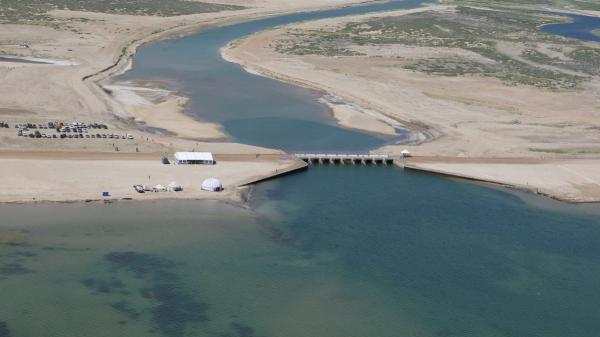
Given this scenario, researchers propose recovering part of its flooded surface. The idea is to re-cover certain areas of the former Aral Sea floor with water to prevent oxygen from continuing to penetrate the sediments and accelerate the decomposition of organic matter.
It would not necessarily be a matter of recovering the lake in its entire original extension, something extremely complicated due to the dimensions of the lost surface and the water needs of the countries in the region. The approach involves identifying those areas where flooding could have a greater effect on carbon emissions and concentrating efforts there.
The logic is relatively simple. If the sediments are placed under water again, their exposure to oxygen decreases and the oxidation process that releases CO₂ slows down. In this way, a part of the carbon that is still stored in the old lake bed could be conserved.
This strategy would also allow us to approach the problem from a different perspective than traditional solutions to climate change. Instead of focusing exclusively on removing carbon dioxide from the atmosphere through forests, capture technologies or ecosystem restoration, it would be about preventing a natural carbon reserve from continuing to release greenhouse gases.
Recovering half of the lake would require an investment of 8.5 billion euros
According to researchers’ estimates, if no action is taken, the ancient Aral Sea floor could release another 605 million tons of CO₂ into the atmosphere. Avoiding these emissions would require large-scale intervention, although scientists believe that there is a technically viable way to achieve this.
One of the main obstacles is in the hydraulic infrastructure of Central Asia. Many of the irrigation canals used to transport water to agricultural areas are old and have significant losses. It is estimated that these facilities can waste up to 90% of the water that circulates through them.
For this reason, one of the fundamental measures would be to modernize the entire water distribution network in Central Asia. The estimated investment to undertake the improvements would be around 8.5 billion euros, an amount that would allow the recovery of approximately half of the surface area occupied by the Aral Sea in 1960.
Carbon credits could finance Aral Sea recovery
To face an investment of such magnitude, the researchers propose taking advantage of the initiative’s own climate benefit: the emissions that would be avoided by reflooding part of the old bed could be converted into carbon credits.
This mechanism would allow an economic value to be given to the CO₂ that would no longer be released into the atmosphere. Companies and organizations interested in offsetting part of their carbon footprint could acquire these credits, generating resources to help finance recovery works.
The estimates included in the proposal suggest that around 323 million equivalent tons of carbon credits could be generated, whose value in international markets would be between 3,100 and 15,800 million euros, depending on the price at which they are sold.
This is an ambitious proposal that would still have to overcome important technical, economic and political obstacles.
If you want to read more articles similar to Spanish scientists propose recovering the Aral Sea to avoid the emission of hundreds of millions of tons of CO₂, we recommend that you enter our Climate Change category.