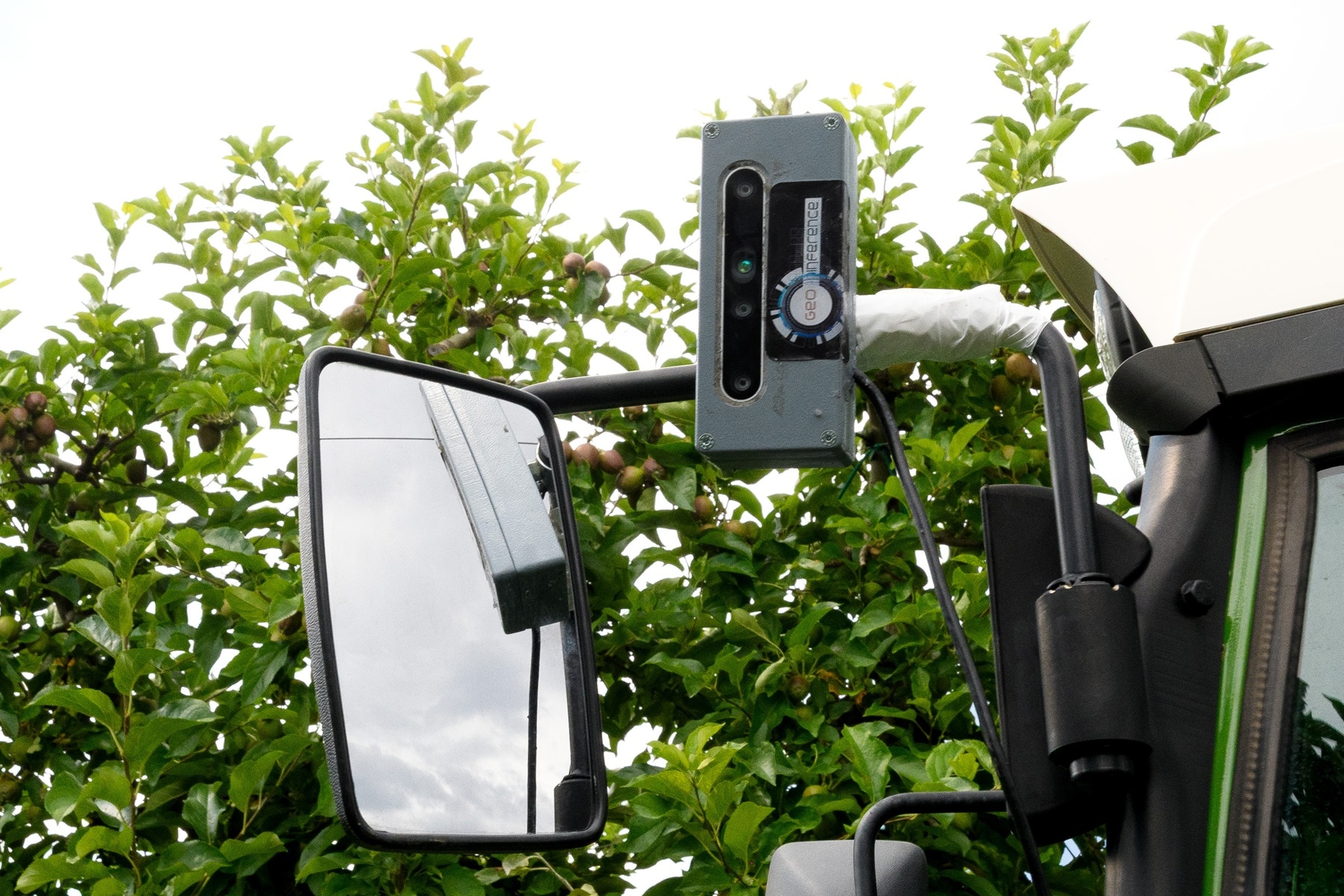
The technology that helps the farmers to estimate the harvest with precision comes from Rovereto.
Providing exactly the quantity of fruit or vegetables that a cultivation will produce has always been one of the most complex challenges for farmers, especially for those who manage large plots of land. “Eye” estimates, entrusted to the experience of farmers, are often inaccurate, exposing companies to organizational and economic risks. Production can vary significantly on the basis of numerous factors: from sudden hailstorms to drought, from the diseases of plants to the invasion of insects or wild animals. All this makes the planning of the collection complicated, the number of laborers to be hired, the booking of machinery or storage warehouses.
To offer a concrete response to this problem comes Biosmart, an innovative solution based on artificial and patented intelligence in Italy and Europe by Geoinference, startup of Rovereto (Trento) founded in 2019 by Eugenio Maffione and Stefano Martini. The system uses computer viewing algorithms which, thanks to a stereoscopic camera mounted on the tractors, manage to count the fruits on the plants, evaluate any defects related to diseases or weather and estimate caliber and quantity of the harvest with an accuracy so far unthinkable.
Count the apples. “The idea was born by observing the Trentino’s apple draws,” explains Martini, a software expert for high reliability systems. “Understanding how many apples, pears or bunches of grapes are on the field is crucial not only to organize the collection, but also to analyze the trend over time and manage logistics”.
Biosmart’s artificial intelligence is not limited to fruit and vines: it can be trained to recognize very different crops, such as corn, broccoli, lettuce or peaches. Each passage of the tractor in the fields – even just to flake the grass – becomes an opportunity to collect useful data: not only the number of fruits, but also color, size, and the presence of parasites or diseases. A particularly advantageous solution for companies with over 5 hectares, but also useful for smaller realities, where manual estimates can present significant errors.
Geoinference also provides a cloud platform where the data is processed and made accessible to farmers, with intuitive dashboard to monitor the situation in real time. The startup also collaborates with the Edmund Mach Foundation to teach AI to recognize flowers and predict future production based on flowering: an experimentation that started with apples, but destined to extend to other crops.
Hi-tech agriculture. Geoinference is only one of the technological solutions designed for agriculture.
In recent years, Agritech has grown exponentially: thanks to tools such as drones, IoT sensors, autonomous robots and data analysis software, peasants can today reduce risks and costs, and maximize efficiency and productivity: for example, the spotto startup has developed IoT sensors with AI for the monitoring of insects, while the cult platform helps farmers to optimize irrigation and irrigation and irrigation Reduce the use of water up to 40%, thanks to the real -time analysis of climatic data.
However, the potential of Geoinference technology go beyond agriculture. In fact, the company has also developed its Smart Chamber for other areas: for example, in golf courses, the IA is able to identify in advance diseases of the grassy mantle, such as the Dollar Spot mushroom, while in industrial contexts the system proved to be valuable for bin picking, i.e. the recognition and automated selection of specific objects positioned in chaotic containers, which proves useful in the logistical and productive field. From agriculture to logistics, Geoinference’s vision is clear: transforming the experience of the human eye into an algorithmic precision, to make the production chains more efficient and sustainable.
