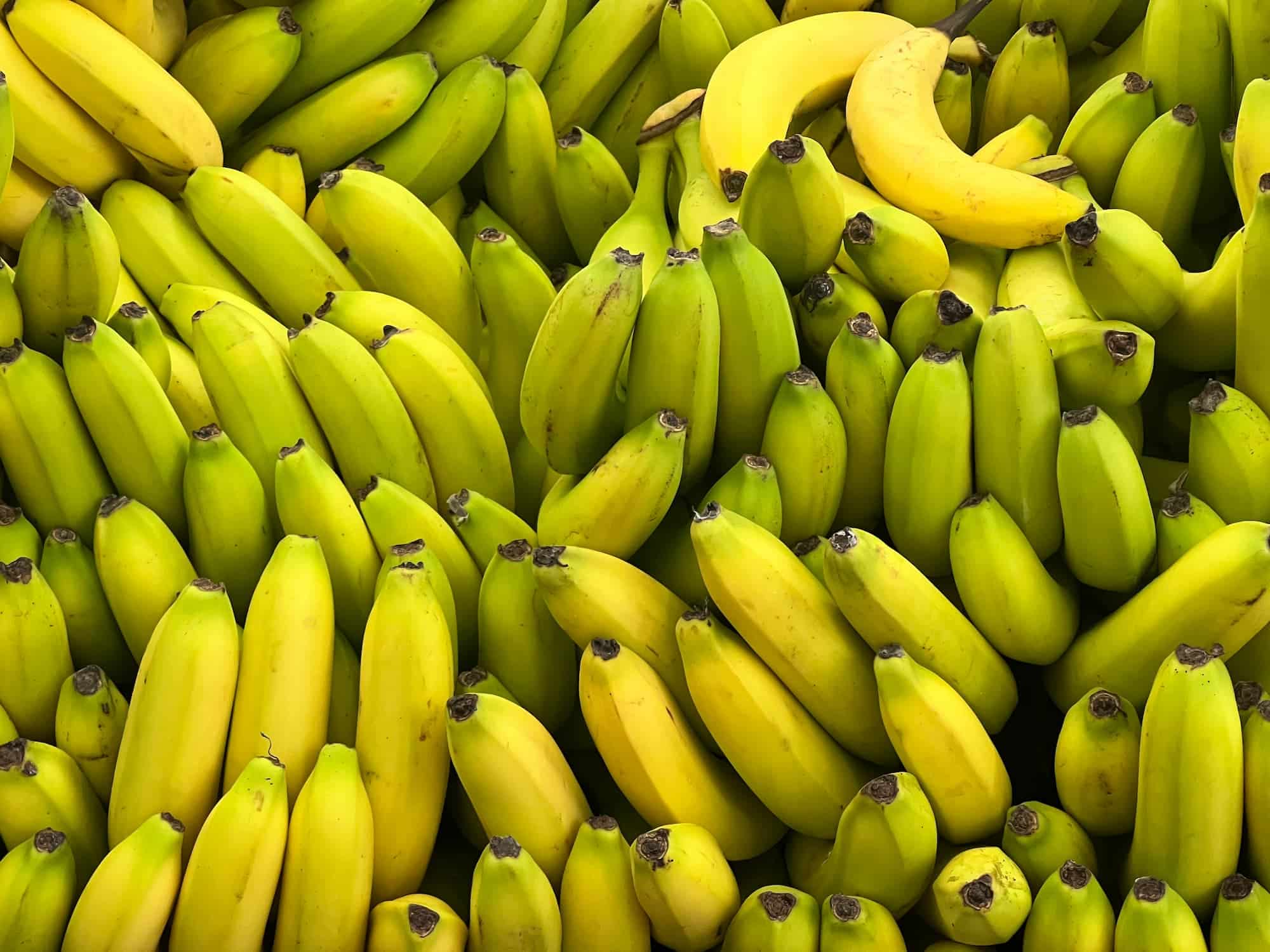
Thanks to CRISPR gene editing, a new variety of Cavendish banana can stay yellow for up to 24 hours after being peeled. The goal? Reduce the tons of food that ends up in the garbage every day.
Every day billions of edible bananas end up in the garbage every day just because they have some brown spots or a dark skin, so biotechnology is trying to take action.
In the UK the bananas modified with the CRISPR technique so as not to blacken have overcome an important bureaucratic obstacle.
On 25 September, the British Department for Environment, Food and Rural Affairs (DEFRA) has given its approval, now only the last step is missing before landing on supermarket shelves: the green light on food safety from the Food Standards Agency (FSA).
If approved, the variety will not be the first worldwide: it has already received regulatory approval in 11 countries, including the United States, Canada, Japan and Brazil.
How does it work?
Most of the bananas we buy usually belong to the variety Cavendish. Since they are sterile fruits without seeds, each plant is reproduced by cloning.
Tropic Biosciences scientists exploited ‘molecular scissors’ CRISPR-Cas9 to act on Cavendish DNA. Specifically, they have deactivated the three copies of the PPO1 gene, responsible for the production of the enzyme polyphenol oxidase. This copper-rich enzyme is primarily responsible for the oxidation process that turns the fruit brown when it comes into contact with air.
By silencing this gene, the banana maintains its yellow color for up to 24 hours after being peeled or sliced (unlike the few minutes of the traditional banana) and is also more resistant to dents caused by transport. Furthermore, since the Cavendish banana reproduces by cloning, the genetic modification is passed down unchanged from one plant to another.
Against food waste
This is important news if we consider waste: almost half of the world’s banana production is lost before it is even consumed. In the UK alone, it is estimated that approx 1.4 million bananas.
According to British legislation, the new variety falls into the category of “precision breeding organism” (Precision-Bred Organism), since the result could have been obtained, theoretically, also through traditional selections and crossings. Accordingly, if the FSA gives the final green light, the fruit it must not include the words “genetically modified” on the label.
Who likes the food of the future?
While decades of scientific studies and international bodies (such as the National Academies of Sciences) confirm that genetically modified foods are as safe and nutritious as conventional ones, some of the public continues to be skeptical of these products.
However, faced with a global population destined to reach i 10 billion individuals and an increasingly extreme climate made up of drought, heat waves and new plant diseases, gene editing could represent an indispensable resource to guarantee our food needs.
