
A forest can seem completely empty when we walk through it. However, it is enough to leave a camera hidden for a few weeks to discover that, far from being silent, it is full of life. Deer, foxes, wild boars, roe deer, fallow deer, mountain goats and even a wild cat can appear before the lens when no one is there to observe them.
That was precisely what Juan Pablo Ivars, a specialist in phototrapping, managed to record and show in his video on social networks, with a camera that he left for a month in a Spanish forest, at about 1,630 meters of altitude. The images, recorded during the spring of 2026, gathered around 400 videos and allowed us to peek into a part of the wildlife that normally remains hidden.
The recordings were not accompanied by music or effects to make them more spectacular. The sound of the forest could be heard as it had been recorded. And among all the moments captured there was one that was especially awaited: that of a doe with her newborn calf.
The forest changes when there is no one to see it in person
In Ivars’ video the scene begins with a camera that was alone, deep in the forest, with no people around. During the following days, the animals began to appear before her as if she did not exist.
At first you could see several deer with very developed bellies, a sign that the moment of birth was near. Roe deer and fallow deer also appeared, while the male deer began to grow their antlers again.
The succession of images allowed us to observe something that would have been very difficult to continue walking through the forest: how the fauna changed as the weeks passed.
One of the deer that appeared at the beginning, still about to give birth, ended up appearing later with her calf. It was not a prepared or sought-after scene approaching the animal. The camera was just there.
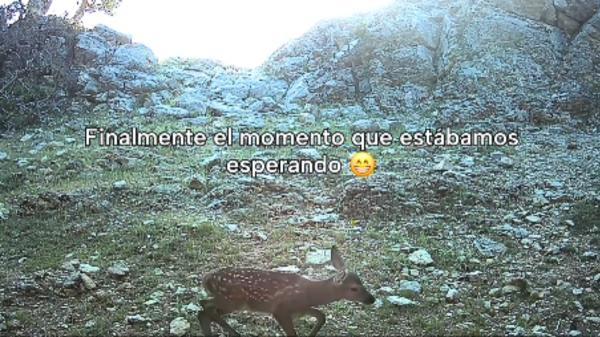
A wild cat, badgers and goats also appear on camera
The deer were not the only protagonists of the recordings. Among the videos, a wild cat also appeared in broad daylight, an especially striking observation for someone who is dedicated to searching for wildlife.
The animal is distinguished from the domestic cat by some of its characteristic features, such as its robust appearance and its thick, ringed tail. Its appearance reminds us to what extent some species can share territory with us without us ever seeing them.
The wild boars also passed by the target and left evidence of their presence with their movements and sounds. As the recordings themselves showed, the forest is far from being a silent place when there are no people around.
During the night another visitor appeared: the badger. This mammal has mainly nocturnal habits, making it especially difficult to observe it in broad daylight.
In the rockiest areas, the cameras were also able to record mountain goats. And the foxes starred in some of the most curious scenes, such as that of a specimen that appeared carrying a roe deer leg, apparently to bring food to its cubs.
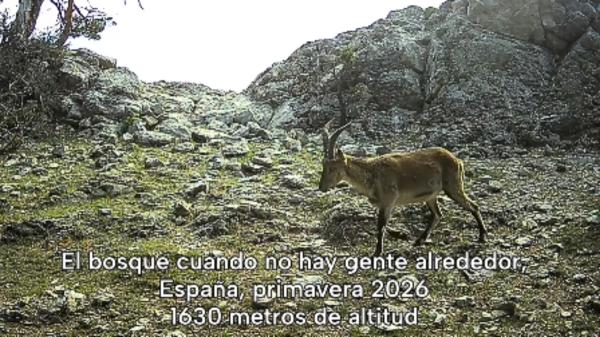
Many of these animals are there even if we never get to see them directly.
Perhaps one of the most interesting reflections that the images leave is that not seeing an animal does not mean that it is not there.
The person responsible for the phototrapping himself explains that he has never seen some of the animals recorded by his cameras in person. For someone watching wildlife, getting an image may be the only way to confirm that a particular species uses that location.
And that is precisely one of the great advantages of camera traps. Instead of a person having to remain hidden for hours waiting for an animal to appear, the device can stay in the field and automatically record what passes in front of it.
In this way, the cameras allow us to discover species that are difficult to observe, know their activity schedules and know which areas they use most frequently. They also make it possible to obtain images of nocturnal animals or animals that are especially distrustful of human presence.
In a way, the camera allows you to look without really entering the animal’s world or disturbing it.
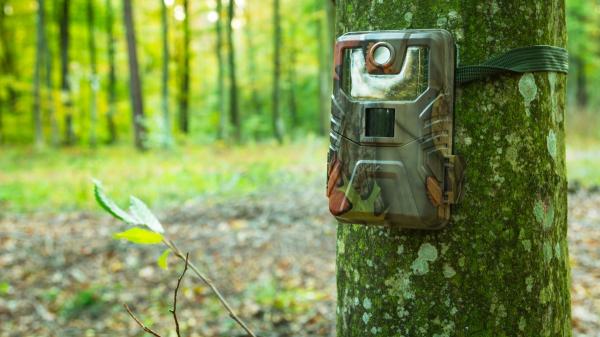
The best way to observe wildlife is to stay away.
Phototrapping also raises an important idea for anyone who enjoys nature: observing should not mean disturbing.
When a person tries to get too close to an animal to photograph it, they can alter its behavior, force it to flee or interfere with especially delicate moments, such as reproduction, feeding or caring for young.
A hidden camera works differently. The animal continues to roam the forest, looking for food or moving with its young without needing to interact with whoever is observing it.
For this reason, photo-trapping cameras are a widely used tool to better understand the fauna without having to chase it or get close to it. They allow us to discover an activity that remains hidden from our eyes and, at the same time, remind us of the importance of keeping our distance when we encounter wild animals.
The images of that spring showed precisely that life that normally remains beyond our gaze. A doe was about to give birth and, weeks later, she appeared with her calf. A fox was carrying food. A badger came out during the night. A wild cat was crossing the forest in broad daylight. The wild boars moved through the vegetation and the goats roamed the rocky areas. All of this happened while there was no one around.
The forest is not empty when we don’t see animals. We are simply seeing only a small part of everything that happens in it.
If you want to read more articles similar to They hide a camera for a month in the deepest part of the forest and this is what happens when there are no humans, we recommend that you enter our Biodiversity category.
