
The expansion of large photovoltaic plants has raised a problem that may seem secondary, but is essential for their operation: what to do with the vegetation that grows under and around thousands of solar panels. If it reaches too high a height it can cast a shadow on the modules, while the accumulation of dry grass increases the fuel available for a fire.
Faced with the continued use of lawn mowers, brush cutters or herbicides, some facilities have recovered a much older tool: sheep. The so-called solar grazing or solar grazing It is growing in different countries and allows combining electricity generation and livestock farming on the same land.
The Texas case has drawn particular attention due to its scale. Thousands of animals already work between the panels, but the American experience is far from isolated. Recent research suggests that this coexistence can offer economic and environmental advantages. And Spain has especially interesting conditions to develop it.
The sheep get under the panels where the machines cannot reach
In Texas, United States, grazing is used to control vegetation on approximately 27,500 hectares occupied by solar installations. One of the companies dedicated to this activity, Texas Solar Sheep, manages more than 6,000 sheep distributed in 12 locations.
Another example is a 900 MW photovoltaic project by SB Energy, where some 3,000 sheep maintain around 1,600 hectares.
The choice of this species is not accidental. Sheep are large enough to consume significant amounts of grass, but can move underneath the modules without normally affecting the structures. According to estimates released about the Texas projects, they carry out between 70% and 80% of the vegetation maintenance, leaving only certain interventions to the machines.
Goats present more difficulties because they have a tendency to climb and can chew on cables or damage components. Cows, for their part, are too big and heavy for many photovoltaic installations.
The system also offers another advantage: the sheep reach narrow spaces under the solar panels that are difficult to access with machinery.
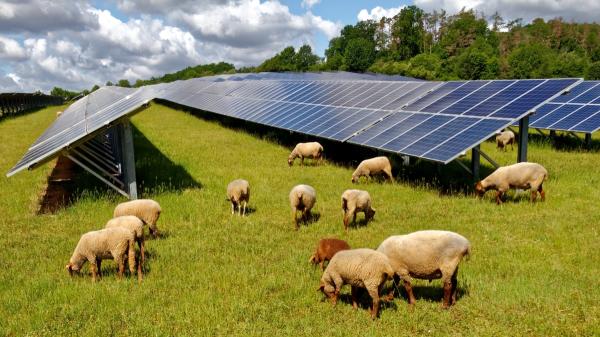
A study estimates that Spain could save millions with this system
Photovoltaic grazing is not just a curious solution used in the United States. A scientific study published in 2026 on sustainable methods for managing vegetation in photovoltaic plants precisely identifies sheep grazing as a competitive strategy from both an economic and environmental point of view.
The research especially analyzes the possibilities that exist in Mediterranean climates and even proposes recovering transhumance routes to connect livestock farms with photovoltaic installations.
Their calculations estimate that approximately 60,000 sheep may be needed for each GW of photovoltaic power per year, although needs depend on factors such as vegetation, climate and management. The authors estimate that the use of livestock could generate savings of millions of euros annually in Spain and open new economic opportunities for extensive livestock farming.
The environmental interest goes beyond replacing a lawnmower. By maintaining an adequate plant cover, the soil is protected from erosion and its water infiltration capacity and biological activity can be promoted.
In Spain, furthermore, the Ministry for the Ecological Transition recommends avoiding herbicides to control the vegetation of solar plants and points out that, whenever possible, grazing should be prioritized.
Extremadura has already tested how photovoltaic grazing works
Spain also has experiences on the ground. The Scientific and Technological Research Center of Extremadura (CICYTEX) developed the Pastoreo PV project between June 2023 and November 2025 at the Augusto photovoltaic plants, in Badajoz, and Veracruz, in Almendralejo.
The researchers analyzed the effects of different strategies on vegetation and the physical, chemical and biological properties of the soil. Their results indicate that proper management of vegetative covers and livestock can improve pasture quality and production, water infiltration, biological activity and soil stability.
A greater availability of floral resources and appropriate habitats for pollinators, such as bees and diptera, was also detected.
However, introducing sheep to a solar plant does not automatically guarantee these results. The number of animals must be adapted to plant production and local conditions. Excessive livestock pressure can degrade the vegetation cover and reduce some of the benefits for biodiversity.
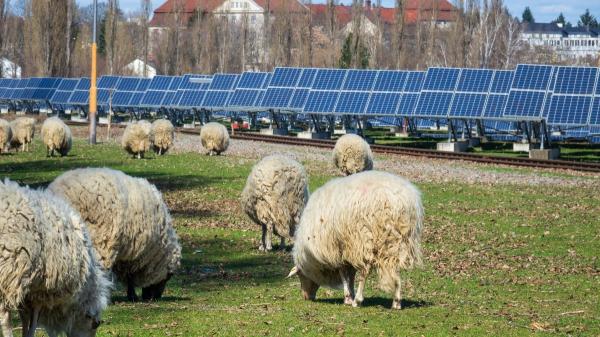
They not only replace machines: they can also benefit the soil and biodiversity
The use of sheep is part of a broader concept known as agrovoltaics, which seeks to make the production of photovoltaic electricity compatible with agricultural or livestock uses.
The formula is particularly interesting because one of the main debates related to large solar plants is precisely the occupation of the territory. Simultaneously using these surfaces to produce energy and feed livestock allows maintaining certain agricultural activity on land that, otherwise, would be used exclusively for electricity generation.
That does not mean that any solar plant is beneficial to the environment by incorporating livestock. The choice of location continues to be decisive, especially when there are threatened habitats or species. Nor do all grazing densities produce the same results.
The image of thousands of sheep grazing under solar panels may seem strange, but in Spain there are already projects that study how to convert this coexistence into a management tool. Solar energy and livestock could end up sharing much more than the same land.
If you want to read more articles similar to Thousands of sheep replace lawnmowers in solar plants: Spain is already testing this solution, we recommend that you enter our Renewable Energy category.
