
In the middle of the North Sea, Belgium is building a construction that looks like an island, but whose reason for being is underwater and in the future European electricity grid. Princess Elizabeth IslandPrincess Elisabeth Island) will be an artificial platform intended to concentrate and transport electricity produced by large offshore wind farms.
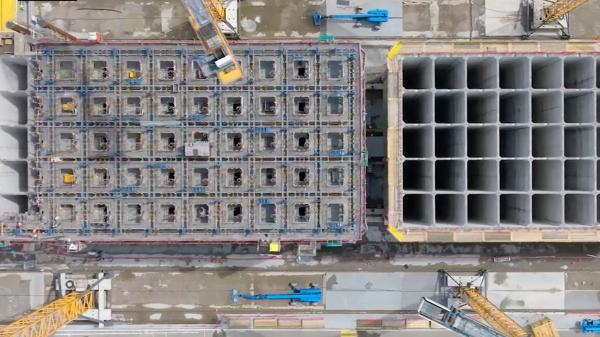
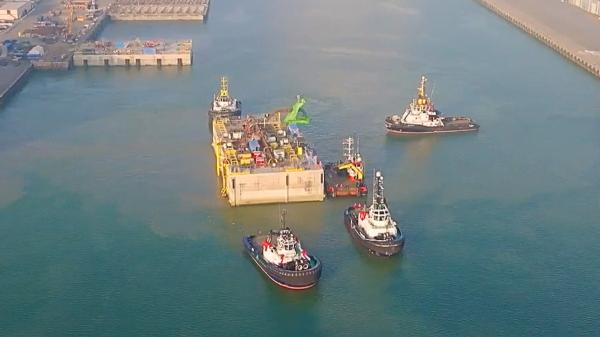
The project is promoted by the Belgian electricity operator Elia and its construction is carried out by TM Edison, a consortium formed by DEME and Jan De Nul. The most striking piece of the work are 23 enormous concrete caissons, each weighing about 22,000 tons, which form the perimeter of the island.
Manufacturing of the last one ended in January 2026. According to DEME, the remaining caissons were to continue being installed at sea during the 2026 campaign. Therefore, more than 23 blocks “sunk” simultaneously, it is a complex phased construction and installation operation.
This is how the world’s first energy island will work
Dimensions help understand scale. According to the Elia technical documentation available, each caisson measures approximately 57 meters long, 28 meters wide and 22 meters high and weighs approximately 22,000 tons before being filled.
The structures were manufactured in Vlissingen, Netherlands. Once transported to their position, they rest on a seabed previously conditioned with layers of rock and are subsequently filled with sand. In total around 2.3 million cubic meters of sand will be used to complete the interior.
But why build an island instead of bringing electricity directly to shore? Its function will be to act as a large connection node on the high seas. The cables of the future wind farms in the Princesa Isabel Zone will converge there, whose planned power reaches approximately 3.5 GW.
The European Investment Bank explains that the infrastructure will allow this new renewable capacity to be connected to the terrestrial electricity grid and, in the future, could facilitate interconnections with other countries. The island will combine high voltage alternating current (HVAC) and high voltage direct current (HVDC) systems.
The environmental impact of building an artificial island in the sea
Building an artificial island in the North Sea also represents a considerable alteration of the ecosystem. The project’s own environmental assessment analyzes issues such as morphological changes of the bottom, the effects on Natura 2000 areas, fishing and sediment dispersion. The project obtained its environmental permit in September 2023.
The expansion of offshore wind power presents, in fact, an environmental paradox: it is essential to reduce emissions from fossil fuels, but its infrastructure is not free of ecological impacts.
A scientific review published in Nature Reviews Biodiversity notes that offshore wind farms can affect fish, invertebrates, birds and mammals through habitat alterations, underwater noise and other disturbances. At the same time, certain structures can function as artificial reefs and refuges for some species.
Similar effects have been observed in the North Sea itself. Research on benthic biodiversity explains that the hard surfaces introduced by wind installations can favor organisms that previously did not find that type of substrate in sandy bottoms. This does not mean that creating artificial structures is automatically beneficial: it modifies existing communities and their long-term cumulative effects still need research.
The island has also been designed to promote biodiversity
Precisely for this reason, Elia has incorporated the so-called “inclusive design with nature” into the project (Nature-Inclusive Design). The intention is to take advantage of certain parts of the new infrastructure to generate habitats that can be used by marine species, including birds.
Underwater surfaces and cavities intended to facilitate the colonization of organisms and measures related to the European flat oyster are contemplated (Ostrea edulis). Spaces have also been designed for seabirds.
It is not a guarantee that the ecological balance will be positive. The Belgian offshore wind monitoring program WinMon.BE has been studying precisely its effects on benthic communities, fish, birds and porpoises for years. Their research shows that the consequences vary depending on the species and the type of impact, making prolonged monitoring essential.
Princess Isabel Island thus summarizes one of the great challenges of the European energy transition: multiplying renewable production without unnecessarily transferring environmental pressure to marine ecosystems. If it works as planned, it will be much more than a spectacular mass of concrete in the North Sea: it will be a large-scale test of how to build Europe’s future offshore power grid without losing sight of biodiversity.
If you want to read more articles similar to Belgium sinks 23 22,000-ton concrete blocks in the North Sea: this will be the world’s first energy island, we recommend that you enter our Renewable Energy category.
