
The most distant black hole ever seen so far is in a galaxy at over 13.3 billion light years from us, which we see as it was 500 million years after the Big Bang.
A supermassive black hole hidden in a rather small, bright and remote galaxy. A signal from an era in which the universe had just been born. This is the extraordinary discovery announced by an international group of astronomers, led by Cosmic Frontier Center of the University of Texas in Austin: the most distant black hole ever confirmed.
Where is it? His house is called Capers-Lrd-Z9, a galaxy located over 13.3 billion light years from us, which we see as it was just 500 million years after the Big Bang. An era in which the universe had only 3% of his current age and was still immersed in his “dark age”.
The discovery was published on The Astrophysical Journal And it is part of the Capers program (Candels-Zone Prism Epoch of Reionization Survey), developed to identify and study the most distant galaxies ever observed. “Capers’ first goal is precisely this: confirming and studying the most remote galaxies,” explained Mark Dickinson, co -author of the study and head of the group. “Jwst spectroscopy is the key to measuring its distance and revealing its physical properties.”
A new class of galaxies. Initially, Capers-Lrd-Z9 seemed only a weak point among the images of the James Webb telescope. But under that tiny light there was something never seen before: a galaxy belonging to a new class, renamed “Little Red Dots” (small red dots).
These are ultra-compact, red and incredibly bright galaxies, visible only in the first 1.5 billion years of the universe. “The discovery of the small red dots was a great surprise: in the initial data of the JWST they did not resemble the galaxies seen by Hubble,” said Steven Finkelstein, director of the Cosmic Frontier Center. “Now we are trying to understand what their brightness comes from, and how they trained.” CAPERS-LRD-Z9 may have the answer.
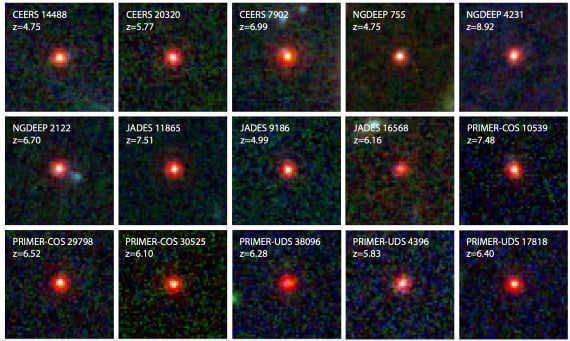

A small galaxy, a gigantic black hole. What makes Capers-Lrd-Z9 so special is precisely the presence of a supermassive black hole, capable of emitting sufficient light to explain the intensity of these mysterious red dots. In such an early era, in fact, there would have been no enough time to form large star populations. But black holes can shine even more than the stars: swallowing gases and dust, compress them and heat them up to generate huge quantities of light and radiation.
“This galaxy,” says Anthony Taylor, the first author of the study, “could also explain their characteristic red color, caused by a dense gase cloud that surrounds the black hole, moving the light towards more red wavelengths”.
Taylor adds that by comparing Capers-Lrd-Z9 with other known sources, a ghostly signature has emerged: “We have already seen these clouds in other galaxies. When we compared this object with those springs, we realized that it was identical ».
A giant. But there is more: the uncovered black hole is colossal. According to estimates, it has a mass of up to 300 million times that of our sun – about half of the total mass of the entire galaxy that houses it. An impressive anomaly, also for cosmic standards.
“This is added to the tests that the first black holes grew much faster than we thought”, observes Finkelstein. “Or they were initially much more massive than expected by our models.”
The primordial universe. To confirm the presence of the black hole, astronomers used the spectroscopy of the JWST telescope, breaking down the light in all its wavelengths. In particular, they searched for the characteristic of the rapid movement of rapid movement: while rotating and falls towards a black hole, the gas emits trained light towards red (when it goes away) or tablet towards blue (when approaching). “There are not many other things in the universe that can produce a signature like this,” explained Taylor. “And this galaxy has it.”
It is only the beginning. The team now includes to collect even more detailed observations thanks to the James Webb Space Telescope, to study the evolution of many black holes in the most remote eras of the universe. «Until recently we were not even able to observe the first stages of life of black holes. Now we can’t wait to understand how much we can learn from this unique galaxy and from those we will study later », concludes Taylor.
In reality there are some even more distant candidates than this black hole, but none of them have yet shown the unequivocal spectral signature of a black hole. With Capers-Lrd-Z9, astronomers have just taken a decisive step forward. And perhaps, looking at this small red point lost in the cosmic darkness, we are observing the birth of the first titans of the universe.
