
A scientist has accidentally discovered the largest newly formed crater on the Moon ever observed in the Solar System: a 222-meter chasm created by the collision with an asteroid.
Sometimes the most important discoveries happen by chance: as happened to Robert Wagner, an image processing specialist who works for Intuitive Machines analyzing data from the Lunar Reconnaissance Orbiter (LRO), the probe with which NASA has been studying the Moon for almost twenty years.
As he scrolled through a lunar map on his monitor, his eye fell on an unusually bright spot, surrounded by a dark halo: a typical sign of terrain that had recently been “shaken” by an impact. By comparing images of the same area taken at different times, he realized he had found something exceptional: the largest newly formed crater ever observed in the entire Solar System. The discovery was reported in the scientific journal Science Advances.
The impact numbers
The new crater was named McGetchin, in honor of one of the pioneers of lunar studies, Tom McGetchin. It formed on the eastern edge of the Moon in a very precise time frame, between April 11 and May 22, 2024, when an object the size of a three- to six-story building – probably a comet or asteroid – crashed into the surface. The result of the impact is a chasm 222 meters wide (the size of two football fields lined up) and 43 meters deep: three buses would fit, one on top of the other. It doesn’t happen every day: scientists estimate that an impact of this size occurs on the Moon about once every hundred years, perhaps even more rarely.

A moon constantly targeted
The Moon, unlike the Earth, does not have an atmosphere that protects its surface: there is nothing that slows down or disintegrates space stones before impact, as happens here when meteors burn as they pass through the air. For this reason, the lunar surface is continually hit, although almost always by objects much smaller than the one McGetchin created.
In seventeen years of mission, the LRO team has identified at least one thousand new craters and over one hundred thousand surface changes caused by impacts or the debris they hurl around. The smallest craters that the probe’s instruments can distinguish are about 9 meters in diameter – like a three-story building lying on its side – and are caused by rocks just over a meter large. Experts estimate that impacts of this “minor” size occur about 140 times a year, even though the vast majority of hits on the Moon are invisible: they are dust and tiny fragments that leave marks too small to be photographed from orbit.
An imprint larger than the crater itself
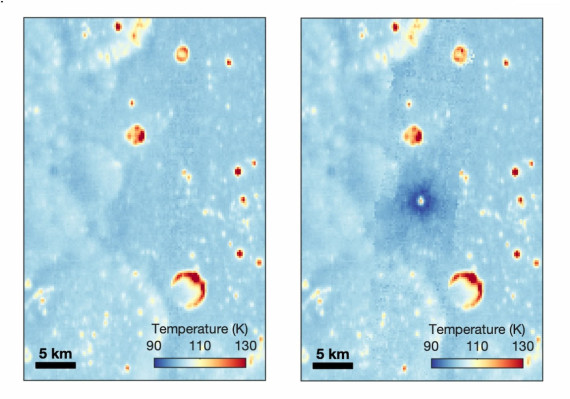
After the initial discovery, other instruments aboard the LRO came into play. Among these, the Diviner thermal sensor, which measures the temperature of the lunar surface. Pointing it at the impact zone, the researchers noticed something surprising: an area about 6.4 kilometers wide around the crater was, at night, about 8 degrees colder than the surrounding terrain.
The explanation, published in a second study always on Science Advancesconcerns the regolith, i.e. the layer of dust and rock fragments that covers the lunar surface (the equivalent of our “soil”, but without the organic component of terrestrial soil).
The impact would have made this layer softer and less compact in the affected area, reducing its ability to retain the heat accumulated during the day. The result is that large “cold patch” detected at night.
The most interesting fact, according to scientists, is precisely the extension of this area: much larger than the crater itself. A sign that a single impact can alter the physical characteristics of the lunar terrain well beyond the point where it hits, with non-trivial practical consequences: for example, it could change the way in which the wheels of a rover interact with the ground in that area.
How to find a crater on the Moon
The discovery was possible thanks to the LROC (Lunar Reconnaissance Orbiter Camera) camera system, which takes images from an altitude of approximately 96 kilometers as the probe orbits from one pole of the Moon to the other. The system consists of two high-resolution black and white cameras and a third, lower resolution camera that captures color (multispectral) images. Over the course of thousands of passes, these instruments have allowed us to build detailed maps of the lunar surface, useful not only for finding new craters, but also landslides, remains of landers, seismic faults and even tunnels dug by ancient lava flows.
Typically, the LROC team analyzes close-up images taken by the Narrow-Angle Camera, looking for variations as small as 30 feet in diameter. But every now and then scientists change their approach and hunt for larger changes (over 45 meters) by building global maps of the Moon and comparing them with previous versions. That’s exactly what Wagner was doing on October 24, 2025, when he ran into McGetchin.
The working method is as simple in principle as it is laborious in practice: using the images taken by the wide-angle camera (where each single pixel corresponds to an area the size of a football field), Wagner overlaid hundreds of “before” and “after” frames with software that highlights the differences.
Everything that remains unchanged appears grey; everything that changes becomes a light or dark spot. The problem is that the software also reports tiny variations in light and shadow that aren’t craters at all, generating hundreds of false alarms.
For this reason, Wagner goes over the results by hand, looking in particular for small blurry halos around bright points: the typical signature of debris raised by a recent impact. McGetchin’s signal, in this sense, left no doubt: it extended over hundreds of pixels. “It was by far the most obvious impact debris pattern I had ever seen in one of these images,” Wagner explained. Once the crater was identified, scientists focused the Narrow-Angle Camera on the area, capable of a much finer resolution (about 90 centimeters per pixel), to photograph in detail the shape and dimensions of the crater and the effects on the surrounding terrain. This data will also be used to estimate the size and strength of the object that generated the impact: results which, according to the researchers, will be published in a future study.
