
The earthquake and tsunami that hit Liguria and the French Riviera in 1887 were devastating: a reconstruction leads to a reevaluation of risk models in certain areas.
A group of researchers from the University of Trieste, together with the University of Genoa and the OGS (National Institute of Oceanography and Experimental Geophysics), has reconstructed with great precision the earthquake that hit Liguria and the French Riviera on 23 February 1887. The earthquake was devastating: it caused over 600 victims and also generated a tsunami that hit the coast.
Ancient tools, modern methods. This time the researchers applied a completely new method for their research: they used very old, so-called, data historical magnetograms — that is, recordings of the Earth’s magnetic field made in the 19th century — and “re-examined” them with modern techniques. Even though that data was not intended to record earthquakes, it proved useful for capturing the ground vibrations caused by the earthquake. In practice, they digitized those historical records, analyzed them with seismic wave propagation models and compared them with simulations: thus they managed to “read” the earthquake as if they had a modern instrument.
Using seismic wave propagation models, the researchers simulated different fault scenarios (see drawing). Having reproduced the real response of nineteenth-century instruments to ground vibrations and compared the simulated signals to the historical ones, they found the scenario of the real fault and estimated the magnitude, also using the 2012 Emilia earthquake (Mw 6.10) as a reference for geographical proximity and similar characteristics.
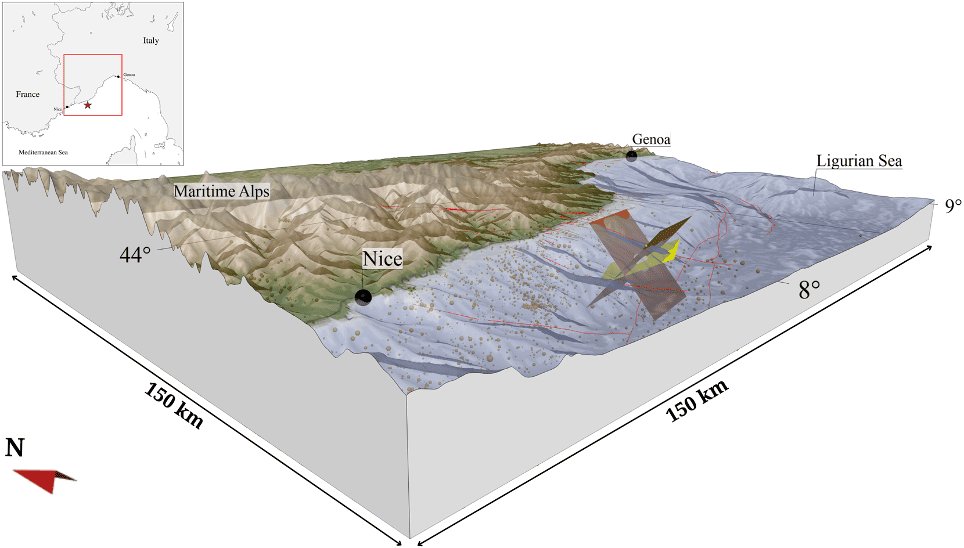
What they discovered. The researchers estimated that the magnitude of the earthquake was around 7.2, which is very strong. They also reconstructed the “fault mechanism”, that is, the way in which the rocks moved: it is a “reverse fault inclined towards the north”.
In simple words: one block of crust rose relative to the other, compressing the earth’s crust, a type of movement consistent with the geology of the area and also with the origin of the tsunami that occurred immediately afterwards. In fact, this movement causes a shortening and thickening of the crust – typical of areas where tectonic forces compress the earth. This explains how an earthquake can also generate a tsunami: because the lifting of the seabed (or coast) displaces a lot of water.
Why it matters. According to the researchers, this type of approach — using ancient magnetic data, digitizing it and reinterpreting it — opens a new way to reevaluate large earthquakes of the past, the “pre-instrumental” ones: events of which we have no modern seismic records, but which are historically documented.
This research allows us to fill a gap: many ancient earthquakes are described only by historical accounts which report, for example, the type of damage caused, but without quantitative data.
As Stefano Parolai of the Department of Mathematics, Informatics and Geosciences of the University of Trieste explains: «With this method it is possible to obtain concrete numbers (magnitude, mechanism, measurements). The method also helps to improve the assessment of seismic danger: knowing that in the past there have been strong earthquakes with certain characteristics forces us to reconsider the risk models for certain areas, as will now have to be done for Liguria and certain areas of Western Europe”.
Don’t underestimate the risks. The system therefore leads to rethinking seismic maps, anti-seismic regulations, urban planning and safety measures: in short, it also has repercussions on how we build and protect cities and infrastructures.
The study is also important because it confirms that in that region seismicity can be driven by compressive forces — that is, it is not just “horizontal sliding”, but “compression + uplift” — and therefore the risks could be underestimated if you only look at simpler models.
Help from the past. This study, published on Scientific Reportssuggests that with the right tools, even an earthquake that occurred over 130 years ago can be reliably reconstructed. Gabriele Tarchini, researcher at the department of Earth, environmental and life sciences at the University of Genoa underlines:
«In the absence of reliable instrumental recordings, these analyzes open new perspectives for the reconstruction of past earthquakes and for the assessment of seismic hazard. Our goal is to use every available data to improve the safety of communities and help mitigate seismic risk.”
